
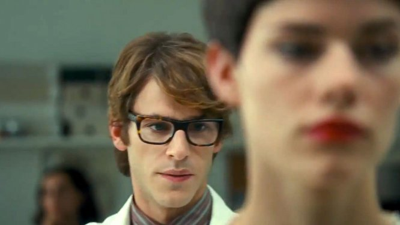


Bertrand Bonello's elusive, weird and thrilling biopic Saint Laurent is Proust, and Kane, and Velvet Goldmine, and Visconti, and I am thankful to the gods of cinema for every languid moment. It is all a fashion show, as the models walk up and down the catwalk, captured in countless mirrors that give us the illusion of their being spun off into new selves as if by light itself. The multiple panes of activity carry with them the spin of infinity, an eternity of motion, and so does Bonello's film, which splinters the designer's life and career into prismatic rays of light and time.
We meet Yves Saint Laurent (Gaspard Ulliel, and also later Helmut Berger) in 1974, checking into a hotel as "M. Swann" and giving an interview posed in the frame between a cigarette and la Tour Eiffel. We haven't even seen the man's face before he's giving us confessions of electroshock therapy. This interview isn’t the skeleton of the film, it turns out, but it sets the many parallel circuits of his life in motion — a magical and maddening balancing act that writer/director/composer Bonnello (House of Pleasures) keeps going through the film’s end … and, truthfully, beyond.
The U.S. poster design does a phenomenal job of illustrating his ability and vision: a high-contrast black-and-white portrait, except for glasses which burn with all the colors of the spectrum. Though it can scan as some sort of gay superhero one-sheet, it nonetheless works in the framework of Bonello's vision. The glasses make the man: The way you’re seen matters just as much as what you see.
Bonello never lets us in to the mind behind those enigmatic, iconic glasses. But that makes Saint Laurent exponentially more interesting. There’s no Rosetta Stone in his childhood, or a first love, that lets us decode the contradictory impulses of this eccentric and charming genius. He pays for an abortion for one of his workers and gives the girl money to cushion the blow, yet he fires her via third party — while at a banquet honoring him for his work for women. There’s an innate hypocrisy to him long before the game of sexual ping-pong that looms in the film's middle third.
Things get suitably Proustian, as one would expect from the film’s opening. Memory becomes a wave, not a breeze. The film’s 1972 section commences with a remarkable polyglot business conference where there’s a war of fabric, languages, cigarette smoke, and more strategies than a whole season of an HBO series. It’s not just a business meeting, but a meeting about business and the future of how business works.
In this sequence, Bonello finds strategies to convey the particulars of Saint Laurent's development and the nature of the industry without resorting to lives-of-the-great boilerplate. Even an art film about fashion requires board meetings and laying out risks versus benefits, and how the artist must become — or find — someone who can navigate the strange customs of the boards and executives who sign the checks. When your name, like the designer's, grows to mean something beyond yourself, then other sets of minds and eyes and hands come in.
The year 1967 plunges us into the process headlong, as nameless and numbered models are measured. The women are something Saint Laurent understands as an abstraction, a concept. But is there any real empathy? The women are much like his beloved Moujik, a continuum upon which he unhinges his mind and incorporates into a grand design. But there isn’t the personal interaction that we see with his lovers, with one notable exception.
This scene — with his client Madame Duzer (Valeria Bruni Tedeschi) scored to "Ave Maria" — is the one that makes the whole film. It’s a demonstration of the power of a detached phantom gaze, that of the artist Saint Laurent and the viewer. It's that remove — his embodiment of the onlooker's attention that every follower of fashion desires — that allows him to remake and remodel the woman's look with just a few well-chosen additions: the infusion of an accessory, a reconfiguration of the hair, the addition of movement. In a two-minute makeover, the movie assembles the elements of style before your eyes.
The film gets into the magnetism of desire, and then alchemically gets across how the clothes carry some of that magnetism. There’s something abstract yet shamanic about Saint Laurent’s facility with clothes — something unspoken and visceral, of the blood. Bonnello has moments where he gets all Regle de Jeu — only instead of hunting critters, Saint Laurent and his occasional side piece Jacques de Beaumarchais (Louis Garrel) hunt a different assortment of game.
And that’s the pivot. Pierre Bergé (Jéremie Renier), Saint Laurent’s manager and lover, is of the established business world, the structure of money and respect, while Jacques is the reptilian brain’s foundation of sex and liberation. And so the Apollonian and the Dionsyian orbit around a tormented genius. Ulliel’s Saint Laurent has moments as a teleological drama queen, but his relationship with Bergé is rather refreshingly portrayed as sensually charged but also lived in. Their relationship involves parties on incredible sectional sofas with Pink Floyd and poppers in sweaty, smutty balance. We see what both Pierre and Jacques represent to Saint Laurent in the way that their love scenes are staged and enacted.
Fidelity is a complex concept. And it’s hard to approach the eventual schism between Saint Laurent and Jacques, as fomented by Pierre, without moving beyond the binary of monogamy. The genius of Bonnello’s film is that there is love mixed in with the louche, sleaze of a piece with sweetness.
A nightclub entrance cut to Frankie Valli’s “The Night” might be the best music cue in decades, our introduction to Garrel in a white tuxedo. Rainbow lights refract across metallic columns, with desire and rhythm becoming one. It’s the mindstate of horny, nervy genius transmuted to the interplay of light and sound, and it dazzles the nervous system. It follows the film’s first epic nightclub sequence, in which we are introduced to Saint Laurent’s longtime muse Betty as a tear of blonde hair twisting in the darkness to Creedence Clearwater Revival.
The majestic sequence is equaled by the film's climactic fashion show, wherein the languid strides of gorgeous people — in the intersecting hallways of one of those classically European châteaux where the aristocracy always languishes in high contrast black-and-white art cinema — become not just the launch of a fashion line, but also a benediction. The film fragments further in this sequence, making the visual presentation into a Mondrian of the story’s serpentine paths: the now-dead fashion magpie Loulou (Léa Seydoux); Saint Laurent slipping into a moment of murderous intent; years slipping by with many bulldogs with the same face; formal cigarette plumes amidst exquisite fabrics.
As in the 1968 splitscreen that pits Saint Laurent’s designs against B&W newsreel footage of the riots, coups, bombings, demonstrations, and shifts in power that defined that globally tumultuous year, the fragmentation of the image allows space to indicate the parallel worlds of industry and ideology. Bonnello collapses, reorients the image to allow it to create its own space that extends beyond the frame. Bonnello has a gift for taking an external scene and reframing it with color; his use of Saint Laurent’s grey room/photography studio is a great touch, allowing for the contrast of flesh and angst and passion.
And Ulliel is astounding, meeting the mise-en-scène every step of the way. His pointillist tour de force of a performance provides a remarkably well-rounded perspective on a person that we can’t ever really know. Saint Laurent loves his delicieux, and really they are as his designs — chocolates and druggy escapes and tiny clasps of beauty that enliven their surroundings through their presence, rather than relying on the vibe and atmosphere of what surrounds them to make them pop. Bonello's dazzling, prismatic biopic leaves us to wonder: Does a smile mean more than a gesture?



