
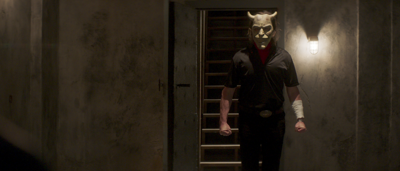

Director Scott Derrickson and co-writer C. Robert Cargill were absolutely right to walk away from Doctor Strange 2 to make The Black Phone. Tackling a 20-page story from Joe Hill, they’ve crafted something upsetting and provocative, a film about youth in crisis that truly inhabits its late-’70s milieu with earth-tone gravitas and rumbling unease. Hill’s short story, from his exceptional 20th Century Ghosts collection, is short and sweet and razor-sharp, like an ice pick. It’s not particularly nuanced, but the strength of its central concept is strong enough to let Derrickson and Cargill to get expansively weird with it, taking a fencing foil of a hook and turning it into a broadsword of a film.
Even before we learn that something malign is afoot in North Denver, a Little League baseball game lays out the kind of perceptible small-town tension that comes across in the way kids interact with each other. Certainly, The Black Phone is true to its era in its relationship to the violent ways in which childhood conflict metabolizes. Some would say it’s unrealistic how these kids beat the shit out of each other without outside intervention, but adult power structures won’t intervene about school shootings today, so why would one expect them to try to stop the physical tyrannies with which bullies ruled schoolyards and street corners 40-some-odd years ago? The neighborhood’s alleys and fences form a grid, as if to gather the youth into common spaces for maximum conflict. It was the ‘70s, after all ...
Finney (Mason Thomas) is a distinctive protagonist. He’s got A. Michael Baldwin’s Phantasm hair, and unfortunately bears a name that can’t help but make viewers of a certain age think of John Knowles’ homophobic warhorse of junior high angst, A Separate Peace. He’s a good friend, loyal and kindhearted even as he’s plagued by some truly awful bullies. (They use that F-word, true to the period and also a lightning rod for contemporary audiences.) He’s good friends with his low-key psychic little sister Gwen (Madeleine McGraw), which is very fortunate when he is claimed by The Grabber (Ethan Hawke), a local boogeyman who’s already kidnapped five boys from the neighborhood.
At some point, Jeremy Davies (Lost, Solaris) grew out of his vaguely Mansonian period, and here he focuses that chaotic terror into an abusive alcoholic dad and struggles with the underwritten part he’s given. It’s the only dead end in the script, using deeply troubling behavior for visceral effect but not doing the work to make the character feel like a human being evolving through multigenerational psychic crisis. His Terrence isn’t a dad so much as a device, but Davies gives good nervy menace (and he listens to Blind Blake, which is an unexpected choice), even if it’s in his character that it feels like there might have been some meddling at the script level — Davies and Hawke are two sides of the same coin, belt-wielding entropies destroying the potential of children, but Davies gets off far too easily. At my advance screening, the audience was fired up and hungry for more vengeance than it got, especially considering that Davies is more violent on screen than the actual murderer is.
But even that can’t diminish the several perfect screenplay flourishes that unwind here. (Think the way that Jim Cameron’s script for Aliens structures its payoffs — yeah, that.) One must wonder why a psychic would marry a violent drunk, but the film focuses more on how that gift of sight manifests in Gwen, caught between spiritual crisis and unlocking forbidden doors with her dreams, keeping the central trauma of the family elliptical and tragic and unexplored. McGraw gets the best line in the film, putting a feeling everyone raised in Christianity has wanted to vocalize in some capacity. A special shoutout is also due James Ransone, the common thread from the two Sinister films (he was also Dingy Dave in A Dirty Shame and part of both The Wire and Ken Park), who takes two scenes and makes absolute magic with them.
When Finney is imprisoned in a reinforced stone basement, the only thing that keeps him from shutting down in the face of overwhelming terror is an old rotary phone hanging on the wall. Not connected to anything except the ambient horror of the previous victims held there, he starts getting calls from the previous victims, nameless in whatever the void beyond this life is (in a devastating Stone Tape shoutout), letting him learn from their failed attempts to escape. It’s a Twilight Zone concept, but Derrickson knows what he’s doing, and you can’t help but feel that swollen bell ringing in the base of your spine. Finney’s time in that basement feels like it’s working on an Elisabeth Kübler-Ross timeline, which is something a horror movie hasn’t really tried since Alien3.
Hawke is very good, embodying The Grabber with all the emotional complexity from but eschewing the distracting bétisier of the story’s portrayal, living up to the genuinely unsettling Tom Savini-designed masks he wears. With a voice that calls to mind both Chris Gethard and Michael Wincott, The Grabber is a new kind of horror menace, projecting neither slasher nor molester vibes, ultimately becoming something truly upsetting in ways that are difficult to parse. Like the demon Bughuul in Sinister, The Grabber has a certain sense of style, bringing in 8mm textures for the horrors he deals out and the rippling aftershocks that turn the grain of dreamscapes into an inescapable sinkhole. Add in a denim-clad pinball and switchblade freakout cut to The Sweet’s “Fox on the Run” and a Pink Floyd "On the Run"-scored race against time, and you’ve got an ambitious and striking horror epic that knows exactly where its limits lay.



