
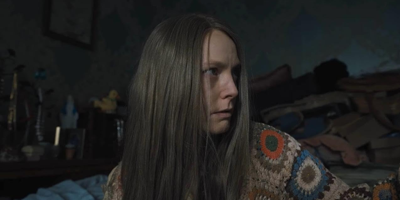

Usually, when there are print inches being devoted to discussions of box office records and achievements, the involved parties are the megastudios (or their corporate overlords) and their massive success or failure, and it’s all anyone can talk about for a day or two before the next offering comes along. But unceremoniously and with a determination befitting both The Little Engine That Could and a properly thought-out demonic curse, writer/director Oz Perkins’ demonic masterpiece Longlegs, after a month in release, became the highest-grossing indie horror film in a decade, as well as breaking the $100 million global threshold and becoming the most successful film in distributor Neon’s history.
Of the many threads that pull taut and strengthen the film and its achievements, the one that has been gathering heaps and skeins of critical acclaim is Nashville’s own Alicia Witt. A secret weapon in seemingly every genre, Witt is an artistic polymath as gifted behind the piano as she is on camera, and she’s taking the time out of her rigorous schedule for a special sold-out screening of Longlegs tonight, Aug. 20, at the Belcourt, followed by a Q&A with Belcourt executive director Stephanie Silverman. Witt spoke with the Scene via Zoom this morning for a brief chat to address the upcoming event and the Longlegs phenomenon.
I hate to use nebulous industry speak, but I have to ask what it feels like to have “awards buzz” with this film.
[Laughs] I can’t even formulate words around that. It’s beyond a massive honor, and the thing about this particular movie is that it would be one of the most profound experiences of my life, even if nobody saw it. Even if it weren’t a critical success. Or a box office success. Or both. Everything with Longlegs has felt nothing short of divine and sacred for me, and all that started with the experience on the set. But all the rest of it? I never could have dreamed. But nothing would surprise me regarding this movie at this point. It’s just magic, and I’m beyond grateful that this is happening with this particular movie, which was already so special to me.

The Maika Monroe- and Nicolas Cage-starring serial killer thriller opens wide Friday
I’m fascinated by how the experience of this film must be for you — to have undertaken the process of making it, and stepping up to who Ruth is and her place in this dark and nasty piece of the cosmos, and then to be done with it. And then all of a sudden when it hits theaters, you’re part of a phenomenon for horror cinema, for indie films, and even for a whole studio. And that’s wild.
It is wild. We had 10 days left in filming when we learned that Neon was going to be distributing the movie, and we had gone into this process as a low-budget indie. The expectation was — well, we really didn’t have any expectations. It was just that everyone involved loved the project, and Oz, and the characters and the story. And then to learn that Neon was coming on board was exciting, and then to watch the way that they’ve treated the rollout for this film — the campaigns, and the cleverness, I’ve never been involved with a film that has received this kind of love.
I want to talk about your affinity for leaping between genres. You should be the interpreter that all Hollywood goes through to organize agreements, because you’ve done it all. You’re the queen of Christmas movies, you were the first St. Alia of the Knife, you are the bridge between Tyler Perry and David Lynch. Was that always your philosophy as an actor — to try every genre and every kind of creativity?
I’ll tell you, yes, that was my philosophy. I did Dune when I was 7, but that was really just an act of God because I was living in Worcester, Mass., with no one in my life who was in the entertainment industry. But from the time I started doing this in earnest, from about the age of 16 onwards, I was really immersed in the business, and I was auditioning and seeing how it works on a set. And from the get-go, specifically at the Sundance Film Festival when I was 18 for the movie Fun, I can remember telling reporters when they asked what my aspirations were, I told them that I always wanted to keep doing different roles; I didn’t want to play the same roles over and over again.
What I loved, and what I still love about being an actor, is that you get to disappear from whoever you are, and whoever this is. And that’s why I act, that’s what gets me excited. I do believe this was very intentional, and there were periods in my life when I would be part of something that was successful, and then, as you do as an actor, you would get offered the same role, variations on that same role. Like when I was on Cybill from when I was 19 till 23, and over and over I was offered the petulant teenage daughter, and I could have done that until I was 25, and then all of a sudden been uncastable. Similarly, the role I played in Two Weeks Notice, a frosty, superintelligent Other Woman kind of role — that was all I got offered for a moment. And I just tried to be mindful and pass on some of these offers, even if it meant I didn’t get to work as often as I’d liked to. And I would recommend that approach to any actor starting out, to have one of those careers as a character actor, and to be mindful of not being typecast. Now I get to read all kinds of projects, and it’s such an exciting moment.
You have a gift for summoning very relatable, unshakable emotional responses in your work, and it’s fascinating to see how that has evolved over the years. Fun was the first film that just knocks the viewer flat, because it’s such an unexpected space to find that kind of empathy. But I’ve been doing a Twin Peaks rewatch recently, and nobody talks as much as they should about the journey of Gersten Hayward, because the way her story "resolves" in Season 3 left me so sad and shaken that I had to cry in the shower before work that day. And it’s just these few moments, and they’re part of the tapestry that is Twin Peaks, which is one of the great works of art of the 20th and 21st centuries. But from this one glimpse in 1990 entertaining a dinner party to this tragic look at what opioids and supernatural unease have done to the American family, it’s a staggering achievement in building something out of little moments spread across decades.
It means a lot that Gersten affected people. In fact, it was those scenes that were the work of mine that convinced Oz I might be able to channel Ruth; that was the one. I didn’t audition for Ruth, it was just a long Zoom meeting between Oz and I, and it was because of Gersten that he knew I could go there.
Are you psyched for tonight’s Belcourt event?
I am so psyched. I love the Belcourt, and if I’m in Nashville I try to go at least once every couple of weeks. It’s my favorite independent theater. I love the work they do and the movies they curate, and I’m so honored that [executive director] Stephanie Silverman is going to be interviewing me. I feel a sort of respite when I come home to Nashville. This is a place I very mindfully chose to live seven years ago, after 25 years, after most of my life, in Los Angeles. And this is home in a way that nowhere else has ever been for me. My dearest friends live here. And as it turns out, not only are they going to be in the crowd at the event — most of the collaborators on my new Christmas album, coming this November, will be there too. John Paul White, Mandy Barnett, Matthew Perryman Jones and my incredible engineer and right-hand man David Kalmusky from Fiction Sound are all going to be there as well — we’re bringing all the worlds together tonight.
Though the special presentation at the Belcourt with a post-screening discussion with Alicia Witt is sold out, Longlegs is still showing in local theaters.



Post a comment as anonymous
Report
Watch this discussion.
(0) comments
Welcome to the discussion.
Log In
Welcome to the discussion.
Keep it clean. Please avoid obscene, vulgar, lewd, racist or otherwise abusive language. Comments featuring hate speech or threatening or violent content will not be tolerated.
PLEASE TURN OFF YOUR CAPS LOCK.
Be truthful. Don't knowingly lie or mislead.
Be proactive. Use the “report” link on any comment that violates our comment policy.
Share with us. We'd love to hear your feedback.