

People who go to Girlhood thinking that it's going to be the female counterpart to Richard Linklater's Boyhood need to get that shit out of their heads right now. Sure, it's definitely a coming-of-age drama. But whereas Linklater's film is a wondrous, ever-unfolding journey, as it spends a dozen years following an unremarkable but well-behaved boy and his family, this melodramatic/neo-realistic mashup comes out the gate letting you know it's not going to be a life-affirming, feelgood movie. You know why? Because it's about a girl — and as any woman will tell you, adolescence is a bitch.
Set in a working-class banlieue near Paris, this movie is seen from the perspective of Marieme (Karidja Toure), a 16-year-old awkwardly going through the motions as a teenager. Apart from suiting up and playing football with her neighborhood girlfriends (which the movie captures in a glorious slo-mo opening montage), there's hardly anything else that gives her joy. She lives in an apartment building with her family, a hardly-there mom who cleans offices at night and a brutish big brother with abusive disciplinary skills. Even walking through her 'hood is a pain in the ass, as wolfish, shady-looking dudes are all around, looking for the right moment to holla at a girl.
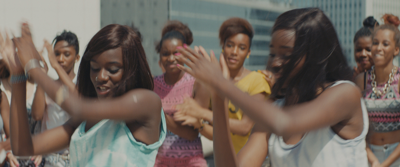
She starts hanging with the wrong crowd when a trio of leather-jacketed bad girls led by the charismatic Lady (Assa Sylla) takes her under their wing. Soon, braid-wearing Marieme becomes weave-a-licious Vic, shaking down high-schoolers so she and her girls can take trips to the mall and lift dresses and get a hotel room where they can hang out and joyfully sing Rihanna songs. But however fun and embracing a time our heroine has with her new crew, reality comes crashing back to earth when she steps back in her 'hood.
Girlhood completes a coming-of-age trilogy French filmmaker Céline Sciamma started with Water Lilies in 2007, followed by Tomboy in 2011. The final chapter certainly shows how living in a male-dominated environment can make a teenage girl confused about what she wants and who she wants to be. Even the trash-talking girls fight viciously, often holding rumbles where the loser is usually stripped for the bloodthirsty crowd.
Yet Sciamma finds beauty and promise in these young girls' faces. (I don't think I've ever seen a movie light and capture black skin more lushly and luminously than this one.) Unfortunately, Sciamma also shows how Marieme and many of the characters incessantly need to use toughness and intimidation just to get through the day. In Sciamma's bleak depiction, among lower-class French-African youth, there's nothing worse than being seen as weak or vulnerable. An uneasy but ultimately resilient view of inner-city femininity and self-discovery, Girlhood reminds viewers that no matter where you're from, going from girl to woman is always going to be a struggle.
Email arts@nashvillescene.com



