
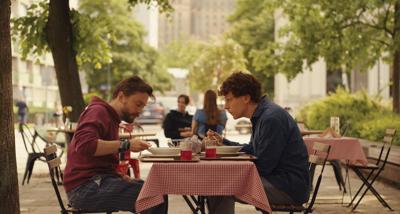

With A Real Pain, Jesse Eisenberg, that jittery mensch of an actor, continues his journey of writing and directing films in which family members try to figure their shit out in front of others. A couple years ago, Eisenberg had Julianne Moore and Stranger Things’ Finn Wolfhard play an awkward, contentious mother-and-son duo in his debut When You Finish Saving the World. If you never heard about that one, that’s because A24 dumped it in a few theaters and on VOD a year after it played the Sundance Film Festival.
Pain, which played at this year’s Sundance, is a more personal film for Eisenberg, who also stars. He’s David, an OCD-plagued family man who travels to Warsaw with his outgoing cousin Benji (Kieran Culkin). Once thick as thieves, they’ve reunited to visit landmarks and learn more about the Holocaust as part of a heritage tour led by a highly informative Brit (Will Sharpe). They’re also there to visit the former home of their grandmother, who recently passed away.
As the trip goes on, we eventually learn that David is not the only one with mental issues. Benji initially charms the tour group (which includes Dirty Dancing’s Baby herself, Jennifer Grey, as an attractive tourist and English actor Kurt Egyiawan as a Rwandan who converted to Judaism) with his easygoing demeanor and spur-of-the-moment photo ops. But his mood swings suggest that he has a bipolar disorder, which has led him down some dark paths.
You could say Pain is Sideways without the wine. (There are a couple of rooftop scenes of David and Benji smoking weed that Benji had delivered to their hotel.) Eisenberg and Culkin go all-in on their polar-opposite chemistry, with Eisenberg serving as the neurotic, nonconfrontational yin to Culkin’s extroverted, touchy-feely yang. Toning down the brattiness that got him an Emmy win for Succession, Culkin displays a brotastic jocularity that makes me think he’s angling to be his generation’s Sam Rockwell.
In addition to stealthily enlightening the audience on Jewish culture before the Holocaust, Eisenberg uses Pain to address the ways people cope with their own personal struggles. It’s apparent David and Benji are clearly going through it. But David obviously chooses to internalize, keeping his emotions in check (there are a couple moments when he overshares while holding back tears), while the emotionally unpredictable Benji can’t help but hit people with how he’s feeling at any given moment.
It’s a risky but well-intentioned move for Eisenberg to make a dramedy with privileged but flawed characters dealing with their inner turmoil while going on a trip where concentration camps are a main attraction. (A film-critic pal of mine who saw A Real Pain at Sundance said viewers will find all of this either deeply profound or kinda gross.) Thankfully, Eisenberg handles this magical misery tour in a delicate, comforting manner.
Even as tension bubbles between our two leads, Eisenberg makes sure the audience still has a pleasant time enjoying the sights. Cinematographer Michal Dymek captures all of the locales they visit with crisp, scenic sharpness, and the soundtrack is littered with melancholy classical piano pieces. (Chopin’s Nocturne, Op. 9: No. 2 in E-Flat Major, which I distinctly remember being used for the opening credits of Bad Santa, also opens this film.)
With A Real Pain, Eisenberg shows how trauma, whether it’s personal or generational, is something that should be acknowledged, but never dismissed or forgotten. Upsetting, tragic shit happens whenever and wherever. Yet time marches on, and you must march along with it. There’s nothing wrong with finding the right time and place to recognize pain and suffering. As Taylor Tomlinson said on an episode of After Midnight the day after a very depressing Election Day, let’s take a fucking second to be sad.



Post a comment as anonymous
Report
Watch this discussion.
(0) comments
Welcome to the discussion.
Log In
Welcome to the discussion.
Keep it clean. Please avoid obscene, vulgar, lewd, racist or otherwise abusive language. Comments featuring hate speech or threatening or violent content will not be tolerated.
PLEASE TURN OFF YOUR CAPS LOCK.
Be truthful. Don't knowingly lie or mislead.
Be proactive. Use the “report” link on any comment that violates our comment policy.
Share with us. We'd love to hear your feedback.