
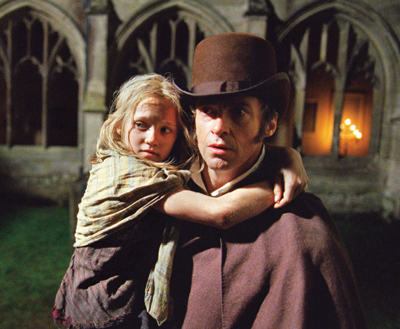

The Scene's Jim Ridley and Jason Shawhan — two guys who snuffle without shame every time they hear the cast albums of Les Misérables — watched the new movie version with the highest of hopes. One discreetly reached for the Kleenex as the characters embraced their fates; the other reached for a musket. Below, the conversation that resulted afterward.
JR: To start, while I definitely enjoyed it more than you did, I share a lot of your problems with it. The decision to shoot much of the movie in close-ups is bewildering, and the editing drove me nuts — I lost track of the times I would get involved in what someone was singing, only to get jolted out of it by a needless cut. But that story, to me, is an engine you just can't derail. I can't help but be moved by Jean Valjean, the most compelling man of principle I've ever encountered in literature. Whereas Tom Hooper's direction had you pretty much storming the barricade ahead of the troops.
JS: I've never seen a film where an Academy Award-winning director makes such a persistent and horrifying case for not being able to direct a film. There are so many medium close-ups where the bottom of the frame is someone's knees and the top of the frame cuts off their eyebrows that at times it passes for some weird stylistic choice, like if Comme des Garcons did a stylebook for filmmaking.
JR: The mitigating factor for me is that many of the songs are interior monologues, so isolating the players and using live singing tends to work in those circumstances — as in Anne Hathaway's devastating one-take rendition of "I Dreamed a Dream," where you get to see all the fury and hurt unfold in real time in the performance. Although I confess the hyping of this moment makes me a little queasy: "Hey, come see the big scene where Fantine gets raped and defiled — and sings about it!"
JS: There are several sequences where the insistence/marketing ploy of all the actors singing live really pays off, and the main one is "I Dreamed a Dream." I can see why, upon seeing that, anybody would say, "Yes, this is the approach to this classic musical to take."
But there are so many more examples of scenes and songs that are completely hobbled by the insistence on the immediacy of live singing. If you're going to cast big stars who can sing, you should at least offer them the support of working within their abilities. Look at Russell Crowe — he's getting shit on left and right for his Javert, and it's ridiculous. He comes from a rock background (he had his band and he was in The Rocky Horror Show in Sydney) and he can sing.
And yet because of Hooper's insistence that the entire film should be about acting the moment rather than singing the moment, you've got Crowe stuck in a very limited range, and getting pilloried for it. Even so, there are little moments in both "Stars" and "Javert's Soliloquy" that are staggeringly effective, but it's on a phrase-by-phrase basis. I give Crowe a lot of credit for trying something this risky.
JR: It's an intelligently conceived performance — Javert as less a zealot obeying a false religion than a robot mechanically following the clockwork of the law — but it doesn't have the edge of mania the material demands. Without it, his voice is a little light and pretty to pull off mad-dog lines like, "They will wet themselves with blood." With exceptions — Hugh Jackman as Valjean, Hathaway, Samantha Barks' heart-rending "On My Own" — I'd say the movie is better acted than sung: The actors reach for different things in their parts, at the cost of some of the songs' dramatic or comedic punch.
JS: You know, I still like Helena Bonham Carter, and her performance here as Madame Thenardier is interesting, if only because it's way more restrained than most performances of the role preserved in recordings. Here, then, is another example of the live singing edict working for the film — the contrast of a less shrill Mme. Thenardier is something we haven't seen before. Whereas Sacha Baron Cohen's Thenardier just hurt my soul. "Master of the House" is one of those numbers that has to have a certain oomph just to counteract the melancholy tone of Act One. But in this film, it's so over-the-top that it kills the dramatic momentum and makes the garish spectacle (starting with that terrible CG boat at the beginning) so overpowering you just want it to end.
JR: It's like Terry Gilliam without the subtlety. (awkward silence) That was sarcasm.
JS: If I was a smoker, I'd say "Master of the House" was an ideal time for a smoke break.
JR: So what did you think of Jackman? I was excited when I heard he and Crowe had been cast, then dismayed to hear who was Valjean and who was Javert. Valjean is perfect for Crowe's rugged nobility, and Javert needs a boost of Wolverine ferocity. But while Jackman gives a much more traditional reading of the part, to me it works in his favor — he's the hounded tragic hero the role requires, even when his delivery comes off as kind of clipped.
JS: Jackman is such a trouper/showman, and he delivers, consistently, for the whole film. But he's so reliable and so devoted to Hooper's idiot concept that I found myself starting to resent him. Part of that is the emotional arc of his character's relationship with Cosette in early Act Two, but Valjean requires a helluva tenor — and Hooper's approach strips the part of its muscular approach to these gorgeous melodies, instead keeping him in a quavering recitative that conveys immediacy and nothing else. When Colm Wilkinson shows up as the Bishop of Digne in the prologue, it shows the cost Hooper's concept will wreak on the film, because Wilkinson tears that part up. No offense to Hugh Jackman, who is a great performer and an exceptional song-and-dance man, but you watch the scene between the two, and you have to ask, "Why isn't the old man singing Valjean?"
JR: To be sure, there's something inherently kitschy about a splashy musical that depicts poverty, degradation and revolt in the streets. I'm not anxious to see Angela's Ashes revamped into Good Morning, Limerick! But I don't think a musical can move you without meeting the risk of kitsch head-on — the form is founded on insuppressible damn-it-all emotion, and arch variants like the movie of Chicago just wind up a stilted hybrid. I was grateful whenever Hooper put away the CG swoops and whooshes into the sky and fell back on square straightforwardness, sticking fast to those stirring Schonberg-Boublil songs. Although did I miss the empty chairs at empty tables in "Empty Chairs at Empty Tables"?
JS: Well, first, I've never seen any musical performance of Les Miz where that little revolutionary imp Gavroche wasn't insufferable. But the whole live singing concept doesn't make for cinematic reality. It doesn't make for theatrical reality either, because it's too focused on the "moment" and not focused on the "melody." But what kind of experience is it trying to create? The environments and sets are so inconsistent from scene to scene that I really have to question what vision Hooper had for this project to begin with.
JR: I dreamed a dream of Spielberg directing this. But I'll probably see this again on the big screen and get worked up all over again.
JS: The perfect director for a film of Les Miz is Trey Parker. Hell, South Park: Bigger, Longer, and Uncut is a better Les Miz film than this one.
Email arts@nashvillescene.com.



