


"Table of Contents"
In fall 2015, Tinney Contemporary opened Topography, an exhibition of work by black artists from around the country that explored layers of African-American culture and history, primarily through sculpture. The show was a highlight of that year’s art calendar, and a new show at Tinney is continuing the conversation that exhibition began. Maryland artist Wesley Clark’s “My Big Black America” was Topography’s signature work — the massive, 16-foot-wide map of America dominated the main wall in Tinney’s front gallery. Clark’s new solo show, The Prophet’s Library, finds the artist exploring the structure and function of language and literature in the black experience in America.
A lot of artists include text in their work, a mix that can easily be mishandled. Clark’s pieces, however, are thoughtfully self-conscious of their ways and means, and part of the power of the work is in the vibrancy of Clark’s vision. Here’s a bit from Clark’s statement:
These works directly engage my love for words and their power. When combined, these pieces make for a very literate show, where words take centerstage alongside their visual co-stars. The phrase “a picture is worth a thousand words” holds true — yet my focus here is how a word creates a thousand pictures.
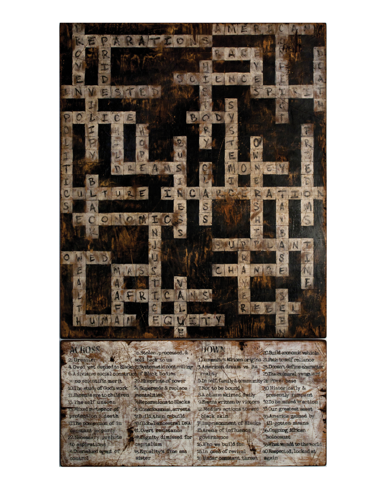
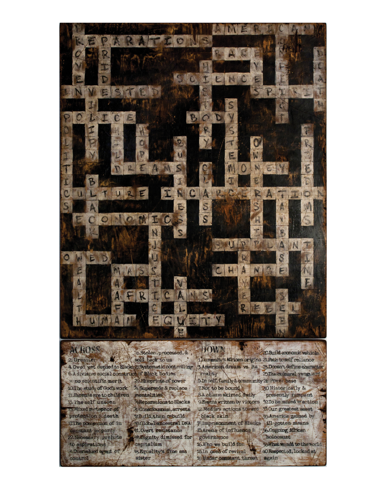
The Prophet’s Library is an expansive, varied show, and one that’s strongest when Clark’s textual preoccupations are allowed to flourish. There’s a recurring theme here with a number of pieces that look like crossword or word-search games — some already have the answers filled in, but others can be played by gallerygoers. “Table of Contents” is a crossword game rendered in oil paint on wood. The game features words like “pride,” “vilify,” “hope” and “black” — as well as the show’s first mention of “reparations,” a theme that recurs throughout the exhibition. “Table of Contents” provides an overview of the rest of the exhibition while simultaneously speaking to its bookish theme.
My favorite works in the show are sculptures of books with titles like “The Prophet’s Library: The Violent Struggle” and “The Prophet’s Library: The Wondrous War.” Made of wood and painted with oils, the book sculptures are mounted to the wall with their decorated spines facing the viewer. The details here are important — they’re all attributed to an author named C.P. Bryant. Bryant is a real scholar and mentor of Clark’s, but these aren’t sculptures of any actual books Bryant has written. Each one is marked with a publication date decades from now, and these future artifacts, as well as many of the word-game sculptures, feature the logo of a publisher called Reparations & Company.
W.E.B Du Bois, Zora Neale Hurston, James Baldwin, Amiri Baraka, Octavia Butler, Huey Newton, Malcolm X and many others have written the books, novels, poems, essays and speeches that have mapped the progress of black American consciousness while simultaneously illuminating that same path — even the posters, pamphlets and newspapers printed by groups like the Black Panther Party and the Nation of Islam have recorded and encouraged the black revolutionary enterprise since abolition. From Marcus Garvey’s Back-to-Africa movement to the Memphis sanitation strike in 1968 and today’s Black Lives Matter movement, broadsheets, newspaper headlines and even Twitter hashtags have played a central role in the organization and the inspiration of popular social movements in black America. It’s these artists, activists and leaders — and the movements they created and inspired — that inform the language and the approach of The Prophet’s Library.
In Tinney’s back gallery, Clark’s “From the Mountain Top” offers chunks of plywood that look like old sections from a torn scroll — or even the crumbs of some ancient sacred tablet. The title references both Moses and Martin Luther King Jr., and it reminds me of the important role the language of the Bible has played in the word culture of black America. There is writing on the various pieces of wood, but instead of the stylized scrawling of some forgotten tongue, these messages appear as a series of text bubbles — taken from actual text-message conversations Clark had with his father — one line of which features the exclamation “Preach Pops! Preach!”
“From the Mountain Top” finds a contemporary electronic messaging conversation petrified on blocks of ancient-seeming wood. The Prophet’s Library likes to mix the past, present and future in books and word games, but Clark’s themes are ultimately timeless — trauma and justice and the history in between.
Email arts@nashvillescene.com



