
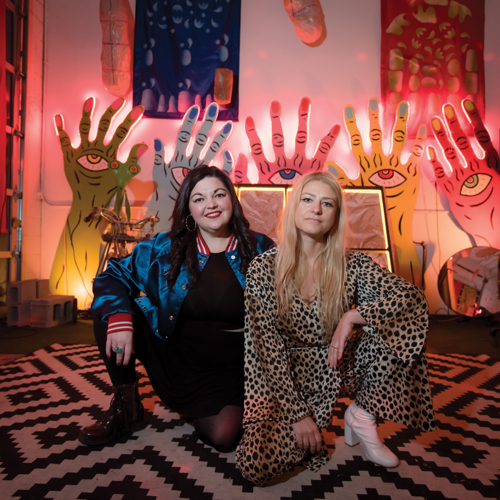
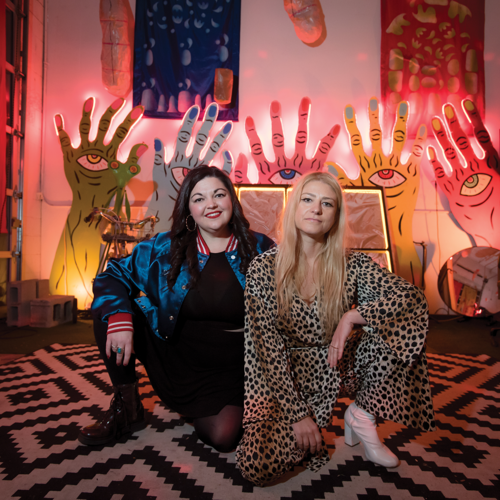
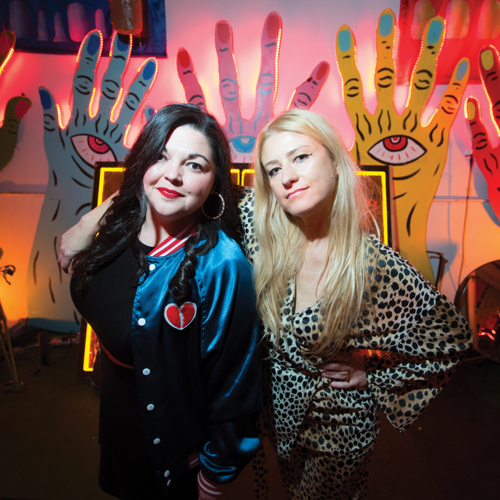


Meg Wade (left) and Maggie Wells
When beloved Hillsboro Village bookstore BookManBookWoman closed up shop in 2016, poet Matt Johnstone wasn’t ready to say goodbye. Saralee Terry Woods and her husband, Larry Woods, had opened shop in 1995, offering used and rare selections in an atmosphere where customers felt at home.
Faced with losing a treasure trove of poetry books, Johnstone decided to raise funds to buy the shop’s poetry collection so it could be relocated elsewhere in town. He raised $536, enough to buy around 400 books. For nearly two years, the collection lived in various places while Johnstone kept his eyes open for its new home.
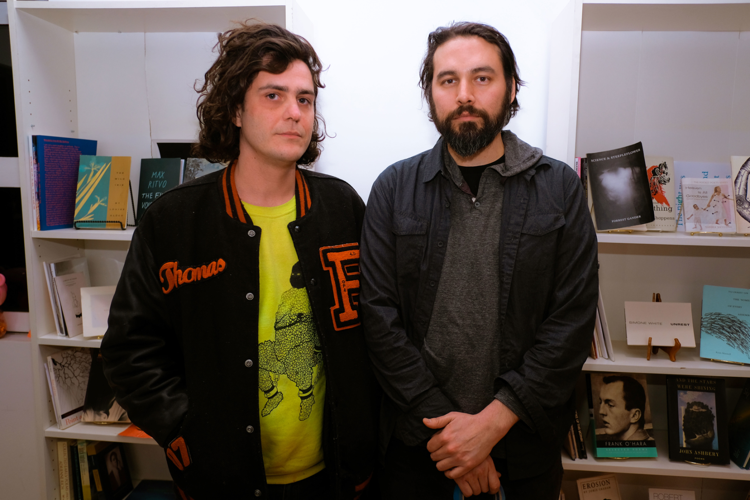
Now you can go to Wedgewood-Houston art space The Packing Plant and leave with a book of poetry recommended especially for you. Johnstone and his friend Thomas Macfie launched The Free Nashville Poetry Library in November in the building, which is also home to artist-run galleries like Coop and Channel to Channel. Located upstairs, the library features a handful of bookshelves, along with tables and stools where readers can settle in. They’ll soon add more shelving so the entire BookManBookWoman collection can have a permanent home. Johnstone and Macfie have also collected chapbooks, journals and zines from many small presses, like Radioactive Cloud, above/ground press and Vegetarian Alcoholic Press. They hope to preserve the DIY spirit of the building’s galleries and also unify the many poetic communities in Nashville. x

Thomas Macfie (left) and Matt Johnstone
The library also has an events component, an innovative example of Nashville’s burgeoning poetry scene pushing the boundaries of what a reading can be. In January, Johnstone and Macfie hosted the library’s first Writer’s Gym, in which participants wrote responses to nontraditional prompts with some poets reading them aloud afterward. “Why is the houseplant dying?” reads one prompt. Others included “Recall your limbs developing” and “Tell your life story using only verbs.”

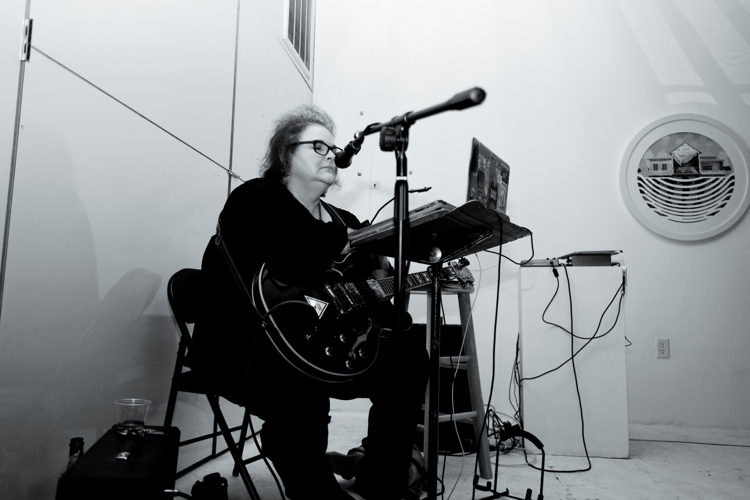
Linda Heck
In January, The Free Nashville Poetry Library hosted three performers who incorporated their texts with digital sounds and technology in pulsating, moody compositions. Memphis artist Linda Heck’s incantation-like tribute to poet W.S. Merwin layered a track of people whispering over sounds recorded from nature, like water rushing and wind chimes, and she strummed a guitar and read a winding, absorbing monologue.
Another initiative is placing poets in a party atmosphere. Maggie Wells and Meg Wade met at a Third Man Books launch party where they were both featured readers. Wade read from material concerning her lineage — which she characterizes as “Appalachian granny witches” — and Wells read a poem about demons. By the end of the night, people were calling them “The Witches.”
“I get historically bored at poetry readings,” says Wells. “I want them to be more alive and fun. The problem with poetry is that you get taught really boring shit, and then you go to boring stuff to watch it. You don’t know that it’s actually cool and funny and alive and interesting. … I want it to exist in a space with energy and weird stuff with people collaborating.”
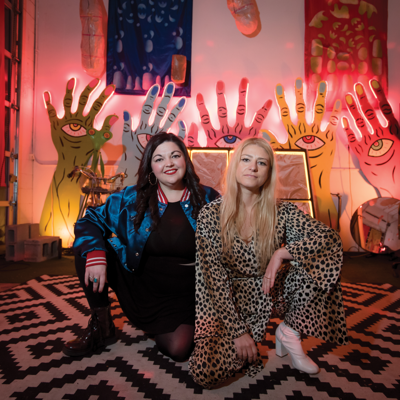
In the summer, the pair launched Be Witched, an event engine with a more-is-more approach. Their January event, Shrimp Cocktail, packed around 100 people into Soft Junk, a small venue on the East Side that Be Witched decked out like a disco in Pee-wee’s Playhouse. Huge papier-mâché shrimp and disembodied toes hung from the ceiling, while an ice sculpture chilled 250 shrimp. (“There was a trail of shrimp tails out the door into the parking lot,” Wells recalls.) Artist Brett Douglas Hunter’s work is a permanent fixture at Soft Junk, and his cutouts of large hands fixed with eyes rose up from the floor behind the poets like waving aliens.

Meg Wade (left) and Maggie Wells
One reader was Third Man Books editor-in-chief Chet Weise. “Every planet has a frequency,” Weise read. “Every person a sound. I wanted to be metal. Loud as a wall of Marshalls in an arena bigger than God.” Brooklyn-based poet Kiely Sweatt took the stage shoeless and wearing a bathrobe. “My body,” she said, “it’s a job. It’s a job. Look at all the hard work it takes. And when I suck the sky through my metal straw, it may as well be your sky because you already own it.” She shrugged off her bathrobe, standing in her undies. As she recited the rest of the poem, a man dressed her carefully — even applying mascara and lipstick. The language of her poem was taut and demanding. She delivered it with scorn.
The house was so packed that it was difficult to see the performers, but spectators stood quietly, scrunched together, listening. Outside, the first snow flurries of the year fell. After the last performance — from Laura Cavaliere, who danced in a zentai suit to Harry Belafonte — Wells got behind the turntable, and a full-on dance party commenced.
“We want to be able to bridge connections between people who are new to town, people who are old to town, people who are poets, people who are into books in general,” says Wade.
The pair says future Be Witched events will have an installation element and likely incorporate music, but they want each to have a very different feel. “We have such a rich community of incredible poets,” says Wade. “Why not expand?”
Both The Free Nashville Poetry Library and Be Witched are challenging Nashvillians to rethink how we experience and consume poetry. The library’s tongue-in-cheek slogan is “Don’t read.”
“It’s not saying, ‘Don’t read,’ ” says Johnstone. “It’s saying ‘Don’t read in a traditional manner.’ Or maybe it’s, ‘Don’t read only one kind of way of reading.’ ”



