
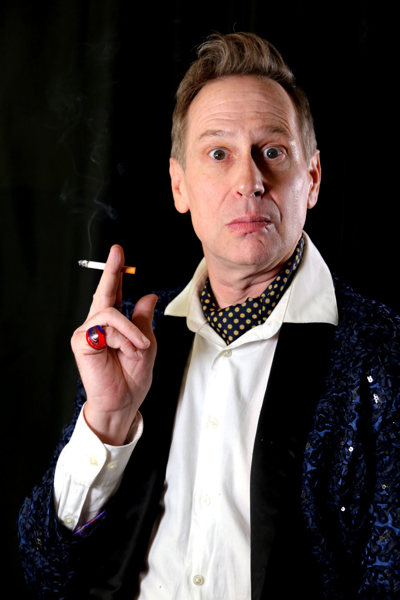
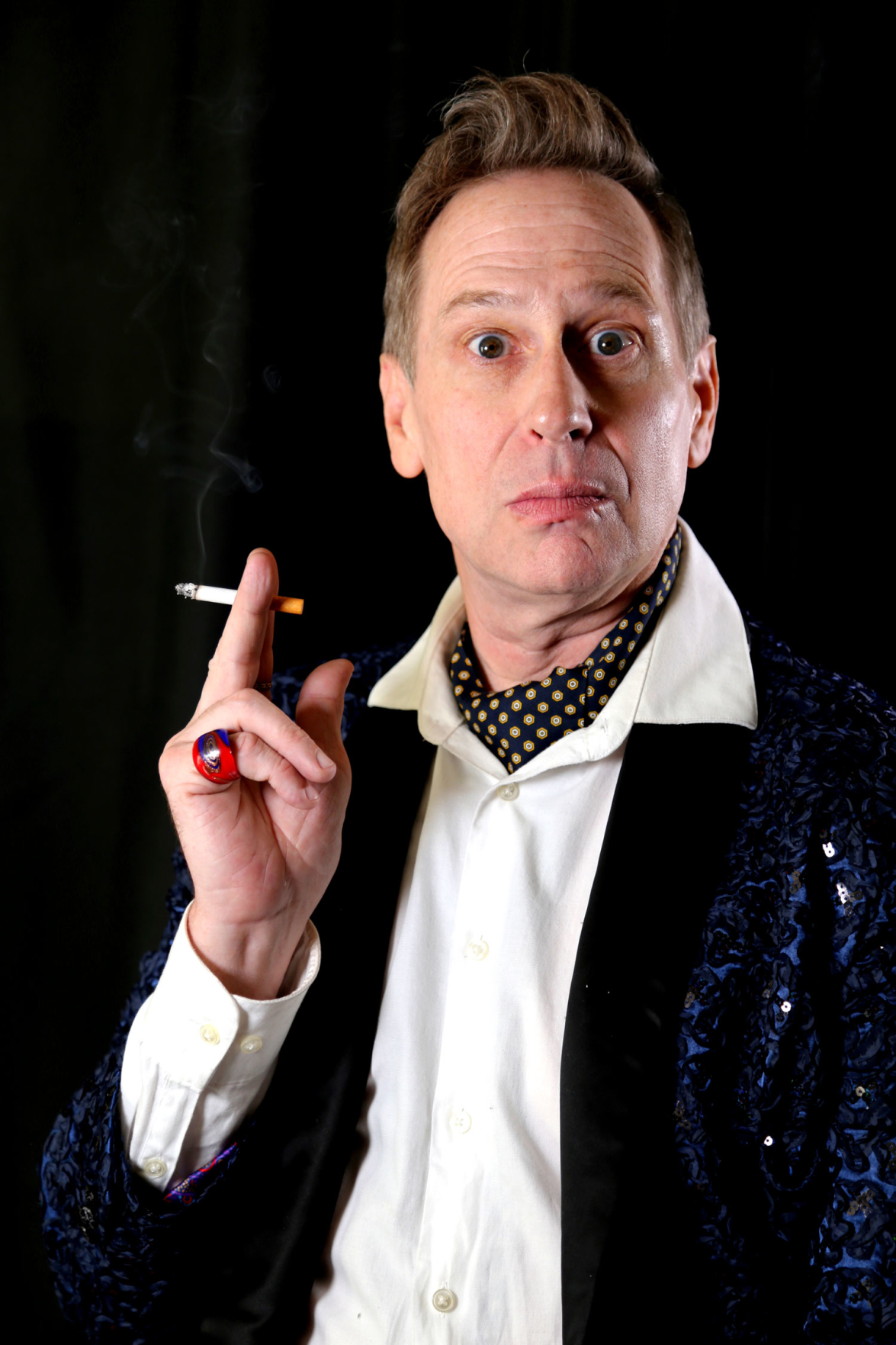
Buddy Cole is a bon vivant, a globetrotting blousy blond who has lived a thousand lives packed into one. With that kind of scope and experience, it’s no wonder he has no time for shocked and appalled audience members and critics. He is kind of like ALF: He’s surrounded at all times by what is, in comparison, a gallery of mouthbreathers, who can only try their best to keep up with his piercing wit, developed over decades. Buddy Cole shoots from the hip. But what’s he shooting? Could be a water pistol full of vermouth, could be a Schwerer Gustav full of provocative snark.
Cole is one of the dearly beloved characters in a Rolodex of personalities belonging to comic Scott Thompson, a founding and keystone member of iconic Canadian TV sketch show The Kids in the Hall. Scott is taking his Buddy Cole act on the road this summer to provoke audiences around the United States, and since his heyday in the ’90s he’s picked up enough new anecdotes to fill his vintage couture garment bag. The Scene talked to Thompson by phone ahead of his upcoming appearance at Zanies in Nashville.
Let’s talk about your book, Buddy Babylon. It’s a re-release, in kind of a redux way — a director’s cut. Are you more satisfied having this version seen by the public?
Yes. Very much. It always felt to me like there was a hole because we took the Philippines chapter out. It wasn’t censorious or anything, it was just basically that the book was too long. I don’t think the publishers were expecting such a door stopper. They were expecting a much smaller book. It feels very good now to have it put back in. It was taken out because it could be removed quite cleanly without affecting the arc of the story. It got put back in, and I’m very happy with it because there are some things in it that don’t actually affect the narrative, but it makes it a little richer experience. And what I love about the Philippines chapter is that it’s such a stand-alone story. It could actually make a really funny movie.
Buddy Cole is an empowering figure — both for the audience, and presumably for you as well. We are currently in an ice age of tiptoeing around hurt feelings and provocative subjects. Would you say that right now is the best time for Buddy Cole to be up on his soapbox, since he can say things that others perhaps cannot?
Totally. It’s absolutely Buddy’s time. As people get more and more afraid, Buddy gets more and more emboldened. It’s like a red flag to a bull. If you tell him he can’t say something, or a place he can’t go, that’s where he wants to go. But I’m a middle-aged white guy. I’m not supposed to be able to say anything. But I’m also a gay man — from a different generation, who suffered — so I am allowed to. But Buddy is really allowed to. My show is appalling, but people love it! And I think that there is a hunger out there for people wanting comedy to get its balls back. I don’t mean that in a sexist way, but get its guts back, and remember that it’s comedy, and there’s nothing that comedy can’t touch. There’s no such thing as a taboo topic, and that’s what comedy does. It’s so important, and we cannot run away from that. … The Kids in the Hall, our heyday of the early ’90s was the heyday of political correctness in the previous generation. And now here we are, and it’s happening again. So it was time to take him out of mothballs, because the time has called for it.
Thirty years ago, there was almost no queer representation on television, and you were on the CBC, not just being out, but being open in a way about sexuality that even today on a network would be considered bold. Additionally, you didn’t stop yourself from being critical of gay culture on Kids in the Hall.
No, I did not.
Being an equal-opportunity critic, did you find yourself isolated during that period, and retroactively? Do you think your pioneering attitude was the main part that was steering your career?
It’s true, I was naive about what it’s like when you attack all sides. Especially today, now that everybody is so tribal, and everybody has to signal which side they are on. To just stand in the middle and not do that, it’s very scary. That’s who Buddy is, and that’s who I am. However, it’s also very thrilling, especially if you know you’re doing the right thing. Also, you’ve seen this happen before, and you know that it will pass. If you’re 25, you don’t quite understand that this will pass. But when you’re 55, you do. There was a part of me that thought, “Maybe this is a period in my career where I should step back and be more cautious,” and I thought, “No, that’s not the way to go.”
Buddy gets into it about subjects like the #MeToo movement on this tour. Have the reactions varied depending on the city you’re in? I mean, you spoke about tribalism, and right now you’re touring the United States. Tribalism in America is geographic.
To be honest, Buddy is not getting negative reactions anywhere, but everyone assumes I’m going to. Like, my director is always going: “When’s the penny going to drop? When’s it gonna break?” And it’s not happening, because I slap everybody around. I feel that Buddy is somebody that anybody can love, wherever they come from. You can’t really say what he is. He’s just so funny, and there’s just so many jokes in the show. If you’re offended, there’s another joke coming right up. No one has any time to wallow in their offense. Also, I don’t really care if you’re offended. The audience is a mob. And if the audience is going crazy with laughter, that person who might be offended doesn’t wanna be that person who goes [in mocking voice]: “Hmmm, I don’t like this. Let’s grind this train to a halt.” No one wants to be that guy. I’m sure that something is going to happen! [Laughs] In this climate I’m certain of it, and I kind of want to get it over with, so we can move on, so people can know that I’m not going to apologize, and we can move on.
I think it’s because I’m a gay man — I know I’m a white man, but I’m gay, and I’m not a young gay man, so I didn’t come from a world that accepted gay people. I come from a very different time. I went through a war. I mean, I come from the AIDS generation. So I think people, particularly young people, look at me and go, “Wow, that guy’s seen some action.” And you kind of have to listen to him. You go, “He’s scarred,” and you see the scars, and you have to listen.
You see sometimes in the queer community a schism between the younger generation and the older one.
Yes! Especially with gay males, because males are the minority group that have the most ages of any minority group. So we are the minority group that gives no love to our elders. We are so ageist, and so sexist, and so looks-ist — which I think is a stupid word, but I’m going to say it anyway — that we don’t want to hear these ugly stories. I don’t think they really know how horrible it was, and so many of the ones that would have told them are not here.
Often if you see an older gay gentleman in a nightclub — and it’s been a nightclub since the ’80s — the younger generation can often see him and say: “There’s that old man. He’s sleazy. Why is he even here?” You have to remember that he likely lost all his friends, most of his family has excommunicated him, and the only place in the entire world that he was allowed to be himself was between these four walls.
He grew up in a time where he was a criminal! That’s yesterday. That’s. Yesterday. So it’s sad that we do not honor our elders and we do not want to know the stories, and I think the greater society has a lot of shame over how it went down. So they don’t want to revisit it, because it’s like slavery or anything like that. I think people have shame, and they don’t want to revisit it, especially now because it’s too close, it makes us look really bad. And the ones that survived, so many of us, are suffering from undiagnosed PTSD. So many of us have shut down and think: “Whatever. Fuck what the young people are doing. I’ve made it to old age, and I’m just going to keep my mouth shut.” I think there’s an enormous wellspring of sorrow with gay men, particularly of a certain age, that is just not explored. I just think it’s huge. And I think that society just doesn’t really want to accept it. And gay men just want to pretend it didn’t happen. But it’s history, so eventually it will all come out in the wash.



