
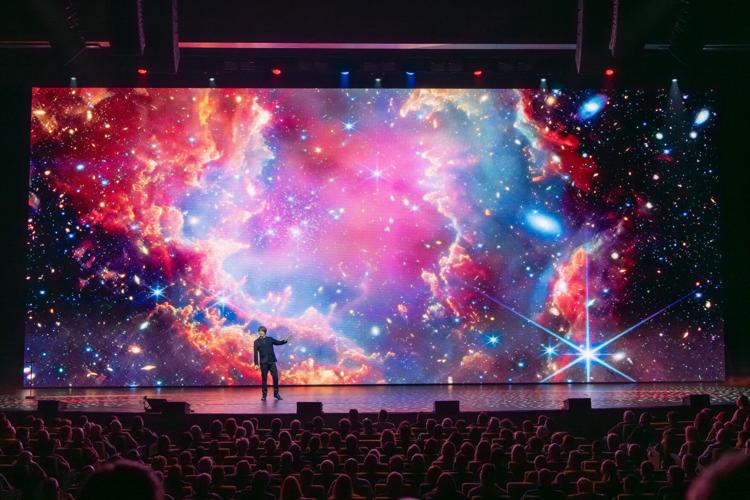
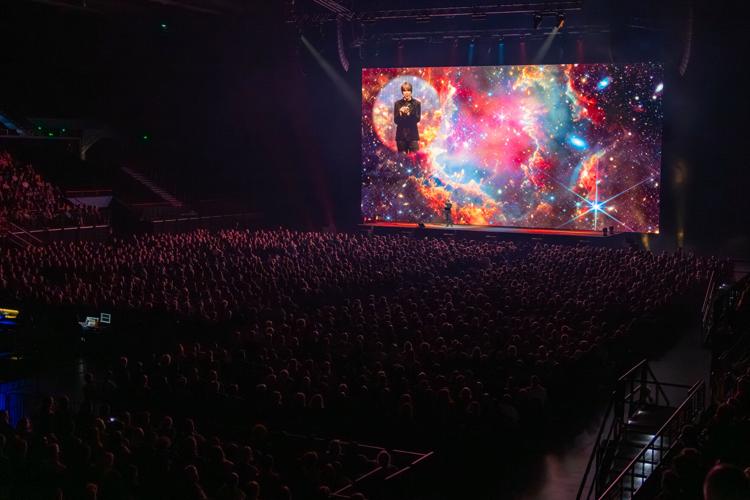

Renowned physicist Brian Cox recently spoke to the Scene by phone about space, science and music ahead of the Nashville stop on his Emergence World Tour, a “celebration of the intricacy of the universe and an exploration of the laws of nature that sculpted it.”
Cox, an English physicist who holds many scientific and academic titles, has released numerous books and appeared on hundreds of television shows, documentaries, podcasts and other public educational programs. His work centers on public curiosity about space, physics and all things science — much like his hero, Carl Sagan.
The show will take place Wednesday, Nov. 25, at the Ryman Auditorium. The Mother Church is a fitting venue for Cox, who is also a musician, having played keyboards with the bands Dare and D:Ream. Cox’s appearance is part of his world lecture tour combining cosmology and other sciences with history, philosophy, music and visual art. Cox promises an “all-encompassing experience.”
“The show, in a sense, begins with a story about the beginning of modern science,” Cox says, explaining how Emergence was inspired in part by German astronomer Johannes Kepler’s 1611 essay “The Six-Cornered Snowflake.”
“The show, in some sense, is based around the questions that we do not know the answers to,” he says. “So these are questions such as: Why are the laws of nature such that life can exist in the universe? What is the role of intelligence in the universe? How many civilizations might we expect in the average galaxy? And so on, so there are those deep questions at the start, sort of built around this wonderful realization of people like Kepler and Galileo [Galilei] back in the 1600s that there are many things that we do not know, and we don’t have all the answers.”
While fact-based scientific evidence continues to meet contemporary political resistance in Tennessee and across the U.S., Cox says the public still has a hearty appetite for knowledge.
“I think the interest is very wide and very deep. What the challenge in — as you will know — a noisy media landscape and public landscape and entertainment landscape is to just connect people with these ideas. … I think the challenge we have as scientists is to connect that curiosity that I think most people have with science, and say, ‘You don't just have to have an opinion on these things. You don't have to watch science-fiction movies or read some kind of weird websites — there are actually people working on these questions, and we're acquiring new data all the time.”
“If this is the only planet that supports civilization in the Milky Way galaxy, you could argue Nashville is the center of the Milky Way galaxy, culturally,” says Cox, adding that he and his son, who is a guitarist, are looking forward to exploring the Gibson Garage in Nashville.

Physicist Brian Cox
“Music actually is a big part of the show,” he continues, noting that Emergence audiences will hear new music: “Voyager,” which he created with PJ Harvey to celebrate the Voyager spacecraft’s upcoming 50th anniversary traveling through space, and compositions by Oscar- and Golden Globe-winning Italian composer Dario Marianelli.
While Emergence dives deep into the questions of space and science, its stories and explorations are accessible to general audiences who bring their own levels of curiosity.
“There is no special requirement for someone to either be a scientist or be interested in science or to understand these things,” Cox says.
“Often I draw the parallel between science and learning to play a musical instrument, because it's the same,” he continues. “All you have to do is, you have to pick up the instrument and practice, and almost nobody can pick up an instrument and just play it, right? So it just doesn't happen. People don't tend to say, ‘I could never learn to play the guitar or play the piano,’ whatever it is. I think it's understood that you … practice, and it's very enjoyable to practice, and you get better at it, and I think virtually every working scientist I've met — including Nobel Prize winners — would say that they are not somehow special people. They're just people who got interested in something and it captured their imagination, and they did some practice, and the practice was enjoyable, and they got better at it, and that's the key to science. …
“It's one of the things that we can be interested in, and what I try to say to people is, it's tremendously rewarding being interested in it. You can read about it, you can keep up with the latest discoveries — they're astonishing. The amount of data — and it’s one of the things in the show — the amount of data we have at the moment is remarkable. I say that cosmology and astronomy are going through a renaissance at the moment, because new observatories and new instruments are just transforming our view of the universe, and that's just interesting. And you don't need to be some kind of Einstein-level person to get great joy from that and to understand it.”



Post a comment as anonymous
Report
Watch this discussion.
(0) comments
Welcome to the discussion.
Log In
Welcome to the discussion.
Keep it clean. Please avoid obscene, vulgar, lewd, racist or otherwise abusive language. Comments featuring hate speech or threatening or violent content will not be tolerated.
PLEASE TURN OFF YOUR CAPS LOCK.
Be truthful. Don't knowingly lie or mislead.
Be proactive. Use the “report” link on any comment that violates our comment policy.
Share with us. We'd love to hear your feedback.