
On playwright John Pielmeier's website, he claims that his only association with a shocking 1977 incident that happened near Rochester, N.Y., was a newspaper headline screaming "Nun Kills Baby!" Pielmeier states that he never read the accompanying story, but approximately nine months later had a eureka moment that spurred him on to write Agnes of God. Still, the media account's particulars are a pretty close match to Pielmeier's attention-grabbing opus — a Broadway hit in the early 1980s, later a well-received feature film, and now showing at the 4th Story Theater on West End.
In reality, a nun was discovered bleeding after failing to arrive for a meal. Later, a baby was found dead in a wastebasket in the nun's small convent room. The nun denied she had given birth and said she couldn't remember being pregnant — instead she'd presumably covered up all visual indications of her pregnancy under her habit.
The case's other facts and its eventual legal disposition offer more logic than does Pielmeier's impressively expressed if somewhat befuddling script. But he delivers a compelling scenario, for sure, as a court-appointed psychiatrist, Martha Livingstone, visits a convent to assess the mental state of a young novice who apparently gave birth and then strangled her child with the umbilical cord.
The physical evidence offers the doctor clues, but the benumbed, almost trancelike 21-year-old Agnes, who sings heavenly melodies with an angelic voice, is Livingstone's initial challenge to gathering all the facts, including the answer to the question who (and where) is the father?
Then the real battle commences — between the shrink and Miriam Ruth, the mother superior, who seems determined to not only protect Agnes (for a special personal reason that is revealed in time) but also the convent and its cloistered ways. That situation provokes Livingstone's mistrust of Catholicism — she's "fallen away" and has her own particular hurtful reasons for that — and raises the stakes in the struggle for the truth, pitting psychiatry against Catholicism's mysterious acceptance of miracles (or at least, its acceptance of the unexplainable).
The taut exploratory atmosphere of Act I turns grittier in Act II, when Livingstone embarks on a series of hypnosis sessions with Agnes, which result in breakthrough but also a welter of torturous revelations and psychological pain for all involved, not to mention the young novice's disturbing episode of stigmata.
Pielmeier writes smart, literate dialogue, and there's no denying the consistent pulse of intrigue that he wrings out of this inherently gripping tale, which unfolds like a suspenseful whodunit. There's a breakdown late in Act II, though — a hokey sensationalism that bleeds through all the drama, capped by the author's intentional but still unsatisfying refusal to grant us the closure we seek. Perhaps befitting the Catholic themes, you have to take this one on faith.
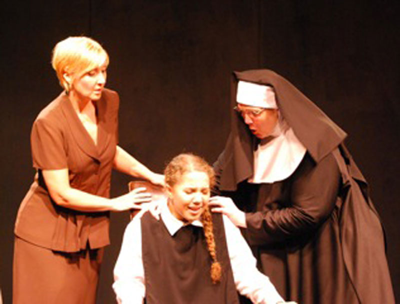
Fortunately, director Robert Kiefer has put together such an engaging cast that the performances sustain the tension pretty much to the bitter end. Cathy Sanborn Street, temporarily stepping away from her producer role at Street Theatre Company, is a marvelous surprise as Livingstone, coiffed and clothed as a sober, serious professional and creating a credibly conflicted character whose interesting personal story is cannily interpolated into the broader one. Veteran singer/actress Carol Ponder seems born to play Sister Miriam, a rigid old bird who can authoritatively stand up to Livingstone's modern science yet still let us glimpse her humanity (and even her humor).
Finally, young Kaila Brooke Wooten — who happens to be the daughter of local actress Holly Goldman Wooten and Grammy-winning bassist/composer Victor Wooten — is a fine complement to her more experienced colleagues, projecting youthful innocence and charm but also the necessary inscrutability that keeps us guessing as to whether she is saint or sinner (or both). As a bonus, she fills the air with dulcet tones, sung during offstage interludes.
With its thoughtful if flawed text and its three strong female roles, Agnes of God can still entertain a crowd — and of that, this committed production grants us something Dr. Livingstone never uncovers in her pursuit of the cold hard truth: proof.
Email arts@nashvillescene.com



