
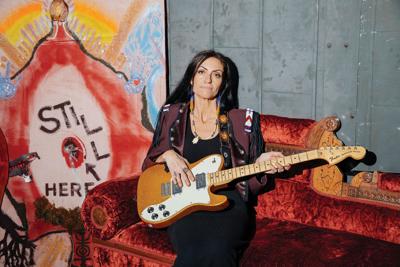

Shayna Hobbs has something to say.
The Stockbridge-Munsee Mohican musician, mother and activist grew up in Nashville. Her Grammy-winning musician father, Bill Miller, moved the family from their Wisconsin reservation in the early 1980s so he could pursue his career, and her childhood was peppered with interactions with country music stars. She remembers times when musicians like Vince Gill and Waylon Jennings would call the family home, and being excited to meet Tori Amos when her dad opened for her throughout the Under the Pink tour.
But throughout all her father’s successes, Hobbs was aware of a difference. She recalls an incident at Christ Presbyterian Church, where she also went to school, when a church elder called her dad a disgrace, ridiculing him for his long hair and Native jewelry. In recent years, however, Hobbs says she’s begun to notice a shift. She performed the land acknowledgement onstage at the boygenius concert in Centennial Park in June of last year, and was shocked by how attentively people listened as she spoke of the Indian Removal Act, and the Native artists who are still here despite all that.
Hobbs developed IndigeNash as a way to harness that energy and direct it back toward the Native community. IndigeNash is a Native-led three-day art and music festival that celebrates multi-tribal Native cultures, and will take place at The Forge Nov. 22 through 24. It is rooted in a traditional pow wow, but instead of focusing on those more traditional aspects of Native life, it also incorporates contemporary music, art exhibitions and cultural discussions. Bands like A Tribe of Horsman, who play 1960s-inspired electric blues and are led by charismatic frontman Dhalton Horsman, will perform alongside Trenton Wheeler, a singer-songwriter who also performs traditional grass dance. Ryan Toll, the Apache chef who co-owned the now-closed Wild Cow, will serve up Native-inspired foods and specialty cocktails.
In a recent series of conversations with the Scene, Hobbs spoke about how she hopes IndigeNash will educate people about Native culture, and how it’s been here all along.
Find excerpts from our conversation below.
On Growing Up in Nashville:
“I really struggled with finding my identity, being an Indigenous girl here in the South. My culture was erased, and my identity was misunderstood. I didn’t have a place where I ever felt like that same feeling that I felt with my family on the rez. We never really found that Native community here, and I saw how it impacted my dad a lot. My dad has always been like a pioneer for Native music, and he really inspired me a ton. But I saw again that he had no place to belong. And even though he helped everybody in every genre, he was the token Native guy. So as I’ve developed as a young woman and gone on all of my journeys, my passion has always been to create music and art, and use my voice to bring healing and hope.
“There’s something stirring in the city of Nashville. Something’s happening here. It’s growing. I will say that there’s kind of, there’s some heavy, hard stuff, and stuff that I don’t agree with that’s happening here. I’m not happy about the way buildings keep being put up and the way that they’re just forgetting the land in a lot of ways, and forgetting the water.”
On the Roots of IndigeNash:
“I’ve always seen this vision for a Native festival that has the echoes of the pow wow, but it’s a little more modern. It’s the other generation that sometimes people forget about when they’re talking to us. They want to over-romanticize us. There is a beautiful side of us as Native people, and a lot of us have those deep spiritual roots, but we also just want to be seen as just modern-day people the same way. … We want to be heard, but it is a long process to get there, because we carry this generational trauma — only if you’re Indigenous do you truly know what that means. And so when I meet Indigenous people, they become brothers and sisters because we share that in common.
“So it’s this blend of honoring our traditions and the tribes that we come from, our family, everything, but it’s also about expressing who we are right now, because that’s also valid. That is Native, whether it’s traditional or not. I am Native, so what I create is Native, and I really want to bring back that narrative as a people. We need that power, because it has been stolen from us. Everything has been taken from us. I mean, no wonder it’s so fucking hard for us to even rise up from that, because our children were taken, our language was taken, our hair was cut, our traditions were outlawed. Like all these things, they took everything away, took our land, everything, and then now all of us are living on what is not even our land. The reservations are like concentration camps. It’s like they push us to the other side. So this is a powerful reclaiming, because I believe that representation really matters, and it’s time that we can create our art and our music again.”
On Being Native in 2024:
“You know, people talk about the civil rights movement, and they don’t realize that our Native people are still fighting for that. We’re still fighting, and the irony is, this is our land. It’s insane. Think about going to Japan or Switzerland. You’re gonna experience the culture, and you’re gonna experience the people, their land, their food, their music, everything that makes them them. For Natives, where do you go? A reservation doesn’t quite show who we are. That’s us after we’ve been wiped out. So what I dreamed of, ever since I was a little girl, is to have places and spaces for us as Natives to come and just be all that we are, so we can be safe to share that with others. I feel like IndigeNash is going to be the start of that.
“It’s like, ‘Hey, we’re still here, and we’re gonna rise up, and we have things to share with you.’ And the world needs to hear these messages right now, in big ways, because it’s about land. It’s about honoring the earth and land, our resources, natural resources. It’s about protecting the voices of minorities. It’s about giving a platform for those who haven’t been heard. It’s about restoring balance. It’s about reclamation, healing, redemption, all of that. It’s a super, super exciting time to be Indigenous right now, and I have a big passion for bringing that vibe and that awareness to the city of Nashville.”

Photographing this year’s NAIA Pow Wow and discussing Nashville’s future with members of the Indigenous community


Post a comment as anonymous
Report
Watch this discussion.
(0) comments
Welcome to the discussion.
Log In
Welcome to the discussion.
Keep it clean. Please avoid obscene, vulgar, lewd, racist or otherwise abusive language. Comments featuring hate speech or threatening or violent content will not be tolerated.
PLEASE TURN OFF YOUR CAPS LOCK.
Be truthful. Don't knowingly lie or mislead.
Be proactive. Use the “report” link on any comment that violates our comment policy.
Share with us. We'd love to hear your feedback.