

Needless to say, live comedy shows — like just about everything else — are currently on hold in response to the COVID-19 pandemic. We recommend keeping up with the comedians discussed in this story by following them on Twitter — @LauraKPeek, @dustyslay, @realbradsativa, @chancewillie, @MikahWyman, @tayslurp, @sethpomeroy, @Connor__Larsen, @maryjayberger, @hollyperk, @realaaronweber, @BillyWayneDavis, @thecroftonshow and @jessecase.
Also follow along with Zanies (@zaniesnashville), which will be hosting livestream events with local comedians as we all self-quarantine. Keep an eye on Third Coast Comedy (@3rdcoastcomedy) and The Comedy Bar (@comedybars) for ways to support that venue and its staff, and follow Nashville Stand Up on Facebook (@nashvillestandup) and Twitter (@nsup).
“Oh, I didn’t know Nashville had comedy!”
If every local stand-up comedian had a dollar for each time they’d heard this line, they could probably all quit their day jobs and pursue comedy full time.
The fact of the matter is, it does — and it’s good. Often great, even.
Stand-up in Nashville has come a long way since Scene contributor Lance Conzett took its pulse in 2013 with a cover story titled “Knock, Knock: You better open that door before Nashville’s burgeoning comedy scene beats it down.” Back then, the city was more of a stop-off for touring comics than a hotbed for local ones. But that’s changed.
Needless to say, the COVID-19 pandemic and Metro Nashville’s March 22 “Safer at Home” order — which restricts all nonessential business and travel — have stopped events like comedy shows in their tracks. But in recent months and years, there has been a groundswell of activity, with a pair of new comedy venues along with open mics and showcases happening constantly all over town, and a high concentration of talent both onstage and behind the scenes.
As a medium, comedy has exploded in popularity. With 200-plus Netflix stand-up specials to choose from and more than 30,000 podcasts available under iTunes’ comedy category, there are more avenues than ever for comedians to put their work out there. Nashville itself continues to swell in population, giving the local scene a steady influx of new blood.
So is Music City becoming Comedy City? Not exactly — at least not yet. But it’s picking up momentum, with a slew of upstart comics capable of holding their own anywhere — and some who have already reached the next level.

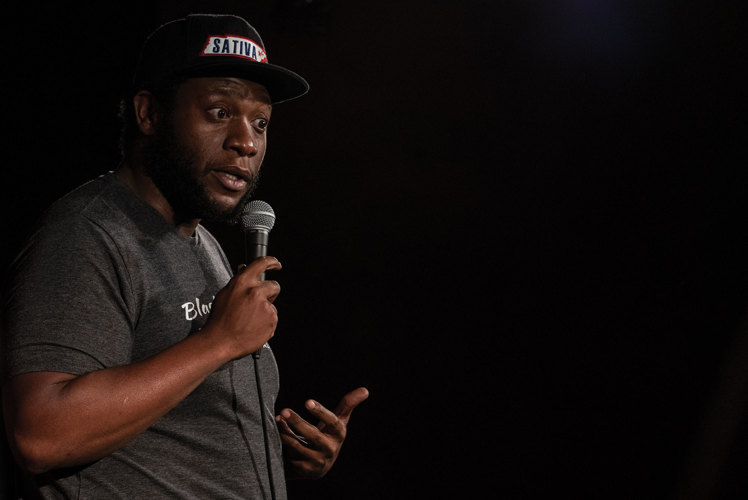
Brad Sativa
When Nashville-based stand-up Dusty Slay appeared on The Tonight Show last summer, Lucy Sinsheimer — booker at the long-running Eighth Avenue comedy club Zanies — held a last-minute watch party at the venue. “I invited local comics and thought maybe we’d have 10 people show up to watch on a projector,” Sinsheimer remembers. “Literally the entire comedy scene showed up, even people who don’t come by very often. It was a great moment for our community.”
Next in line for the national spotlight could be Laura Peek or Brad Sativa, Nashville comedy fixtures who in the past two months each played their first headlining shows at Zanies. To headline there is a milestone for any in-town stand-up, a hard-earned reward for years of slugging it out at open mics and moving up through the ranks — showcasing, MC-ing, featuring, working the road. Both comics’ shows sold out.
Peek is a Nashville native who recently moved to Los Angeles. She’s a deadpan observational humorist who last year earned plaudits from arts-and-leisure site Thrillist in an extensive state-by-state breakdown of stand-ups to watch. Peek capped 2019 opening for podcaster, writer and stand-up icon Marc Maron at TPAC. In L.A., Peek has been performing at the iconic Hollywood Improv. Sativa has plans to take his bracingly honest, high-energy-stoner act and eye-catching merch (his logo is the all-caps “SATIVA” inside the outline of the state of Tennessee) from Music City to New York City. Before he gets there, he hopes to make a three-month stopover in Chicago to train in its club circuit.
Connor Larsen and his roommate Chance Willie are working stand-ups and show producers in their mid-20s. “Ever since Chance and I have lived together, this is all we do,” Larsen tells the Scene. For them, seeing peers like Sativa and Peek move on from Nashville is exciting but bittersweet. “It’s like when the timer’s done, the food’s ready, time to take it out of the oven,” says Willie. “You miss having that smell in your kitchen, but if it’d stayed in too long, it might’ve burned.”
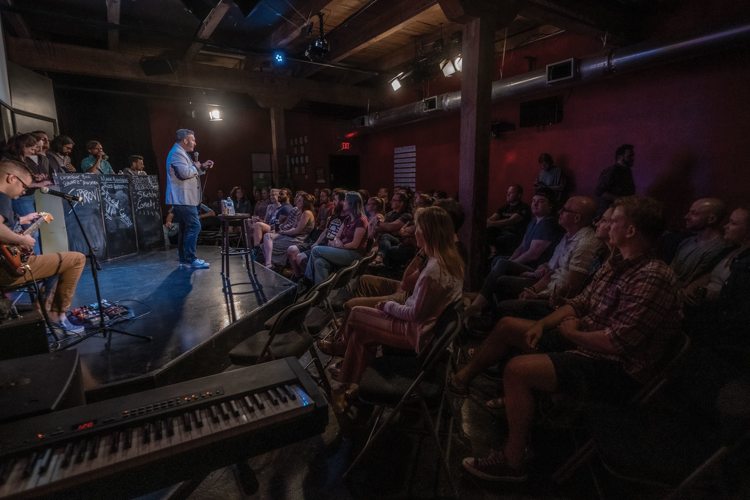
An improved venue situation has helped kickstart this new wave of Nashville comedy. Zanies has existed for nearly 40 years and remains the hub for national, regional and local comedians on the rise, but now it’s got some company. In 2016, Third Coast Comedy Club opened for business in Marathon Village, putting on stand-up, sketch and improv shows and offering comedy classes and workshops. Last year, Chicago venue The Comedy Bar opened a downtown Nashville outpost that, when open, hosts a weekly Wednesday local showcase, Thursday open mic and Sunday brunch show. On Fridays and Saturdays the bar also typically sees stop-ins from touring headliners like Ahmed Ahmed.
The new clubs serve different needs in the city’s comedy ecosystem. Allison Summers teaches improv at Third Coast and performs there twice a week. She says a permanent venue for comics to hone their skills in a professional but not pressure-cooked atmosphere was something Nashville previously lacked. She describes Third Coast as part clubhouse, part think-tank for the local improv, stand-up and sketch scenes, which don’t typically overlap. “It’s nice to have a dedicated space for comedians who want to collaborate and develop their own shows,” she says.
If Zanies is the most traditional of the three venues and Third Coast the most experimental, then Comedy Bar, with its proximity to Broadway, is the wild card. Willie has hosted showcases there, including during last April’s NFL Draft. He compares its rowdier vibe to a certain rogue pro football league. “Comedy Bar is like the XFL,” he says. “It’s dope, but you never know what’s going to happen.”

Comedian Taylor Williams at the Back Corner in Germantown
Nashville has always had comedy, but in recent decades much of it was underground and niche-driven. The downtown venue Jazz and Jokes catered to a largely African American audience, but it closed in 2014. Across the river, the Ultimate Comedy open mic at The East Room got its start in the early 2010s and ended up becoming the unofficial living room for the alternative-comedy community. But for the most part, stand-up happened in scruffy, smoky, since-shuttered dives like Spanky’s off Nolensville Road. Black comics, hipster comics and country comics didn’t mix much at the dives, and women in the scene weren’t as well-represented.
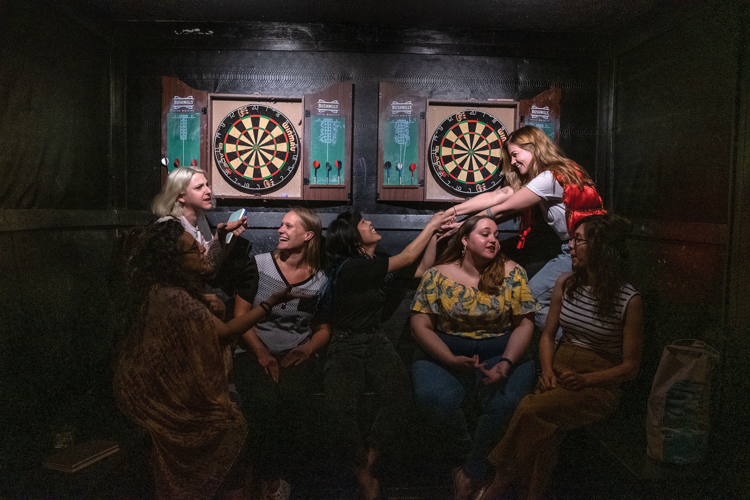
The pool of talented Nashville comics has grown exponentially — and it’s grown more diverse — in recent years. Many stand-ups also produce or host shows. Comedian Mary Jay Berger says the number of mics and showcases “has skyrocketed” compared to when she first started doing open-mic night at Spanky’s in 2012. To Taylor Williams, a newcomer from Charlotte, N.C., it’s an embarrassment of riches. “I feel like I’m always missing a show I want to be seeing because I’m at another show,” Williams told the Scene just weeks ago.
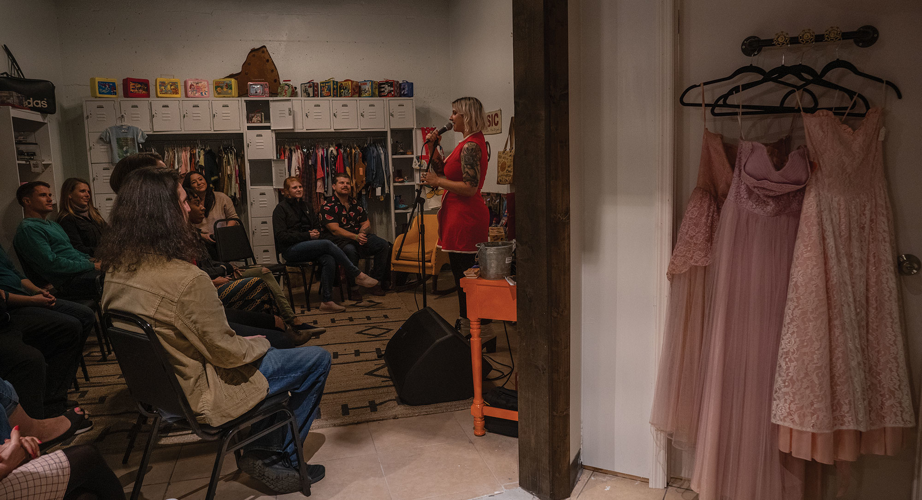
If you haven’t seen much local comedy, or haven’t checked it out in a while, the quality and professionalism of these shows might surprise you — not just the showcases at Zanies, Third Coast and Comedy Bar, but ones in East Side alternative venues. There’s Larsen’s Brewery Laughs at Southern Grist Brewing, Willie’s Good Job Boys at The Crying Wolf, Holly Perkins’ Kiefer Sutherland Comedy Hour at East Nashville Beer Works and Seth Pomeroy’s Anaconda Comedy Hour at Anaconda Vintage, among others.
These are community-building events where Music City comics share stage time with their counterparts from Memphis and Louisville, Chattanooga and Atlanta. In addition to the monthly showcase Pomeroy hosts at the Grimey’s-adjacent Anaconda, he also puts on pop-up shows at Nic Schurman’s off-the-wall gallery and showspace Soft Junk. These are meant to foster what he calls an “exchange program” between Nashville and Los Angeles. “I want to put local openers with the L.A. headliners so they see we have real talent,” Pomeroy explains.
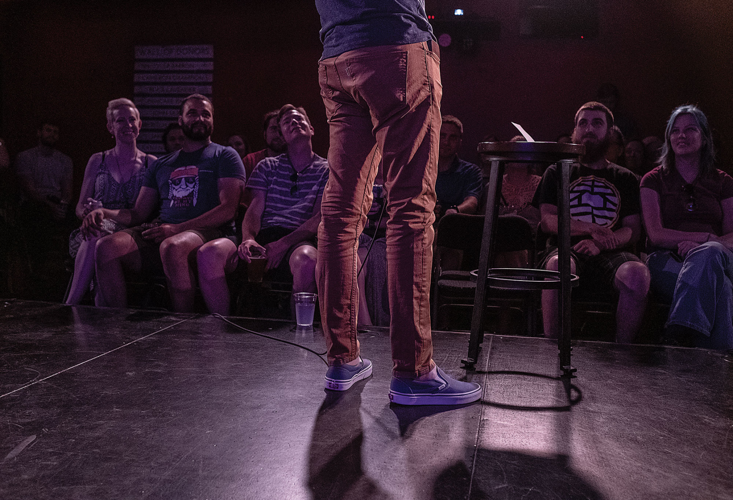
Nashville comedians are used to having to fight to raise awareness of their own existence, but at their more recent shows, they began to notice they’re no longer performing just for each other. A pattern began to emerge: people from outside the scene coming out to the shows, and more importantly, coming back again and again.
“We’re working to cultivate a fan base,” Pomeroy says. “Because it’s Nashville and people are fatigued with the music to a certain degree, people end up showing up at these shows a lot ... simply because it’s at a venue they frequent, or their friend’s going, or their friend’s doing stand-up, or their friend’s roommate’s a stand-up. Because we have so many stand-ups and so many shows now, we’re starting to get to entertain people who aren’t already our friends.”
Developing a presence in rooms where live bands typically play has helped generate some crossover between Nashville’s music and comedy factions. Pomeroy credits The East Room’s open mic for “starting this kind of rock ’n’ roll vibe.” Third Coast’s Summers even sees stylistic commonalities between local songwriters and stand-ups. “Our voice is unique,” she says. “We are innately storytellers, and we have a way of telling stories that are rich, detailed and truthful, honest and fucked-up — which is funny — without being too drawn-out.”
With the addition of Third Coast and Comedy Bar, Nashville comics and promoters have become slightly less reliant on existing music-scene infrastructure to prop themselves up, but it remains an asset. “There’s a million stages, a million PAs,” says Larsen. He goes on to mention Malcolm Gladwell’s oft-cited metric for how long it takes to master a talent or trade: “Instead of 10,000 hours, it’s 10,000 venues.”
“We’re like hermit crabs who live in shells left by other animals,” jokes Mikah Wyman, producer of Third Coast’s Nashville Is Comedy Country showcase. “We book venues on their worst night, we need almost no sound check, and will perform in front of anyone.”
As much as comedy in Nashville has grown in recent years, “it’s not yet so big here that stage time isn’t there for the taking,” Larsen says. “There’s opportunities for new people to start and add to it. The barrier of entry is literally just show up, hang out and persevere for a month. That’s all you have to do to get into this world. Stand-up is only as hard as they say it is the first five times. Then it drops so steeply. You realize even if you bomb, you’re not going to die.”
Before the stay-at-home order was issued in Nashville, a typical week for a working local comic consisted of as many open mics as possible Monday through Thursday, then showcases and paid gigs on the weekend or whenever they could be had, here or in nearby cities. The stand-up hustle “is an every-night thing,” says Willie. “The writing is never done until it works in front of a crowd. It’s why you’ve got to hit multiple spots. That’s ingrained into the culture of comedy — how many you can squeeze into a night — and it becomes addictive.”
Succeed at it long enough, and like Peek and Sativa — and Billy Wayne Davis, Chris Crofton, Jesse Case and countless Nashville expat comedians before them — you’re confronted with the question of whether to stay or relocate to one of the Big Three comedy cities: New York, L.A. or Chicago. Lately, however, more comics are doubling down on Music City, treating it not as a stepping stone or proving ground, but rather as a home base. Working stand-ups like Zanies mainstay Aaron Weber (who came up in Montgomery, Ala., but came into his own in Nashville) or Slay (who arrived from Charleston, S.C., in 2014) have shown that maybe you don’t have to go to L.A. to make a career of it after all.
Slay has had his droll, gentleman-redneck joke-telling featured on Fallon (twice), Jimmy Kimmel and Comedy Central. He’s a regular at the Grand Ole Opry, and has played the Ryman “a couple times now,” he says. But he still makes time each month to host his Grand Ole Comedy Show at Zanies, which is entering its fourth year.
“This is where I became a full-time comic,” says Slay, sitting on a couch backstage at the club before a recent gig. (Read our full interview here.) He’s about to go onstage to a nearly full room — a stark contrast from Grand Ole’s early days.
“I’d go on Lightning 100 sometimes to give away tickets, then come out and see maybe 75 people out there. Then, all of a sudden, it happened [for me], and I just ran with it.
“I don’t want to move to L.A.,” Slay continues. “I don’t want to move to New York. I like being in Nashville. Shows [here] are getting better all the time. And everybody likes to laugh. So if everybody’s good, that doesn’t mean they’re going to come to less comedy shows. It means they’re going to be inclined to go to more. ’Cause comedy on Netflix is not the same thing as live comedy.”
Nashville has made great strides as a comedy town. Still, it’s a delicate line between being proud of what’s been accomplished, and becoming complacent. Sativa acknowledges it’ll take time for live stand-up to become embedded in the culture the way live music is — he just hopes his hometown doesn’t sleep on it for too long.
“Right now in Nashville, you could be seeing someone who in a decade could be hosting a late-night show,” he says. “Someone like Laura Peek — she’s not just one of the best local comics, or best lady comics, she’s one of the best, period. ... And people like her succeeding is what’s going to keep the scene motivated to keep doing events and not making excuses, so that when they do get known, people aren’t still like, ‘Oh, I didn’t know Nashville had comedy!’ ”



Post a comment as anonymous
Report
Watch this discussion.
(0) comments
Welcome to the discussion.
Log In
Welcome to the discussion.
Keep it clean. Please avoid obscene, vulgar, lewd, racist or otherwise abusive language. Comments featuring hate speech or threatening or violent content will not be tolerated.
PLEASE TURN OFF YOUR CAPS LOCK.
Be truthful. Don't knowingly lie or mislead.
Be proactive. Use the “report” link on any comment that violates our comment policy.
Share with us. We'd love to hear your feedback.