
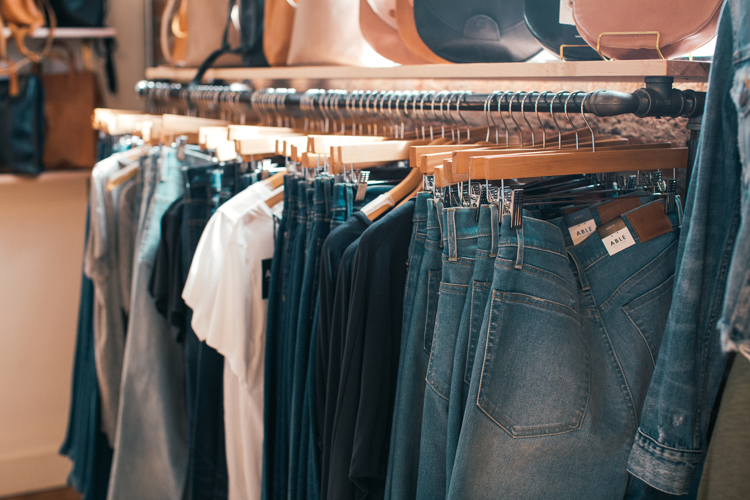
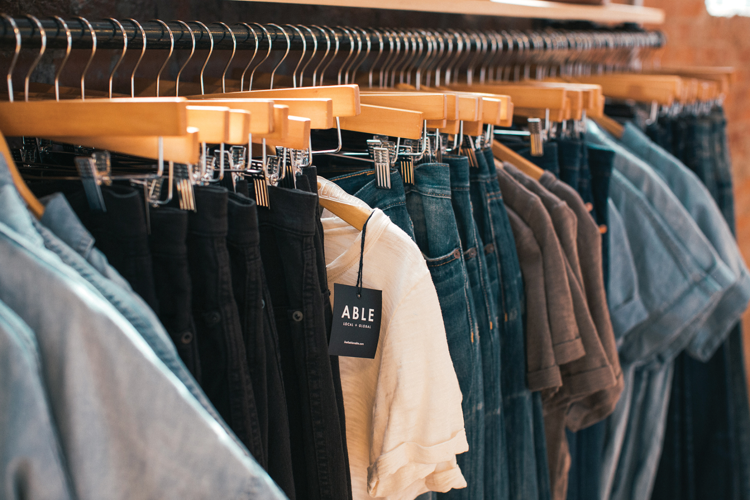
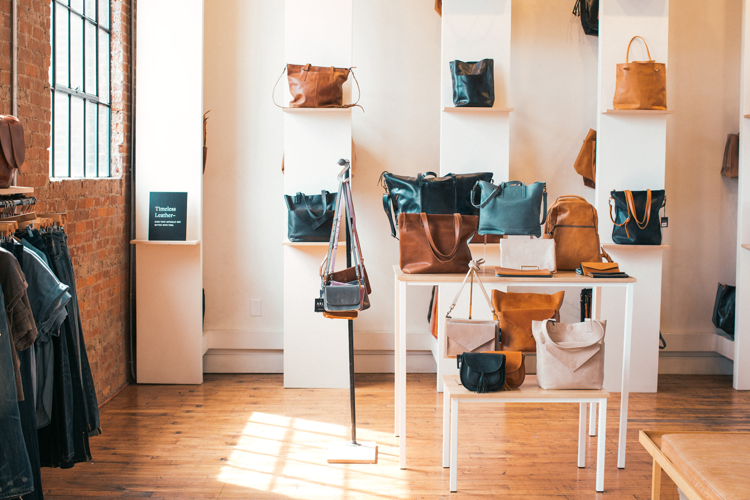

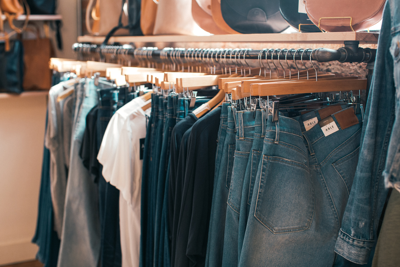

Barrett Ward is popular in the Stocking 51 development that houses his fashion and lifestyle brand, ABLE. At neighboring coffee shop Frothy Monkey, the baristas recognize him as soon as he walks in the door, and a handful of people say hello or shake his hand as they pass his table. The affable fashion entrepreneur is unassuming and self-deprecating, but he exudes a genuine warmth and a passion that is contagious. And he’s doing his part to infect the entire fashion community, locally and globally.
“I don’t know the first thing about fashion,” he says with a laugh. And while it’s true that he lacks the ostentatious flair or hipper-than-thou air that often accompany men in the industry, it’s obvious he’s an astute businessman with a clear vision. He started ABLE in 2010 to create economic opportunities for women in Ethiopia, where he and his wife were living at the time. Startled by the prevalence of the commercial sex trade, Ward began talking with women and girls to understand how they ended up in the industry.
“What you learn was these aren’t women making bad choices with their lives,” Ward says. “They’re doing anything they can to survive. I met one woman that went into the sex industry to save her sister from breast cancer. So these are heroes, right? So when we started working with them, there was some charitable work that we were funding around health care — 75 percent of them were HIV-positive — around child care, counseling. But they always said to us: ‘Look, we’re grateful for the charity. We need it. But at the end of this, what do you expect us to do? We need a job.’ ”
ABLE — formerly FashionABLE — began with three women making hand-woven scarves in Ethiopia. It has grown into an ethical fashion powerhouse that employs 86 workers in Nashville (83 of whom are women) and partners with hundreds of workers worldwide to manufacture leather goods, shoes, denim, clothing and jewelry. The company’s mission is to end generational poverty both locally and abroad by creating opportunities for women.
“We really started not as a business with a mission, but a mission with a business, and that is to create jobs for women,” says Ward. “As it grew, what we started realizing is we have an opportunity to have influence here. Consumers were starting to identify with that thought that we can have a genuine, positive impact with our purchase — especially on these women.”
Committed to honesty and transparency, ABLE recently formed an independent auditing nonprofit called Accountable and has launched an initiative of publishing their lowest wages. “It’s estimated that as low as 2 percent of the women around the world that make fashion products earn a living wage,” says Ward. “And that means that 45 million women around the world can barely meet their basic needs so that we can do this. And they work 12 hours a day, and they work six days a week often, and that’s just unacceptable.”
ABLE is using the clout it has in the fashion industry, specifically in Nashville, to inspire other brands to be more socially responsible. On April 1, the company will partner with Nashville Fashion Week for the first Sustainable Summit, an interactive event focused on sustainability and ethical responsibility within the fashion industry. Joining them on the panel will be this year’s Fashion Forward Fund recipient, designer Van Hoang, who’s building her young brand with a holistic approach to sustainable and ethical practices.
“My triple bottom line is people, planet, product,” Hoang says. “And so making sure that all those things are in line together and being used in a responsible way. You know, fair labor, fair wages ... but also looking at the product and seeing how it’s made.”
Hoang was chosen as Nashville Fashion Week’s Fashion Forward Fund recipient because of her commitment to sustainability, and she plans to use the endowment to attend the Copenhagen Fashion Summit — a global conference on sustainability in fashion — to gain greater insight into building a sustainable brand and to learn about new innovations in the field. Although the fashion industry overall is witnessing a shift to “slow fashion” — a commitment to small-batch or made-to-order production, sustainable materials, longer-lasting garments, environmental consciousness and the fair treatment of workers — it’s still very difficult for independent brands and designers to make the switch or launch businesses adhering to these methods. Taking a sustainable approach to fashion is a time-consuming and expensive endeavor, not to mention overwhelming. Much like “farm-to-table” or “organic,” the term “sustainability” has become a buzzword in the fashion industry and isn’t policed. There are so many ways a brand can practice sustainability and responsibility that it can be challenging for consumers to discern who is legitimately committed to it and who is exploiting the trend.

Local designers Jamie Frazier and Hannah Jones of Jamie + the Jones happened into the slow-fashion movement without even realizing it. The pair first connected as students at O’More College of Design and bonded over their mutual interest in natural textiles and slow-process design.
“What we fell into was, ‘We’re slow process, natural materials,’ and that’s always what we said,” says Frazier. “And then along came this huge movement, trend — I don’t know what you want to call it — and somehow we just fell right into it.”
The two launched their clothing line upon graduation in 2009, taking a hiatus between 2012 and 2015. Nowadays, they’re committed to made-to-order production, making well-constructed and well-designed garments that are meant to last, and limiting waste. They use every bit of their materials by turning scraps into swatch kits, scrap bundles, quilts and clothing under the Scrap Collection label. They’ve also launched a “seed-to-sew” textile project for their handwoven cottons, in which they work with cotton farmers and weavers to create their own materials. And yet, they’re still reluctant to identify themselves as sustainable or ethical.
“We actually never, ourselves, used those words, because we never thought we were ‘ethical,’ and we never even thought we were ‘sustainable,’ ” Frazier says. “And we still don’t necessarily think we are, and maybe that’s a horrible thing to be saying, but ethically, we could be doing a lot better, sustainably, we could be doing a lot better. All we know is this is what we want to do and in our hearts what we feel is the right thing to do.”
Whether it’s a sign of Nashville’s altruistic DNA or a representation of heightened awareness and demand for social responsibility from consumers, many of the top Nashville-based designers and brands have made it their mission to conduct business in an ethical way, regardless of the personal cost.
“Responsibility to me feels like a bigger calling,” says Liz Pape, designer and founder of Elizabeth Suzann. “A call to leave everything and everyone we interact with better than before we interacted. A call to show up and do my best for women trying to get dressed and feel whole. I think we have a responsibility to make products people can trust, to make them with integrity and run our business honestly, to represent our customers fairly and equally in our imagery, to care for people in every way we can, and to push meaningful conversation forward, even when it gets uncomfortable or feels unnatural as a business.”
As one of the more established and successful designers in town, Pape plays the role of inspirational and aspirational guide for the up-and-comers in the industry. Elizabeth Suzann is committed, first and foremost, to creating garments with long-term durability and wearability. The company uses all-natural fibers, and all of the made-to-order clothing is produced in the Nashville studio. “We don’t outsource any steps of the process,” says Pape, “and the ability to control our working conditions, pay structure, the physical and emotional environment, and growth and development of our team — that’s a big part of building a sustainable company that can last and improve over time.”
All the designers agree that consumer awareness around the issues and the importance of sustainability and responsibility are crucial to the future of the slow fashion movement, here in Nashville and around the world. As customers become more educated on the far-reaching impact of their purchasing habits, they’ll be more likely to shop responsibly. But sustainability is just as much about what you don’t buy as what you do.
“Convincing customers to buy more shit in the name of sustainability is the biggest scam of our generation,” Pape says. “We all know this, but it bears repeating: Buying nothing at all is the most sustainable thing any of us can do, and when you must buy or want to buy, then use that opportunity to shop responsibly. Treating sustainability as a trend is the biggest threat to it being taken seriously, and to take it seriously it has to be more than surface level.”
Here’s a look at spring trends from several local designers with sustainable practices
Nashville Fashion Week Events
Participating Shop Nashville locations include UAL, Madewell, ABLE, Emerson Grace, H. Audrey, Levy’s, Glenn Nash, Haven and many more. For full listings, ticket information and details, visit nashvillefashionweek.com/schedule.
Monday, April 1
5:30-8:30 p.m.: NFW Sustainable Summit: Nashville Turns Ideas Into Action (OneCity, 8 City Blvd., Suite 402); free
Tuesday, April 2
10 a.m.-6 p.m.: Shop Nashville (various locations)
6:30-11 p.m.: Nashville Fashion Week Night 1 (OZ Arts Nashville, 6172 Cockrill Bend Circle); $50
Wednesday, April 3
10 a.m.-6 p.m.: Shop Nashville (various locations)
1-3 p.m.: NFW Learning Labs, Create: Margaret Ellis Jewelry (2809 Bransford Ave.); $250
6:30-11 p.m.: Nashville Fashion Week Night 2 (OZ Arts Nashville); $50
Thursday, April 4
10 a.m.-7 p.m.: Shop Nashville (various locations)
6:30-11 p.m.: Nashville Fashion Week Night 3 (OZ Arts Nashville); $50
Friday, April 5
10 a.m.-10 p.m.: Shop Nashville (various locations)
6:30-11 p.m.: Nashville Fashion Week Night 4 (OZ Arts Nashville); $50
10 p.m.-1 a.m.: NFW Official After Party (Dream Nashville, 210 Fourth Ave. N.); $20
Saturday, April 6
9-11 a.m.: NFW Learning Labs, Beauty: The Cosmetic Market (4015 Hillsboro Pike, Suite 107); $45
10-11:30 a.m.: NFW Learning Labs, Marketing: Emma (11 Lea Ave.); free
10 a.m.-10 p.m.: Shop Nashville (various locations)
12-1:30 p.m.: NFW Learning Labs, Business: Amax Talent (Fleming’s Prime Steakhouse, 2525 West End Ave.); $30
6:30-10:30 p.m.: Fashion Forward Gala (OZ Arts Nashville); $250

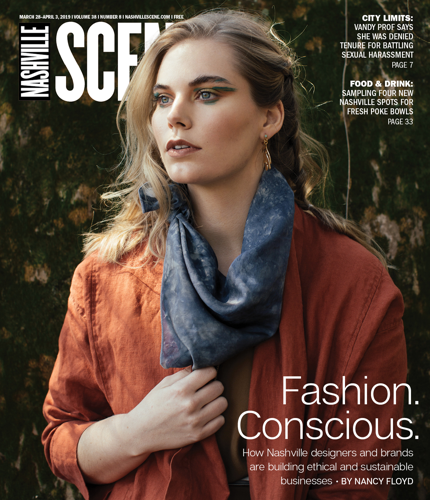
On Abbie: Ella slip dress in moss, Clyde jacket in terra, Serpentine wrap belt in flax (Elizabeth Suzann); Natalie Busby x Honor Of scarf, earrings (Natalie Busby)



