
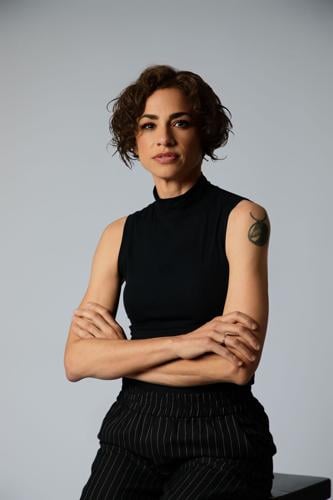


Emily Lordi
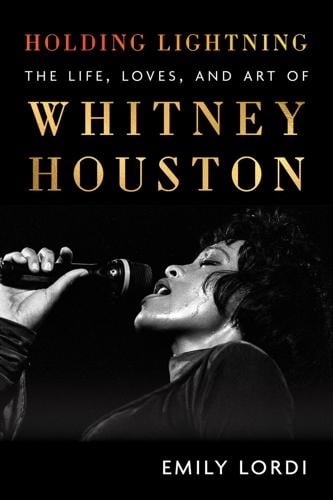
Emily Lordi’s Holding Lightning: The Life, Loves, and Art of Whitney Houston begins with a deceptively simple question: What happens when we remember a woman’s destruction more vividly than her genius? The answer, Lordi posits, is that we lose the person herself. This biography stands as a capital-T True reclamation of Houston’s story, placing her at the center not as an object but as the subject.
Lordi, a professor of English at Vanderbilt University and a writer-at-large for T: The New York Times Style Magazine, spent four years researching Houston’s life and work. A seed for the book was a 2023 T article, “Whitney Houston’s Enduring Legacy: Lifting Up Other Black Women,” in which Lordi began reconsidering an artist whose cultural significance had become obscured by the circumstances of her death. The resulting biography contains hundreds of source notes, but it is also animated by something less academic: an evident fascination with Houston’s enormous, unruly talent.
The title comes from producer Narada Michael Walden, who described Houston’s singing as “holding lightning in your hand, holding lightning in your throat.” It is an apt metaphor for a voice that seemed almost physically impossible: controlled and explosive, technically extraordinary and emotionally immediate. But Lordi extends the metaphor beyond the voice. Houston, she argues, was a woman trying to contain an almost uncontainable force while navigating the demands placed on a Black woman who became one of the most famous people on earth.
Lordi’s central argument is that Houston belongs in the pantheon of musical geniuses. Instead, she writes, Houston “has been slotted into the genre that shadows that of the genius: the famous doomed woman whose only agency appears to be the power to self-destruct.” She “appears not as a visionary but as a femme object we gaze at or gape at, asking what happened to her, not what she did.”
That distinction gives Holding Lightning its urgency.
The familiar story is one of spectacular ascent followed by spectacular collapse: the New Jersey girl raised in the orbit of her mother, singer Cissy Houston; the discovery by Clive Davis and signing with Arista; the meteoric rise of Whitney, the first album by a woman to debut at No. 1; the more than 200 million records sold worldwide; the movies, the fashion, the national anthem, the marriage to Bobby Brown, the drugs, and finally the bathtub in a Beverly Hills hotel in 2012, where Houston drowned at 48 with drugs in her system.

Lordi does not erase any of this. She puts it in proportion. Her account of Houston’s relationship with Robyn Crawford is particularly illuminating. Their connection — by turns romantic, platonic and professional — was shaped by the impossible conditions of an image-conscious, homophobic entertainment industry. “Whitney would never be able to publicly date Robyn,” Lordi writes, “but neither would she … give her up.” The relationship becomes neither scandal nor explanatory key, but one of the many complicated bonds through which Houston tried to construct a life of her own.
The same complexity informs Lordi’s treatment of Houston’s drug use, which began in adolescence. Houston understood early that her evolving mixture of marijuana and cocaine could threaten the concentration her career demanded. Yet addiction does not become the book’s organizing principle. Neither does Bobby Brown, whose tumultuous marriage to Houston has so often been used as a shorthand for her decline.
Instead, Lordi keeps returning to the work and to Houston’s agency within it:
Whitney was not only a vocal technician with an encyclopedic knowledge of music. She was a multimedia strategist who broke barriers as a Black model and actress and labored to help other Black creators thrive across the arts.
That may be the most important achievement of Holding Lightning. It does not ask us to forget how Houston died. It asks us to stop allowing her demise to eclipse the breadth of her life.
Lordi restores the scale of the woman behind the myth: ambitious, magnanimous, funny, complicated, loving, difficult, sometimes self-destructive, often fiercely self-aware, a woman who valued faith and family, vices and autonomy. She honors Houston’s contagious light and spirit without pretending that light was cost-free. To burn that brightly, so publicly, exacted a price.
But the price should not become the legacy.
The lightning was the point.
For more local book coverage, please visit Chapter16.org, an online publication of Humanities Tennessee.

The 38th annual celebration of the written word takes place Oct. 17 and 18



Post a comment as anonymous
Report
Watch this discussion.
(0) comments
Welcome to the discussion.
Log In
Welcome to the discussion.
Keep it clean. Please avoid obscene, vulgar, lewd, racist or otherwise abusive language. Comments featuring hate speech or threatening or violent content will not be tolerated.
PLEASE TURN OFF YOUR CAPS LOCK.
Be truthful. Don't knowingly lie or mislead.
Be proactive. Use the “report” link on any comment that violates our comment policy.
Share with us. We'd love to hear your feedback.