
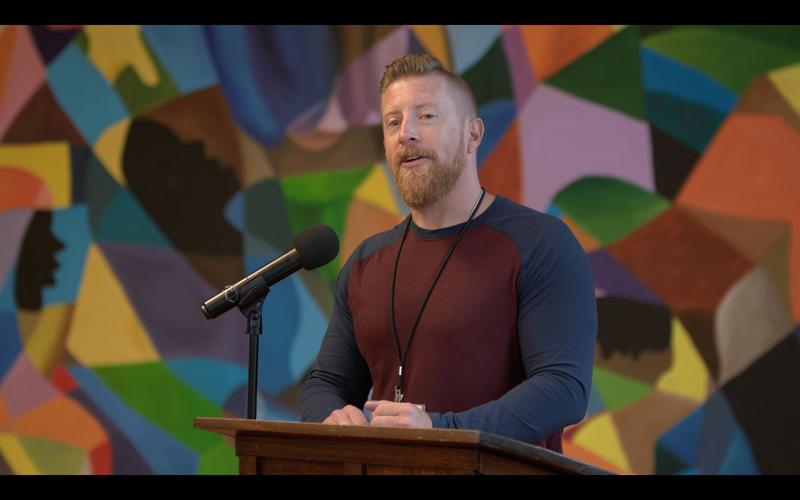
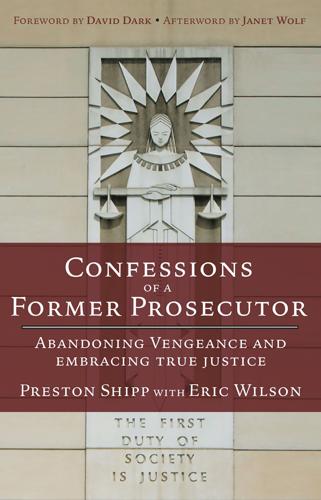
The most powerful moment in Preston Shipp’s memoir, Confessions of a Former Prosecutor: Abandoning Vengeance and Embracing True Justice, is not flattering. It is not a moment of triumph or a funny anecdote showing the author’s wit and intelligence. It conveys a red-hot burning shame you feel through the pages. In it, Shipp stands on the curb opening an envelope he just retrieved from the mailbox. In an ordinary correspondence from his former employer, he learns that seemingly unremarkable actions he’d taken as part of a job he once loved had consigned a friend to life in prison.
Shipp’s book details his journey from an ambitious young prosecutor in the Tennessee attorney general’s office to an activist committed to reform, and a key factor in his evolution was meeting Cyntoia Brown, a victim of trafficking. In 2004, when Brown was 16, years of abuse and desperation drove her to a terrible act — the murder of a middle-aged man named Johnny Allen who had brought her to his Nashville home for sex. Charged as an adult and hit with a life sentence, Brown languished in the Tennessee Prison for Women before joining a Lipscomb University program known as LIFE in which Shipp was an instructor.

Shipp, who found himself troubled and deeply moved by his experience teaching prisoners, had already left his job as a prosecutor and was working for the Tennessee Supreme Court’s Board of Professional Responsibility when he first met the bright, resilient Brown in 2009. She arrived in his class “a voracious reader” who was also “fiery and outspoken.” To him, this young woman bore no resemblance to the teenager who shot Johnny Allen:
I knew Cyntoia was a changed person. We exchanged books, shared jokes, and had side conversations about what she wanted to do with her life. She wanted to put her experience to work in service of others by helping at-risk youth avoid the tragic turns her life had taken. … Although she was serving a sentence of fifty-one years, she was nurturing hope that one day she would get a second chance.
Their friendship was tested when they both learned that Shipp had earlier written a brief arguing against an appeal of Brown’s murder conviction — a brief he never remembered writing before that fateful trip to the mailbox. Brown’s quest for clemency later became a cause célèbre, and she was freed in 2019. Shipp took an active role in advocating for her release, and her case pushed him further toward a complete rejection of the retributive paradigm of the criminal legal system.
The term “criminal legal system” is used deliberately throughout the book and stands as a repudiation of the “criminal justice system” referenced in every Law & Order intro. Shipp considers the current approach little more than “institutionalized vengeance,” wildly inadequate to address crime or other social problems. He brings a prosecutor’s mind to his indictment of the current system and includes heartbreaking statistics about America’s staggering rate of incarceration, which exceeds that of Russia and China. No doubt Shipp, with his acumen for storytelling and memorable data, made a formidable adversary in court.
Confessions of a Former Prosecutor serves as a good explainer on the inner workings of the system Shipp critiques, but it will resonate with an audience beyond lawyers, judges and reformers. Anyone who has ever become disenchanted with a career will find something relatable. “Every day I felt more and more like an imposter,” Shipp writes of his days as a prosecutor. “I no longer believed in the work I once dreamed of doing. Meetings with my colleagues were increasingly uncomfortable, as I no longer shared their common faith in a system of retribution.”

Shipp’s process of abandoning one life for another more in accordance with his moral values is deeply spiritual. He writes movingly about silent meditation retreats, labyrinths and monastic disciplines, but the greatest spiritual practice of all is proximity to the marginalized. “The gospel as a ministry of reconciliation wasn’t something I learned in church,” Shipp writes. “No, this was a lesson I learned from people in prison.” Through genuine friendships with his students, death row inmates and wrongfully convicted exonerees, Shipp realizes a faith that is more exacting, yet also richer and deeper.
Shipp notes repeatedly that the building he used to work in is inscribed with a pithy directive: “The first duty of society is justice.” Throughout the book, he asks readers to consider what justice really means. In the end, his ethos is one of deep connectedness with those caught up in the criminal legal system. Russian dissident Aleksandr Solzhenitsyn once wrote that “the line dividing good and evil cuts through the heart of every human being.” Shipp’s wrenching examination of his own heart is proof that achieving justice could never be so easy.
To read an uncut version of this review — and more local book coverage — please visit Chapter16.org, an online publication of Humanities Tennessee.



Post a comment as anonymous
Report
Watch this discussion.
(0) comments
Welcome to the discussion.
Log In
Welcome to the discussion.
Keep it clean. Please avoid obscene, vulgar, lewd, racist or otherwise abusive language. Comments featuring hate speech or threatening or violent content will not be tolerated.
PLEASE TURN OFF YOUR CAPS LOCK.
Be truthful. Don't knowingly lie or mislead.
Be proactive. Use the “report” link on any comment that violates our comment policy.
Share with us. We'd love to hear your feedback.