


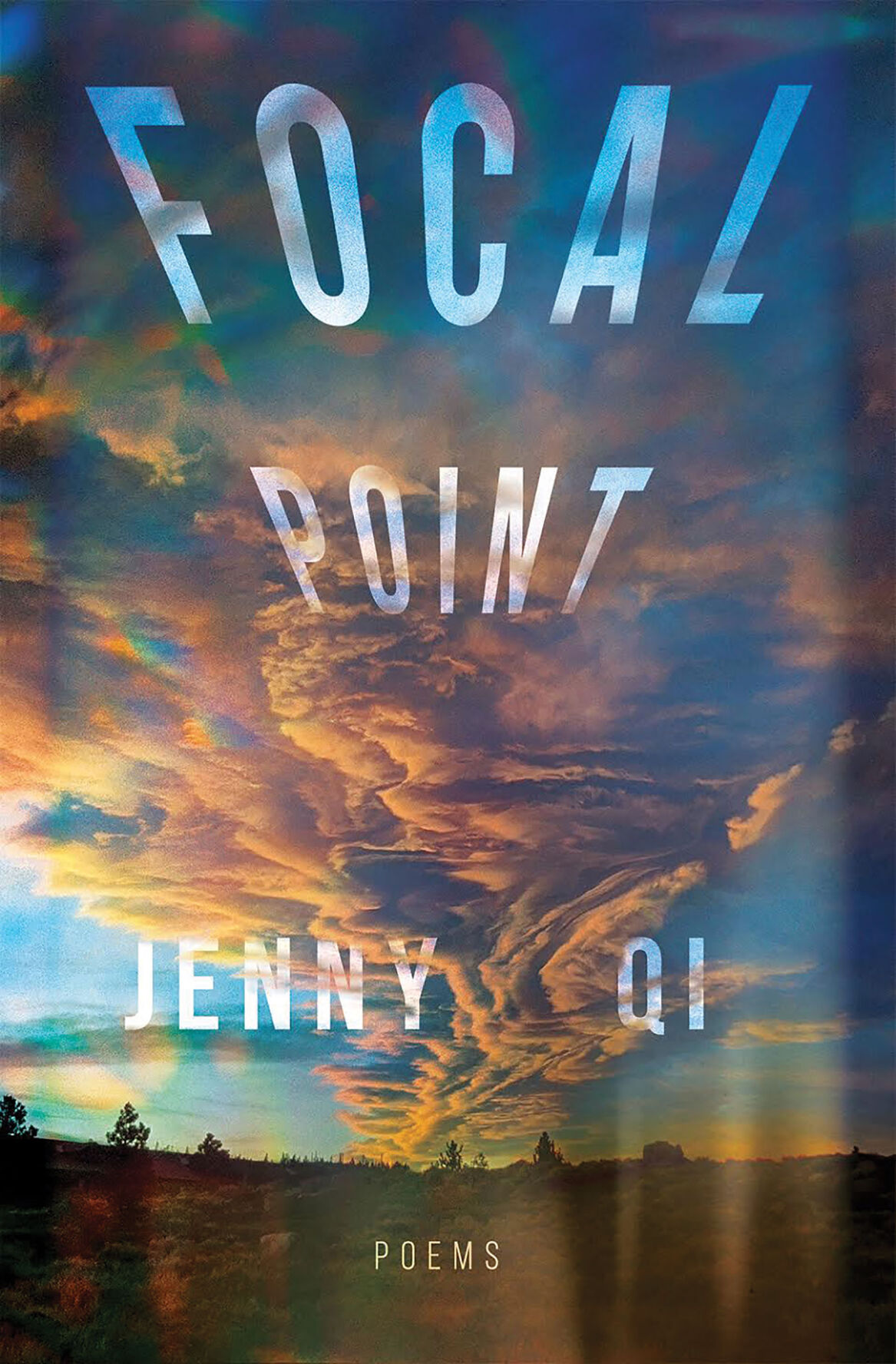
An accomplished poet and essayist, Jenny Qi brings a complex perspective to her writing. She’s the child of immigrant parents from China, both highly educated, who struggled to make their way in the United States. Qi entered Vanderbilt University when she was just 16, and while she thrived there academically, she also had to deal with her mother’s terminal illness, somehow juggling school with trips home to Las Vegas to help provide care — an experience she wrote about for The Atlantic.
Though Qi was active as a writer during her undergraduate years, studying with Mark Jarman and serving as poetry editor for The Vanderbilt Review, her chief focus was on science. She went on to earn her Ph.D. in biomedical science from the University of California, San Francisco, and during graduate school she began to write intensely, pouring her grief and memories into poetry. Those poems, along with more recent work exploring an array of concerns, are gathered in her award-winning debut collection, Focal Point.
Qi answered questions via email.
The poems about your parents, and especially about your mother’s death, are deeply personal and revealing. Do you worry about telling more of your parents’ story than they might want?
Jeffrey Kingman wrote a really kind early review of Focal Point in Compulsive Reader, in which he made a point of distinguishing between the speaker and the author, and I really appreciated that and now try to remind people to keep that in mind. Poetry isn’t exactly nonfiction, after all, and while there are often autobiographical elements, not everything is always 100 percent true.
But to answer your question, yes, I do worry about it, particularly because Chinese culture is one that shies away from ever talking about anything negative or personal. But that’s exactly why I wrote, and I wrote a lot of these poems not with the initial intention of publishing them but rather for myself. I wrote for the younger me who felt so deeply alone in some difficult experiences, and I have to believe that has some kind of value. The other thing I remind myself is that in spite of this aspect of the culture, my mom also wrote deeply personal work, so I hope she would have understood.
In poems like “The plural of us” and “Two Cures,” you use wordplay as a way into much deeper themes. Is language often the spark for a poem for you?
Yes, I suppose it is, more than anything else. I love thinking about language, about the various definitions of words across disciplines, the translations of words, homophones and cognates across languages, how adding or removing a single letter can transform a word completely. Often, a poem comes out of ruminating on a word or phrase, and sometimes if I’m obsessing over a word, I look it up in the dictionary, and I start a poem exploring the various official definitions of that word.
Poems such as “Commonalities,” inspired by the Pulse nightclub shooting, or “About Face,” which deals with anti-Asian racism, are more overtly topical than some of your other work. What pulls you toward those issues? Do you feel a responsibility to take them on?
When I first started writing poems as a child, it was often in response to events and injustices in the world, and writing a poem or a story was a way to process my emotions around those events. One of my earliest poems, from when I was 12 or so, came from reading an article in National Geographic about sex trafficking and human slavery around the world. I was always kind of obsessed with understanding how we can treat other humans, or any other living things, so terribly and be so shortsighted and how we might evolve beyond that, and I believed that stories could help people recognize our shared humanity.
Does your training as a scientist shape your work at all?
If you’d asked me this a few years ago, I would have probably said no. But now I realize of course it does. It’s evident in the metaphors and vocabulary I use, the subjects of some of my poems, maybe even the systematic way in which I tend to analyze things. I think a lot about systems, how we as individuals are all part of a system, what roles we play in that system, how much we can or cannot control in that system, how we are all ourselves systems of cells. My scientific background probably has helped me zoom out and recognize connections and patterns, see the forest rather than the trees, if you will, though maybe that has also come with age and being less harshly governed by strong emotions.
To read an extended version of this interview — and more local book coverage — please visit Chapter16.org, an online publication of Humanities Tennessee.



Post a comment as anonymous
Report
Watch this discussion.
(0) comments
Welcome to the discussion.
Log In
Welcome to the discussion.
Keep it clean. Please avoid obscene, vulgar, lewd, racist or otherwise abusive language. Comments featuring hate speech or threatening or violent content will not be tolerated.
PLEASE TURN OFF YOUR CAPS LOCK.
Be truthful. Don't knowingly lie or mislead.
Be proactive. Use the “report” link on any comment that violates our comment policy.
Share with us. We'd love to hear your feedback.