




On May 6, 1940, five Black men walked into the Haywood County Courthouse in Brownsville, Tenn., and made a fruitless attempt to register to vote. All the men were members of Brownsville’s chapter of the NAACP, formed the previous year. Their simple request to exercise their rights outraged local whites, who were already hostile to any sign of Black organizing. The campaign of racist intimidation and violence that followed led to the brutal killing of a 31-year-old laundry worker, Elbert Williams.
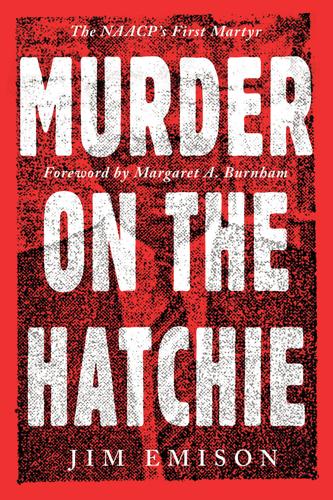
Murder on the Hatchie: The NAACP’s First Martyr by Jim Emison is a chronicle of “the Brownsville Terror” and its aftermath. Emison, a former trial attorney from neighboring Crockett County, has spent years investigating Williams’ death and promoting awareness of the case. Despite an FBI investigation and the efforts of the national leadership of the NAACP, including then-special counsel Thurgood Marshall, no one was ever prosecuted for the murder or held accountable for denial of the men’s voting rights, which at the time were protected — at least in theory — under two Reconstruction-era federal statutes.
Emison’s account is meticulously researched and backed up with 30 pages of endnotes. But the book is not dry or academic — far from it. Emison clearly wants readers to be moved by this decades-old injustice, and he delivers his narrative with a novelist’s care. The book opens with the discovery of Williams’ body on June 23, 1940:
The dead man had floated face down in the river for two days and three nights. His macerated corpse, bloated by the Hatchie’s turbid water and the summer’s heat, had been exhumed from its watery grave and laid out supine on the riverbank, sightless eyes fixed on heaven.
A man “of impressive size and strength,” Williams was described by a friend as “not easily intimidated.” He and his wife Annie had no children but doted on their nieces and nephews, treating them to movies and ice cream even as the couple lived modestly on $18 a week in wages from the laundry.

The prime suspect in Williams’ murder, a policeman named Tip Hunter who served intermittently as the county sheriff, was a small fellow with an “elfin and foreboding” expression. “Gray piercing eyes, sheltered beneath dark, arching brows, gave Tip Hunter the look of a predator and engendered fear,” Emison writes. Tip and his brothers were famously violent and racist.
Emison sketches the large cast of Brownsville characters and their complex relationships with a keen understanding of the web of power and dependency that exists in a small rural town. He makes it easy to see how the majority-Black population of Haywood County could be kept down by a white minority that held most of the wealth and was always ready to enforce the color line with ruthless violence.
But Murder on the Hatchie is ultimately about a much larger story than the individual victims and perpetrators in Brownsville. Emison wants readers to understand how white supremacy operated in 1940 and extended far beyond one tiny community in the South. Emison indicts a host of villains for the failure of justice in this case, including U.S. Attorney for the Western District of Tennessee Bill McClanahan and FBI director J. Edgar Hoover, as well as U.S. Attorney General Francis Biddle — a supposed liberal on race who nevertheless appears to have “ditched,” as Emison puts it, the Brownsville voting rights cases the Department of Justice had actively pursued for the better part of a year. The reason for the abandonment is a mystery, but the author points his finger at Tennessee’s U.S. Sen. Kenneth Douglas McKellar, a Memphian and Boss Crump ally who was no friend to civil rights and had enough political influence to pressure Biddle.
Though he doesn’t quite qualify as a villain, NAACP executive secretary Walter White comes under harsh criticism for the national organization’s failure to support its Brownsville members. He made a series of blunders such as sharing information with McClanahan, who was, in Thurgood Marshall’s opinion, actively trying to stall any prosecution. In Emison’s portrait, White comes off as somewhat incompetent and insufficiently concerned about the danger Brownsville’s Black citizens faced.
In a “Postscript to America” at the end of the book, Emison writes, “White supremacy, the gaping crack in America’s foundation, skewed the original construction of our national home, and white supremacy deforms our national house still.” Given events of recent years, it’s impossible to argue with him. Nevertheless, Emison’s painstaking effort to tell the full story of Elbert Williams’ death and rebuke the powerful for their complicity is surely part of the work of reshaping the house we share. In her foreword to Murder on the Hatchie, civil rights expert Margaret A. Burnham says it well: “This book is the judgment Williams never received in a court of law.”
For more local book coverage, please visit Chapter16.org, an online publication of Humanities Tennessee.



Post a comment as anonymous
Report
Watch this discussion.
(0) comments
Welcome to the discussion.
Log In
Welcome to the discussion.
Keep it clean. Please avoid obscene, vulgar, lewd, racist or otherwise abusive language. Comments featuring hate speech or threatening or violent content will not be tolerated.
PLEASE TURN OFF YOUR CAPS LOCK.
Be truthful. Don't knowingly lie or mislead.
Be proactive. Use the “report” link on any comment that violates our comment policy.
Share with us. We'd love to hear your feedback.