
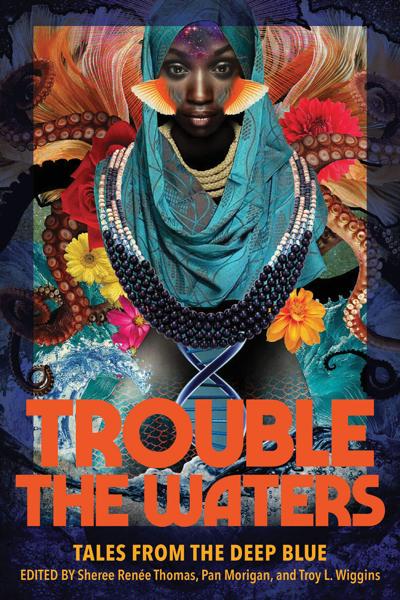


Trouble the Waters: Tales From the Deep Blue — a new anthology of speculative fiction co-edited by lauded Memphis writer Sheree Renée Thomas — celebrates the boundless wealth of creative sustenance offered by our world’s bodies of water.
Any anthology taking on a subject so vast and varied would require a nimble, thoughtful approach, clear about what mythologies and histories it evokes. This book communicates that rich, assured perspective from the start.
Thomas has received acclaim for her work in Afrofuturism, which includes sitting on the Curatorial Council of Carnegie Hall’s much-anticipated Afrofuturism festival in New York, which runs in February and March. She is the author of several books of fiction, most recently 2020’s short-story collection Nine Bar Blues: Stories From an Ancient Future. Thomas shares editorial credit with fellow Memphian Troy L. Wiggins — whose own writing focuses on Afrofantasy, comics and other aspects of the speculative-fiction world — and Canadian-American Pan Morigan, who writes and performs as a singer, composer, musical dramatist and author of surrealist fiction.
Hybridity, multivalence and shapeshifting of all kinds permeate Trouble the Waters from start to finish. This emphasis not only helps bring cohesion to this wide-ranging collection, but also underscores a powerful argument for our fundamental interconnectivity — with one another, with our nonhuman neighbors and with the environments that surround us.
But Trouble the Waters also recognizes that currents of peril run through this
storytelling lineage. The myths of changeable creatures that recur around our stories about our waterways can upend our sense of knowing who and where we are. “I was following the wrong legend,” says the narrator of Thomas’ compelling story “Love Hangover.” “Delilah was something else, something more ancient.” This anthology beckons us to follow its legends wherever they want to lead us, however disorienting or dangerous.
Each co-editor provides an introductory essay that’s as much an invocation as it is a preface. In his essay “We Are Called to the Water,” Wiggins links the fight against the world’s current slate of water crises to humanity’s ancient pull toward “water-based histories, myths, ideas and futures.” He describes these anthologized stories as “a clarion call to remember that human connection to water.” Facing contemporary crises, he reminds us, “We must look out on our own times with eyes as clear as the Mother Waters.”
Trouble the Waters’ contributors extend a truly global reach: Northern Ireland, Jamaica, Scotland, Nigeria, Iceland, Hawaii, Australia, Bolivia, Canada and far beyond. Whether invoking the voices of their ancestors or drawing from their contemporary surroundings, these writers bring the mythological, historical and aesthetic undercurrents of their backgrounds into the book’s larger vision. Their stories run the gamut of speculative approaches, boasting water-borne creatures, visiting ghosts, techno hybrids and trips to future centuries, to name only a few.
Stateside, the diversity of perspectives continues. Detroit writer adrienne maree brown brings the details of a city neighborhood to life through an indelible voice. Nashvillian (and Scene contributor) Betsy Phillips’ “Mother of Crawdads” crackles with inventive energy and wit. In “Spirits Don’t Cross Over Water ’Til They Do,” Memphis writer Jamey Hatley poignantly illuminates the memory-rich inner world of an American soldier in Vietnam.
Maryland-based writer Rion Amilcar Scott spins a riverside tale of water-women set in 1918. Jaquira Díaz offers a woman Marine’s riveting humanitarian mission amid a bombed-out tropical village. Poet Heather “Byrd” Roberts brings the collection to a powerful close with “Maafa to Mami Wata,” which engages the horrors that enslaved people experienced during the Middle Passage.
Thomas and her co-editors have imbued Trouble the Waters with an abundant, generous vision. That spirit yields a wealth of imaginative, entertaining storytelling that will please a wide variety of speculative-fiction readers. It may also provide a pleasing invitation to readers who are uninitiated in the genre but ready to get their feet wet.
For more local book coverage, please visit Chapter16.org, an online publication of Humanities Tennessee.



Post a comment as anonymous
Report
Watch this discussion.
(0) comments
Welcome to the discussion.
Log In
Welcome to the discussion.
Keep it clean. Please avoid obscene, vulgar, lewd, racist or otherwise abusive language. Comments featuring hate speech or threatening or violent content will not be tolerated.
PLEASE TURN OFF YOUR CAPS LOCK.
Be truthful. Don't knowingly lie or mislead.
Be proactive. Use the “report” link on any comment that violates our comment policy.
Share with us. We'd love to hear your feedback.