

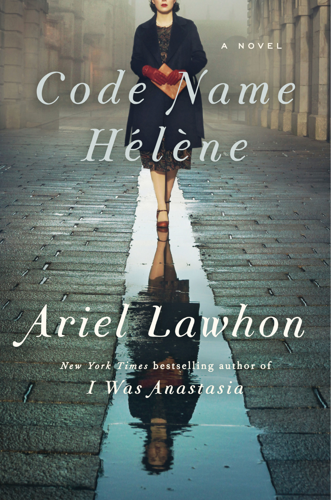

World War II heroine Nancy Wake should be so widely celebrated that whole bevies of schoolgirls dress up as this brave member of the French Resistance for Halloween. It’s a mystery — and a travesty — that she isn’t. But perhaps New York Times bestselling author Ariel Lawhon’s novel Code Name Hélène will finally bring her the recognition she deserves.

Lawhon’s exhaustively researched and vividly woven historical novel introduces readers to Wake, who was such a formidable force of nature that she led approximately 1,000 French Resistance fighters, became a critical Allied asset, and eluded the Nazis so effectively that she inspired the nickname “The White Mouse.” (The White Mouse is the title of Wake’s 1985 autobiography, which is currently out of print.)
In the 1930s, Wake was an Australian expat living in Paris. She had brilliantly bluffed her way into a journalism gig stringing for the European branch of the Hearst Newspaper Group. Well before the start of the war, Wake documented the depravity and revolting cruelty of Adolf Hitler’s private militia known as the Brownshirts. On assignment in 1934 in Vienna’s Old Square, she and her photographer witnessed the paramilitary group publicly and viciously torturing an old Jewish shopkeeper — something the Brownshirts apparently liked to do on Fridays before the beginning of Shabbat.
In the novel, as Hitler’s men burn the contents of Jewish shops in a massive bonfire, the Wake character describes an old woman “tied spread-eagle to the massive waterwheel.” She continues: “They turn her round and round as she cries and screams. Her long salt-and-pepper braids swish back and forth across her shoulders as her shawl drags on the ground beside her” before a Brownshirt attacks further. “There is a single crack, like the sound of a breaking rock, and then a red stripe opens across the old woman’s back, splitting her dress diagonally, splitting the air with her screams.”
Wake had to fight to get the article published, but when it finally appeared in the New York Evening Journal — her stories often were published in American newspapers — it wasn’t bylined. Failure to credit women journalists wasn’t an oversight but instead a purposeful and unfortunate reality for women of the time — a reality the hard-drinking, foulmouthed Wake character in the book characterizes as “bullshit.”
The fictional Wake’s response is no doubt true to life. Lawhon writes in her author’s note that the real Wake used profanity “Liberally. Unapologetically. And with flair. It was one of her greatest weapons in gaining dominance and respect with the Maquisards of the French Resistance. If she was to lead those men, she could not appear weak, delicate, or easily offended.”
The author’s note also painstakingly details the areas in the novel where any creative license breaks from Wake’s own accounts, those of her biographers or established history. Most of these are benign, meant to avoid disrupting the narrative. Others include educated guesses about, for example, the shade of Wake’s lipstick — Victory Red, an Elizabeth Arden shade the U.S. military commissioned for female servicemembers — which she continued to wear like “armor” even during the prolonged deprivations of war.
But, Lawhon writes, “some of the dialogue and many of the descriptions of people and events” are taken directly from Wake’s autobiography. And the most notable and important aspects of Wake’s life are mostly unembellished in Code Name Hélène, which is as much an epic love story as an engrossing narrative of an unlikely anti-Nazi combatant.
Lawhon, a Nashville resident, has proven herself a master at her craft, and she does readers a great service with Code Name Hélène, which she penned after a friend suggested a few years ago that she write about Nancy Wake. Like many of us, the author had not heard of the Aussie legend before 2015. “In all my years researching and writing historical fiction, I have never come across such a bold, bawdy, brazen woman,” she writes.
Wake died in 2011, only belatedly being awarded the decorations and distinctions she so justly deserved, including from France, the U.K. and the United States. Lawhon writes that when Wake was first recommended for commendation in Australia, the government refused because she had not fought for the Australian Army. When it backpedaled years later, Wake was famously quoted as saying, “I told the government they could stick their medals where the monkey stuck his nuts.”
To read an extended version of this review — and more local book coverage — please visit Chapter16.org, an online publication of Humanities Tennessee.



