
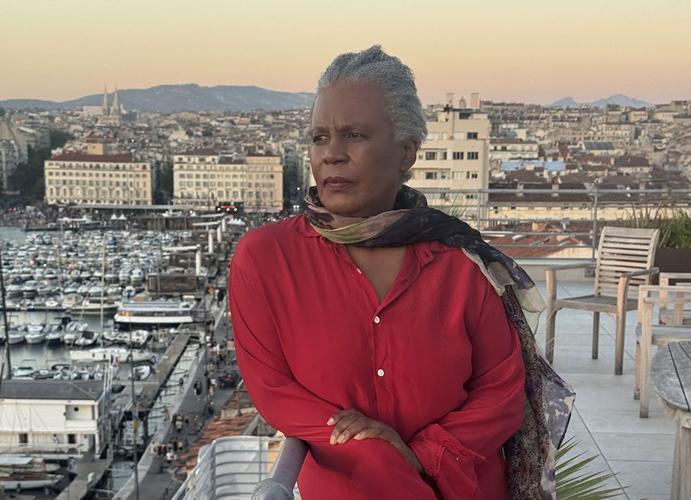
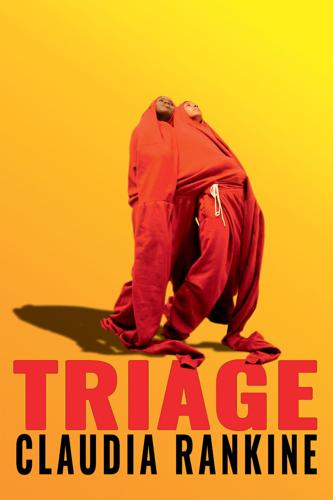
When you open a Claudia Rankine book, you never really know what genre it’s going to be — and thank the literary gods. In a world that seeks to return us to hard binaries of class, race and gender, the categorical fluidity of Rankine’s work is a reprieve.
This all makes sense, though, when you consider that Rankine is a poet, essayist and playwright. In her latest book, Triage, the Jamaican-born Rankine seems to move between all three. Extended memories read like soliloquy, effusive reflections on language like the linguist’s essay, and unindented (sometimes brief) paragraphs like stanzas in a poem. She explores the devastation in Gaza, Afro Caribbean womanhood, whiteness and other themes through the turbulent relationship of the narrator (or Rankine) and a nonbinary character called “the theorist.”
Those who have read Rankine — perhaps Don’t Let Me Be Lonely or Citizen, both from her American Trilogy — already know that when approaching her work, you should simply believe what she tells you. But the details she doesn’t give are not irrelevant; instead, they are almost like holes in the fabulation, a mesh that allows your ideas to enter the text.
This is to say that it does not entirely matter whether or not, in this work of nonfiction, the theorist is a shadow self of Rankin, a lover, or something of both. What we need to know is that the narrator and theorist experience a shared physical event they call “collapse.” As collapse repeats throughout the years of their relationship, we come to understand that we are all a collapsing of someone’s idea about us. Time collapses and we collapse time. The narrator experiences a time collapse between her mother’s journey to becoming a nurse and that of Mrs. Mary Seacole, who answered Florence Nightingale’s call for nurses on the British front lines and was met with racism.
Rankine writes of her mother, “She once told me she was treated so well as a child, she was unprepared for the cruelty of the world.” There are decades between the lives of these women, but in collapse’s hold, all pain is happening right now.
Rankine has these revelations as she gazes at two works of art, a photo and a sculpture at the Getty Museum in Los Angeles. It is imperative to note that this is a book in conversation with art, but the reader can scarcely forget that fact. Interspersed between the stanza-like paragraphs are the works themselves, including the sculpture in the Getty that the narrator struggles to believe has not been carved from her mother’s likeness, and a painting by Jennifer Packer, “Blessed Are Those Who Mourn (Breonna! Breonna!),” which unfurls across two pages.

Rankine’s words about the painting are soaked in the sour lime yellows that we see on the canvas: “Embedded in its quietude, in the oil and brushstrokes, resided a world, lonely and cold. The intangible, hanging low, grabbed hold. The colors black and blue found me, though the painting’s yellow covered everything.” She collapses again, into the cold yellow, but also into reflections on Breonna Taylor, dwellings and doors.
Rankine reminds us that she is a master of setting. With the aerial view of a playwright, she places the narrator and the theorist along river walks, in kitchens, falling into mattresses, couches, in cafes, standing in the living room reading love letters fermented by forgetfulness. In every scene, the reader is collapsed into their drama, and somehow, for the same reason that we are inclined to root for the odd couple in every television series, we hope that they can close intellectual distance and the ache of time.
We often praise a book as being “for everyone.” While that acclaim certainly applies here, the better reflection is that Triage is a book about everyone. We all exist, or have existed, in time. We have all loved. We have all known the world to be cold, whether by the absence of a beloved’s touch or the nuclear winter of war. Expansion has had its day. In collapse, we are spent of our own individuality. In collapse, time and our collective memory come together. And that is what we need right now.
For more local book coverage, please visit Chapter16.org, an online publication of Humanities Tennessee.

The 38th annual celebration of the written word takes place Oct. 17 and 18





Post a comment as anonymous
Report
Watch this discussion.
(0) comments
Welcome to the discussion.
Log In
Welcome to the discussion.
Keep it clean. Please avoid obscene, vulgar, lewd, racist or otherwise abusive language. Comments featuring hate speech or threatening or violent content will not be tolerated.
PLEASE TURN OFF YOUR CAPS LOCK.
Be truthful. Don't knowingly lie or mislead.
Be proactive. Use the “report” link on any comment that violates our comment policy.
Share with us. We'd love to hear your feedback.