

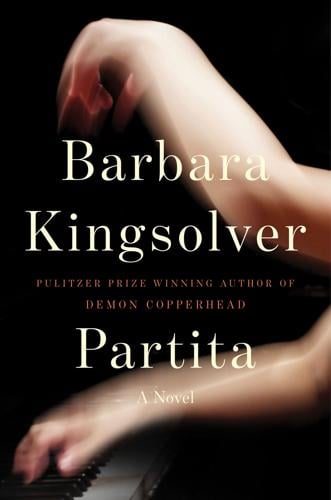

Barbara Kingsolver
The title of Pulitzter Prize-winning author Barbara Kingsolver’s new novel, Partita, refers to a musical “composition made of a lot of parts with different paces and moods.” As described by narrator Livia, a partita — like life — “will never be all happy rondos, or all andantes in a minor key.” For Livia, a pianist, as for Kingsolver the novelist, “the contrast is the point. The parts are all different, and the artist’s work is to make them all add up to a something that feels whole.” By that standard, Partita is a triumph.
Kingsolver splits Livia’s story into two timelines. In her peaceful current life, she is married to Charlie Cable, a good-hearted dairy farmer, and shares her musical passion through piano lessons for students from their East Tennessee community. In her tumultuous childhood, she overcomes the suicide of her beloved older brother and her mother’s abuse to pursue a career as a pianist by enrolling as a scholarship music student at the University of Indiana. Her college performances show promise until her life spirals out of control when she falls in love with Sigurd, a handsome labor leader. Their affair results in disaster, emotionally and physically, to the point where Livia must be carted home to heal her wounds.
The two plots converge when, after two decades of mutual silence, Livia receives a call from Sigurd. He’s in Nashville for medical treatment and would like to drive out to visit her. Livia’s first instinct is to say no. She and Charlie have worked hard to achieve stability, and she doesn’t want this cyclonic force from her past to damage what they’ve built. But as Livia recollects that traumatic year — 1989, when revolution spread over the world — she decides it’s time to make a final reckoning.
Kingsolver creates in Livia a character who embodies music. For her, playing the piano is not simply a cherished activity, but a mode of being. “When I’m playing, I’m not me anymore,” she tells Sigurd. “I go inside the music and disappear in there.” She compares the experience of performance to being “drugged” into a rapture: “The word I could think of, that seemed the right size, was joy.” Composers communicate directly to her soul. She feels reassured by Bach (“This all comes out all right in the end”), whereas Chopin’s preludes convey “the foregone conclusion” of romantic devastation, a feeling Livia shares: “We connected … across the centuries, one brokenhearted fool to another.”

Partita offers equally acute depictions of sexual attraction, as Livia’s instant connection with Sigurd turns into uncontrollable passion. She has one boyfriend before him, but the sex is tepid: “Even our lovemaking was on the order of what bread and cheese might do to conceive a sandwich.” With Sigurd, Livia burns to touch and be touched — “I can’t stand being separated from him by the width of a table” — and marvels at their chemistry: “The magic he worked on me, Jesus.”
Part of their intimacy derives from their shared blue-collar background, but for Livia it also partakes of the mysteries of art: “It was almost like discovering music again, to find that lovemaking could also hold so much more tension and release than I’d imagined.” Livia wonders if her musical ability contributes to Sigurd’s desire for her, and the evidence of later scenes indicates an emphatic affirmative. When he watches her perform Ravel in a private practice room, the novel lurches into E.L. James territory.
Livia deserves these moments of ecstasy, we feel, given how horribly her family has failed her. She recalls her mother’s abuse when she and her brother Cyrus were children, a “good day” being one when she used the leather end of her belt, rather than the buckle. As they grow, the mother resorts to emotional manipulation, accusing her of “putting on airs” and “tooting her own horn” when she expresses enthusiasm about music. Livia struggles to understand Cyrus’ decision to step in front of a moving train, leaving her defenseless against her mother and depriving her of emotional support. When Livia leaves for college, her mother turns her warped mind toward hoarding, filling their house with mounds of junk. At the same time she contemplates Sigurd’s return, Livia searches for ways to forgive her family and thereby relieve herself of the burden of the past.
At first glance, Partita presents Livia’s two major loves, Charlie and Sigurd, as a dichotomy, with security and comfort on one side and sexual fulfillment on the other. As the story progresses, though, the questions become more complicated. Kingsolver acknowledges, as she does in Demon Copperhead and Unsheltered, that romantic relationships cannot be separated from the times when we encounter them.
Mr. Right, it’s safe to say, is necessarily Mr. Right Now; everything else exists in the unreachable past or the unimaginable future.
For more local book coverage, please visit Chapter16.org, an online publication of Humanities Tennessee.

The 38th annual celebration of the written word takes place Oct. 17 and 18





Post a comment as anonymous
Report
Watch this discussion.
(0) comments
Welcome to the discussion.
Log In
Welcome to the discussion.
Keep it clean. Please avoid obscene, vulgar, lewd, racist or otherwise abusive language. Comments featuring hate speech or threatening or violent content will not be tolerated.
PLEASE TURN OFF YOUR CAPS LOCK.
Be truthful. Don't knowingly lie or mislead.
Be proactive. Use the “report” link on any comment that violates our comment policy.
Share with us. We'd love to hear your feedback.