
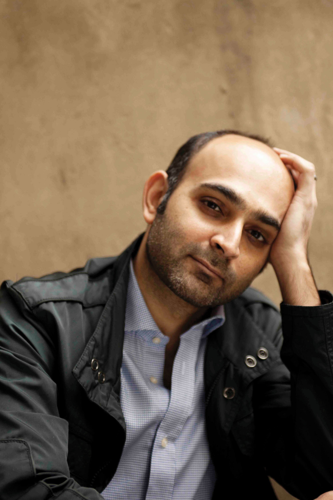
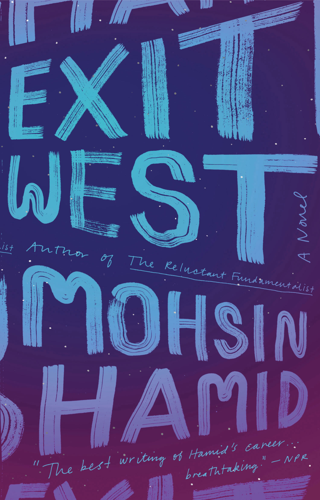


“We are all migrants through time,” Mohsin Hamid writes in Exit West, his fourth novel, a slender, poetic tale that packs a wallop as it traces the odyssey of two young lovers escaping their war-ruined city in the Middle East. Hamid comes by this sentiment naturally: Born in Lahore, Pakistan, he spent part of his childhood in the United States and was educated at Princeton and Harvard Law. As a writer, he has divided his time between Lahore and abroad — London, New York, the Mediterranean — and is a dual citizen of Pakistan and the United Kingdom.
In Exit West, a series of magic doors conveys Nadia and Saeed first to the Greek island of Mykonos and then to London and Northern California, with dread and desire as their traveling companions. A delicate weave of Narnia-like fable, shrewd observation and strikingly gorgeous prose, Exit West draws its power from the global refugee crisis, the erosion of traditional nation-states and their porous, often arbitrary boundaries. Hamid answered our questions via email.
Exit West pivots on some magic doors that ferry two young lovers away from a bloody conflict. You’ve used devices of magical realism before, even in novels that are fundamentally realist in nature. What’s the relationship between magic and realism for you?
I like to write fiction that is slightly skewed from consensus reality. Whether that is the surreal trial that frames my first novel Moth Smoke, or the doors in Exit West, I am always looking for ways to tell stories that feel more emotionally true by confessing to being made-up, make-believe. Writing isn’t reality. Writing is words. But reality isn’t reality either — what we call reality is often built on false assumptions. I don’t believe in magic, but I don’t fully believe in reality. So I try to abide by the laws of realism but bend them a little, here and there.

You use the myth-rich Greek islands as vivid settings for scenes in both Exit West and The Reluctant Fundamentalist. How have you been influenced by classical literature, Western and Eastern?
I first visited the Greek islands in 1993. I’ve been back many times since. They have an enormous power for me. They are beautiful, special places. I was fascinated with Greek mythology when I was a kid. Stories of Zeus and Hera jostled up against stories of Tolkien’s Middle Earth and stories of the Arabian Nights. I never really differentiated between classical literature and fantasy literature. I remain a fan of both. I’m re-reading the Iliad these days, and I’ve been watching Game of Thrones.
The novel’s final scene, set decades in the future, unfolds as both coda and benediction. In a political climate for refugees that doesn’t exactly engender hope, did you ever envision different fates for either or both characters?
I’m a father. Finding some way to be optimistic is part of the job description. But also I believe that critical optimism is a political necessity. Pessimism gives rise to nostalgic politics, and nostalgic politics tends to be racist, xenophobic, exclusionary, regressive and very, very dangerous.
This novel has been widely praised for its evocative depiction of the global refugee crisis, but it also suggests changes that await what we think of as stable populations. In your view, what should the West expect in the coming years?
The West as we know it will cease to exist. People (and ideas) from the East and the South will live in the West. And people (and ideas) from the West will live in the East and the South. What we call the West is a recent invention. Cities, humans — these exist. But the West is just an idea, and that idea is changing, dissolving, reforming.
Both Saeed and his father are sympathetic, complex men. In our #MeToo moment, I’m especially grateful for beautifully drawn male characters who are morally decent and aware. Is this something you considered as you wrote?
To be a man and gentle in times of great conflict and violence requires enormous strength. I wanted to explore that kind of strength, something different from the toxic masculinity that we are so often told is “strong” but is actually weak and harmful, to women and to men, too.
To read an uncut version of this interview — and more local book coverage — please visit Chapter16.org, an online publication of Humanities Tennessee.



