
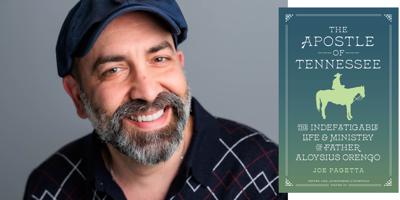

In The Apostle of Tennessee: The Indefatigable Life & Ministry of Father Aloysius Orengo, Joe Pagetta chronicles the work of a 19th-century Catholic priest. Father Orengo was born in the Kingdom of Piedmont-Sardinia, now part of Italy, and arrived in America in 1845. He spent the next 25 years traveling Middle and West Tennessee serving local Catholics, converting others to Catholicism, and building churches.
Pagetta is the director of communications for the Tennessee State Museum and frequently writes about Catholicism and his life. He answered questions via email.
You confide to the reader that after moving to Tennessee from New Jersey you recognized you’d need to intentionally cultivate your relationship to Catholicism. Did the experience of writing this book influence your connection to your faith or your connection to Tennessee?
Absolutely, it did both. While my formative years were spent in Jersey City, and I always include that fact in my bio, I’ve been in Tennessee for almost 30 years, more than half my life. Researching and writing The Apostle of Tennessee took me places and introduced me to people and stories in the state that deepened my connection to it. I feel great affection for the state and feel more like a Tennessean now than I did when I started the book.
Regarding my faith, the experience has deepened it. On a nuts-and-bolts level, even though they may have nothing to do with the book, I know now the names of certain vestments and architectural aspects of churches I didn’t know before. I was in the sacristy at St. Peter’s in Memphis when I learned about the sacrarium, a special sink that drains directly into the earth rather than the sewer so that when vessels or linens are cleaned, the body and blood of Christ return to the soil. I’ve been Catholic my whole life — I was even an altar boy for four years — and never knew about that!
What would you like the reader to remember about Father Orengo, and does this change depending on whether they are Catholic?
I’ve wondered if you must be Catholic to enjoy the book and Fr. Orengo’s story. I don’t think you do. My hope is that people remember his humility and his selflessness, his commitment to his mission and the people he served. His story is an American one, too: an immigrant who served mostly other immigrants at an extremely difficult and unwelcoming time in this country for both Catholics and immigrants. If you are Catholic and a Tennessean, I hope you remember him for the great tradition he established for us. Lastly, his indefatigability! And in the process, how to pronounce indefatigable.
In addition to writing, you produced the film A Grand Design: Captain Le Roy Reeves and the Tennessee State Flag, and you and your wife Keri produced The Passion of Ethel Rosenberg, a podcast based on a play. How does the medium affect how you tell your story?
I see film and podcasts as collaborative mediums. There are exceptions, but for me, you can’t really make a film by yourself. I had a vision for A Grand Design, a general idea in my head and then on paper of the order of things and what interviews and B-roll we needed and where I wanted things to go, etc. It was the talent that everyone else brought to it, however, that really made it work.
The podcast was a similar collaborative effort, even though we had Ed Morris’ script and Carolyn German’s original direction to work from. Keri and I, when we make the time while being parents and having jobs and our individual personal creative endeavors — she’s an actor, voiceover artist and co-producer of an independent film currently in post-production — are great collaborators.
Writing might seem a little less collaborative at first, even a bit lonely, but I’m still in some kind of dialogue in the process with God and with the eventual reader. I try to begin with what Ignatian spirituality calls colloquy, or an intimate conversation with God.
In Apostle you write, “As a second-generation Italian American, adding to the scholarship and accomplishments of Italians in America (and cutting down the Hollywood stereotypes) has always been a priority for me.” You’ve published several articles about the Italian American author Pietro di Donato, and now you’ve published this book. How will you continue your mission?
Before I signed the contract for The Apostle of Tennessee, I’d been shopping around a book proposal, unsuccessfully, for a biography of Pietro di Donato. I think he’s such an important and yet sadly unheralded American writer. I think putting him back into the conversation about our country’s great writers could really expand our history of Italian Americans. I hope to sharpen that proposal and get it back out there.
To read an uncut version of this interview — and more local book coverage — please visit Chapter16.org, an online publication of Humanities Tennessee.



Post a comment as anonymous
Report
Watch this discussion.
(0) comments
Welcome to the discussion.
Log In
Welcome to the discussion.
Keep it clean. Please avoid obscene, vulgar, lewd, racist or otherwise abusive language. Comments featuring hate speech or threatening or violent content will not be tolerated.
PLEASE TURN OFF YOUR CAPS LOCK.
Be truthful. Don't knowingly lie or mislead.
Be proactive. Use the “report” link on any comment that violates our comment policy.
Share with us. We'd love to hear your feedback.