


"Doilies (HIV)"
Brooklyn-based artist
Laura Splangave a talk at Austin Peay on Wednesday evening titled “(Re)Materializing the Biological Imagination.” Splan is interested in re-contextualizing and re-imagining familiar objects of the home as they relate to the body. Fascinated by the molecular structures of viruses, the history of medical instruments, and the details of human anatomy, Splan is attentive to both our obsessive cultural messages and personal ambivalence about the body. Her work makes visible the intersections of art and science, commenting too on socially constructed norms.
The APSU lecture room was packed, and Splan took us through her works piece by piece. Although her work navigates the crafting world in many ways, she told the audience she was much more interested in working by the light of the computer rather than the light of the fireplace. She claims the computer as her main medium, casting further complications on a desire for easy categorization.
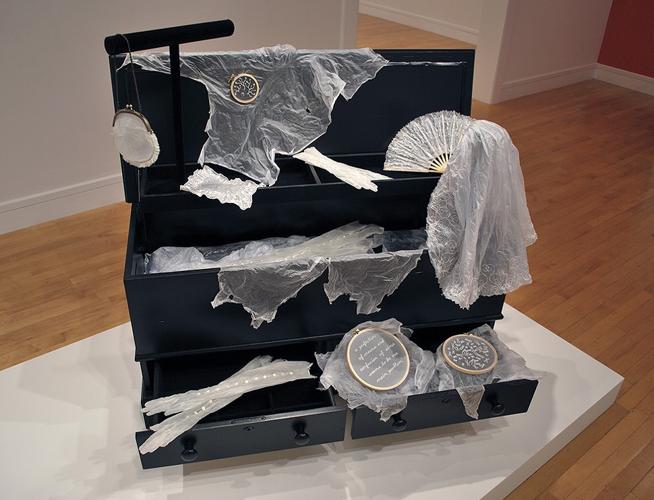
This defiance is necessary for Splan to make intersections visible. She sees things in the body that, on my own, I simply don’t — namely the possibility for fantasy, whimsy and play. This is best seen in her sculptures culled from used cosmetic skin peels. Splan described the process of covering her body in a facial mask, allowing it to dry, and peeling it off in one large “hide.” If you’ve ever used such a product, you know that what comes off is not something you want to, say, sew into underwear. It shows every goosebump, pimple, ingrown hair — basically all of your imperfections — in strips of water-soluble remnant. Splan used this as fabric to sew intricate lingerie and perform embroidery, camouflaging the clinical refuse as the dainty accessories of a Victorian lady. She goes even further than that. On “Negligee (Seratonin),” she embroidered the molecular structure of Serotonin; she embellished “Handkerchief (Human Tear Duct)” with a design based on the anatomy of tear ducts; and a motif based on the human retina is embroidered on “Fan (Anatomy of the Gaze).”

"The Trousseau"
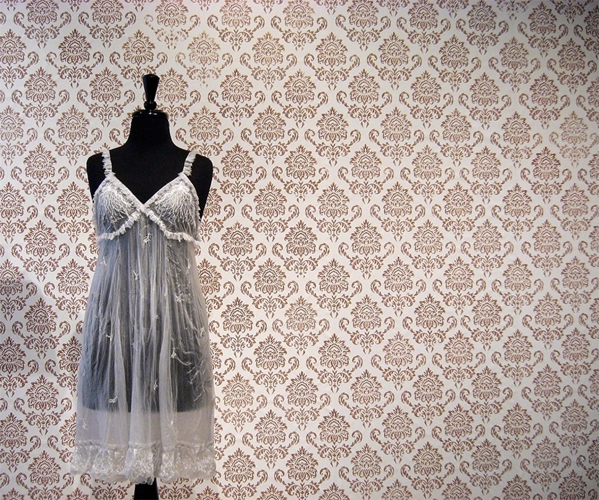
The use of her own body for materials does not stop there. In “Wallpaper,” she designs a traditional, decorative print that camouflages the material used: the artist’s own blood. Shown at the
Museum of Contemporary Craftin 2008 alongside “Negligee (Serotonin),” the design is imposing, and the print, as Splan described, insists its way out of the wall. This drew many questions from the audience, all of which I’m sure she’d answered before. If you’re curious, she usually pricks her fingers but sometimes uses a butterfly needle, and she needs an even smaller amount of blood than you donate in one sitting to the Red Cross. She adds an anticoagulant to keep it usable and sprays the finished designs with fixative.

"Wallpaper with 'Negligee (Seratonin)' "
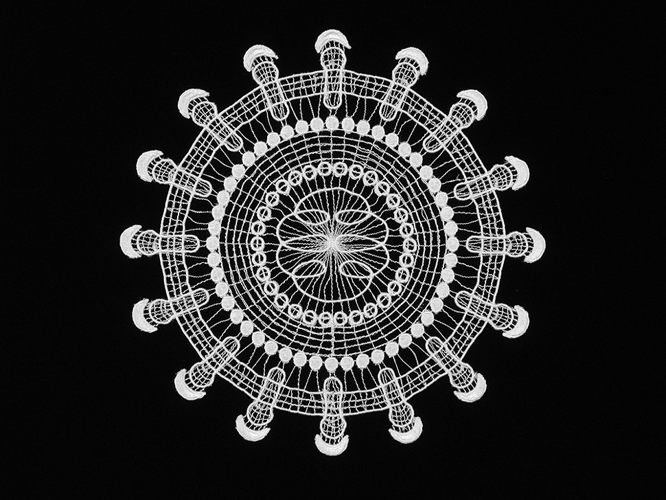
Splan is looking for ways that we can relate to our bodies through familiar designs and objects. If you’re picturing her huddled over an embroidery hoop, think again. Once upon a time, she used Babylock Palette 2.0; now, she uses Adobe Illustrator. Her graphic design skills are seen best in “Doilies,” which are embroidered from radial virus structures: HIV, Herpes, SARS, Influenza, and Hepadna are transformed into the innocuous household doily you might inherit from your grandmother. With these, Splan presses us to consider our cultural inheritance and the baggage we pass on within and about our bodies.

"Prozac, Thorazine, Zoloft"
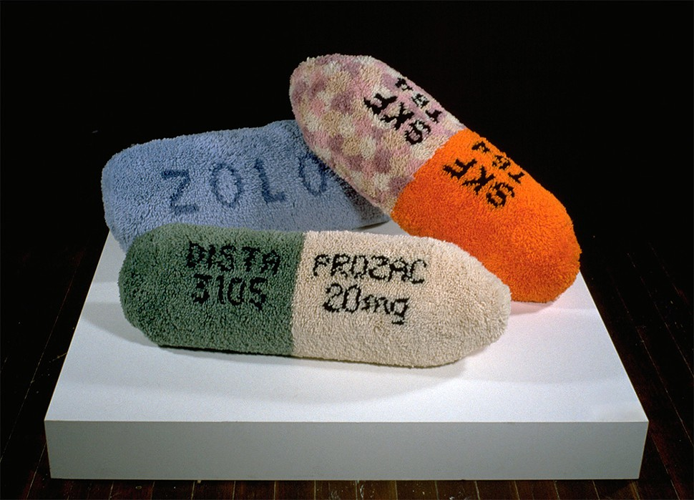
Splan has a wonderful dry sense of humor that appears in her sometimes deadly serious work. At the height of the Anthrax paranoia of 2002, she made latch-hook renderings of microorganisms, including Anthrax, Ebola and Smallpox. The title of these, “Vigilant,” recalls the U.S. government’s vague advice to its anxious citizens. Here, the innocence of the medium (latch-hook is the epitome of mind-numbing craftiness) meets the national anxiety of deadly disease and bio-terrorism. Also using a latch-hook, Splan made three-foot long pillows representing Zoloft, Prozac and Thorazine, drawing attention to our relationship with pharmacology. The prescription drugs are now just as much a part of our domestic landscape as a quilt or a crochet scarf.
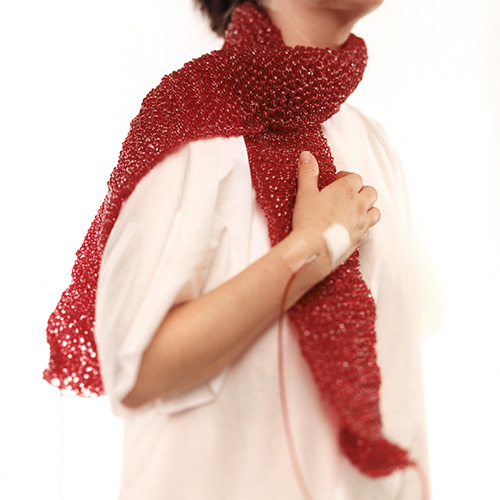
"Blood Scarf"
If you’ve gotten this far in my glowing praise for Splan, I will let you in on the real jaw-dropper from the talk. In the photo prints of “Blood Scarf,” a scarf is knitted from thin vinyl tubing that’s inserted intravenously in the wearer’s hand, filling the scarf with blood that in the end drips onto the floor. It paradoxically keeps the wearer warm even while draining her drop by drop. Made in 2002, Splan had no idea that people would view the photograph and think the Blood Scarf a plausible device. It’s Splan’s skilled use of Photoshop and her provocative imagination that allows us to indulge in the fantasy, and she’s shocked every time someone asks about physical garment. She certainly had me fooled.
It’s quite telling: Our biotechnical realities advance more each day, yet our perceptions of our bodies stay largely the same. By re-configuring familiar objects, Splan re-imagines the uses of the body. The talk was well worth the two-hour drive. The next morning, I cut my hand slicing a bagel and fainted.



