
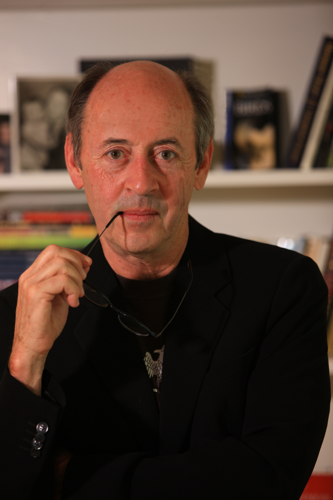

There may be no such thing anymore as a famous poet, but the winner of this year's Nashville Public Library Literary Award comes very close. Billy Collins is a frequent guest on National Public Radio shows like A Prairie Home Companion and Fresh Air, his readings pack halls that seat 2,000 people or more, and his books sell by the tens of thousands in a publishing climate where the print run for a new book of poems rarely exceeds 500 copies.
Collins served as poet laureate of the U.S. in the immediate aftermath of the 9/11 terrorist attacks, a time when, thanks to his guidance, many major media outlets quoted poetry more often than at any time since the 19th century. During his two-year stint, he worked tirelessly to bring home the point that poetry is not an effete art that exists as an endangered species in the protected cage of university English departments. Collins' own work is almost universally referred to as "accessible" (though he prefers the word "hospitable"), and the major effort of his laureate years,
Poetry 180, was an initiative designed to reintroduce high school students to the pleasures of poetry by divorcing poems from the anxiety-inducing act of enforced interpretation.
Collins recently spoke with us by phone from his home in New York.
As poet laureate, you launched the Poetry 180 initiative, in which you urged schoolteachers to read the poems to students without discussing them or assigning work related to the readings. What was your thinking behind that project?
Boys and girls often have the natural pleasures of poetry beaten out of them by the time they get out of high school. Two reasons why: forceful emphasis on interpretation, and using poems that are very dated — poems that were written a hundred years ago. The poems in Poetry 180 are funny and they're clever and they can pretty much be gotten in one hearing.
You recently told an audience at Cornell that "the trouble with poetry is its availability: You can pick up a 29-cent pen and express yourself. Self-expression is overrated. If I were Emperor of Poetry, I would make everyone learn to play the trumpet before they could write poetry, just to make it difficult."
What I meant in the comment at Cornell was the means of writing poetry are too accessible. In other words, if you were to play the cello, you'd have to obviously go to school and buy a cello and practice. Even oil painting or ballet requires lessons; you wouldn't just get up there and start jumping around in a tutu. And you wouldn't just pick up the trumpet and just blare into it. But [with] poetry, people think you just pick up a pen and start writing down how sad you are in the middle of the night, and add some autumn leaves and you've got a poem. The training in poetry is reading. Reading, reading, reading. Reading from Chaucer on. Reading the Spanish poets. Reading John Donne. Reading, reading, reading. Memorizing 10 Emily Dickinson poems. That's the training.
Entertainment Weekly once called you "the best buggy-whip maker of the 21st century." Any response to the accusation that you're really good at an art that's now completely irrelevant?
[Poetry is] a minority sport. It's not something that everybody plays. And the irony is that poetry really tries to talk to everybody, because poetry does deal with these very basic human emotions, and because poetry values subjectivity. It lights up inner parts of you — your appreciation of nature, your conscience, your desire for love. All these areas of your interior are being sparked by a poem, and so one might say, "Why doesn't everybody read it? It sounds pretty good." But most people don't. It doesn't play any part in most people's lives. All you have to do is say to somebody next to you on an airplane that you're a poet. You get some pretty strange reactions.
Readers coming to your work for the first time might be surprised to encounter so much wit, and even outright humor, in your poems. Do you ever find that people in your audiences, especially when you read to students, are shy about laughing at the funny parts?
They are at first, but they're relieved to be able to. And then for some people it's like giggling in church.
To read an uncut version of this interview — and more local book coverage — please visit Chapter16.org, an online publication of Humanities Tennessee.



