
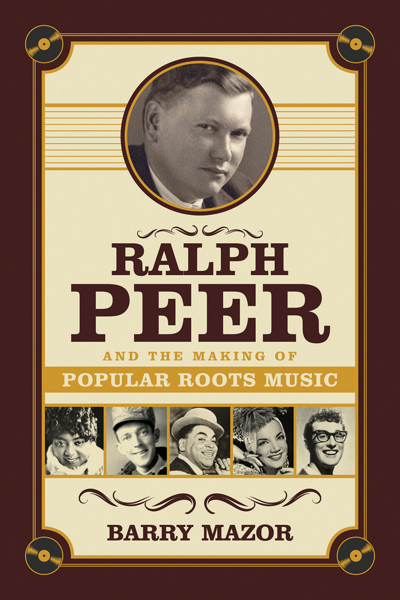

Barry Mazor's Ralph Peer and the Making of Popular Roots Music traces the life and career of Ralph Peer, who rose from Kansas City phonograph salesman to one of history's most influential A&R scouts, record producers and music publishers. At the beginning of the biography, it's hard to imagine how this working-class kid with a cherubic face and more interest in science than in music could possibly affect the evolution of American music as we know it. By the end, it's hard to imagine the history of recorded music — and country music in particular — without him.
Just perusing the list of performers Peer was involved with, as either producer or publisher, is enough to boggle the mind: Louis Armstrong, Jelly Roll Morton, Emmett Miller, Sara Martin and Sylvester Weaver, the Carter Family, Jimmie Rodgers, Hoagy Carmichael and Blind Willie McTell, to name a scarce few. The names are listed in a useful appendix, but the real magic is in seeing these many dots connected.
Nashville music journalist Mazor, the author of Meeting Jimmie Rodgers, brings the reader along to the recording of the very first African-American blues record, the creation of the Brill Building, the development of the stateside samba craze of the 1940s, the formation of the Country Music Association and beyond, all with an impressive command of the many overlapping narratives and a dry wit to match. There are frantic location recordings, altercations, divorces, lawyers sent roaming the country in search of the origins of "Home on the Range," and at least one incident in which Russian police seize sheet music because they suspect it contains coded messages — with Peer somehow always at the center.
If Jimmie Rodgers is the father of country music, then Peer — who recorded his first sessions, managed him as much as Rodgers could be managed and oversaw the revival of his legacy decades after his death — can be thought of as its midwife. The "Big Bang of country music," when both Rodgers and the Carter Family recorded for Peer in Bristol, would be accomplishment enough for most, but that event constitutes just one part of one chapter in this information-stuffed biography — one in which Mazor demonstrates his skill in managing multiple, sometimes conflicting, accounts of what happened.
Peer recognized early in his career that regional music, modernized and performed the right way, had an audience. But that's not the only way in which he was ahead of his time, as Mazor writes:
Most famously and strikingly, performers he was recording for race records would show up, credited or uncredited, on recordings by hillbilly artists recording in the same sessions. ... Blues guitarist and singer Clifford Gibson and the Louisville Jug Band featuring Clifford Hayes (who'd recorded for Peer at Okeh) both backed Jimmie Rodgers during his 1931 Louisville sessions — at which Peer was also recording those acts themselves. And he'd use virtually the same arrangement and musicians on "Please Don't Holler, Mama" with bluesman Ben Ferguson as he used with Rodgers and the jug band on "My Good Gal's Gone Blues."
Even so, Mazor is careful to place Peer's progressive attitude in context. "This is not at all to suggest that Ralph Peer was any sort of political or social activist concerning racial integration in music. Such activism was not his style," Mazor writes. "But presented with situations where it looked like the music and combination of players would work, he said yes, and openly so." Further, he doesn't let Peer slide when his attitudes are more reflective of his time, or even a little behind it. Referring to a conversation in which Peer describes Jimmie Rodgers as playing the "nigger blues," Mazor writes: "There he goes, in 1959, using the repugnant n word again, interchangeably in that conversation with 'Negro,' the generally accepted term of the time."
There are times when Mazor's prose is almost impossibly dense with references to singers, songwriters and song titles. But as the book goes on, the cumulative effect of all those interconnected histories becomes its own reward. At other times, Mazor inverts this mode of presentation by using a single song as a way of showing not only Peer's influence but the tangle of intersecting histories, legal claims and collective memories that muddle notions of a song as a single, stable entity. "Home on the Range" serves as one such example, as Mazor carefully lays out the story of the song and its various copyright claims. Peer made a career out of getting artists to write the definitive, copyrightable version of a song that had floated around campfires and living rooms for countless years, and Mazor does an excellent job of parsing that process, along with seemingly ho-hum music business basics like mechanical royalties.
Throughout the book, Mazor draws convincing parallels between Peer's time and ours. In November, recording engineer Steve Albini told the audience at the Face the Music conference in Melbourne, Australia, that the record business Peer grew up in and helped create is gone. "There is still an independent label network, but it's a slim fraction of what it was," Albini said. "The labels continuing to survive do so by supplying niche music to a discerning audience." Which is exactly how Ralph Peer got his own start.
How he took it from there is a thrill to read, and is wonderfully told.
For more local book coverage, please visit Chapter16.org, an online publication of Humanities Tennessee. A longer version of this review appears there.



