


There’s always been both a huge tie and somewhat of a disconnect between soul and country music. While there are certainly plenty of music fans who love both, there are also sizable portions of each constituency who regard the other with suspicion at best, and contempt at worst.
But no one would dispute that during the ’60s and ’70s, remarkable musical connections were made across those genres by black and white performers, musicians and songwriters. Charles L. Hughes, an author and assistant professor of history at Oklahoma State University, thinks that while there have been some exceptional books written about this period and music, there’s also a need for a different look at the era, especially in regards to race.
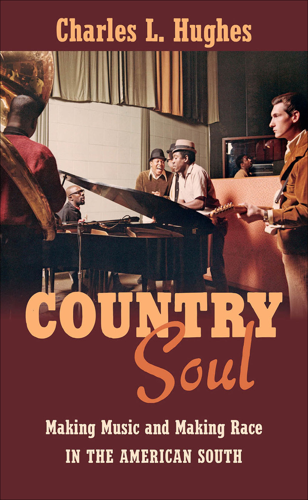
Hughes' new volume Country Soul — Making Music and Making Race in the American South (UNC Press) offers an alternative view of the complicated interactions of race, commerce and art in the most tumultuous days of the civil rights era, while discussing events and personalities in what he calls “the country-soul triangle” (the cities of Nashville, Memphis and Muscle Shoals, Ala.). He recently communicated with the Scene about the book via email.
You cite the works of three acclaimed authors on Southern soul, Peter Guralnick, Robert Gordon and Rob Bowman. It seems that you feel they've contributed somewhat to myths regarding the Memphis Sound. Do you consider their books overall valid and worthy?
Absolutely. Anyone who writes or thinks about American music (or simply loves American music) owes all three writers a tremendous debt, and I couldn’t have approached these topics without their foundational works. Guralnick is rightly celebrated for his many great books, and Sweet Soul Music remains the standard-bearer for books on soul music even though it was released over 30 years ago.
Bowman and Gordon have both contributed immensely to our understanding of Stax Records, each producing essential histories that everyone should read. (Gordon’s is also simply one of the best books on Memphis that I’ve read in quite a while, which is in keeping with his other great work on the area’s cultural history.) All three authors were an inspiration, and their works were all crucial resources.
Despite their strengths, I do feel that another interpretation is necessary, particularly in regards to discussions of the Memphis Sound’s racial politics. I’m trying to offer a counterpoint to the still-common notion that Southern soul studios — particularly in Memphis and Muscle Shoals — were a symbol of racial progress, or even a racial utopia, in the early 1960s.
There’s some value to this idea, certainly, but I think it needs to be complicated. Not only do I discuss racial conflicts that took place at Stax and elsewhere from the beginning, but I also try to complicate the idea that everything went bad in the late 1960s with the rise of Black Power and the assassination of Martin Luther King. I think there are serious flaws in this narrative, so I’m trying to add a new interpretation that will add to the conversation. My biggest hope is that my book earns a place on the same shelf with Bowman, Gordon and Guralnick. That would be a great honor!
The abilities of black musicians in the soul/country triangle are often undervalued, by your accounts. Do you feel that music executives like Buddy Killen, for example, ever truly considered these artists, or black vocalists, as equals, or was it strictly a profit/working relationship?
It’s very hard to judge what Killen (or other producers/record executives) personally felt towards artists, and it gets particularly tricky when considering the dynamics between white executives/producers and black artists. I think it’s absolutely fair to say that Buddy Killen (or Rick Hall, or others I discuss in the book) appreciated the artistry and talents of the black musicians they worked with. I also think it’s fair to say that there were often mutually good personal feelings between them. (Although that’s less common than we might think.)
At the same time, we have to reckon with the economic and working realities of the music business, and the fact that — in this story — most of the people who benefited most financially from the success of Southern soul were white men like Killen and Hall. They recognized the potential of selling records to black audiences, and they sought talented black performers who could break into that previously inaccessible market.
Their interest in black artists — even those whom they worked with as closely as Killen worked with [Joe] Tex, or Rick Hall worked with Arthur Alexander — was primarily to sell records. This didn’t equal a deeper brotherhood, despite what the myth-making would have us believe, and it led to some serious conflicts.
Despite the closeness of the two sounds, very few blacks have ever been successful as country performers. There is some resentment among contemporary black country artists I've met towards Charley Pride for — in their view — not helping bring more of them into the fold. Do you feel that's valid?
I hesitate to criticize Pride personally, just because he had a tremendously difficult path to navigate as he became the first hugely successful black country artist. As I talk about in the book, Pride was the subject of great debate and interest in the 1960s and 1970s, and he did a deft job of trying to embrace his fame while also ensuring that he didn’t alienate audience members either black or white.
At the same time, I do think that the larger criticism is valid, and Pride is the most obvious target. Despite Pride’s success, and despite attempts by Nashville-based record companies to find other black country artists in the wake of his success, the doors to major country stardom remained closed to most other African-American performers. As you’ve noticed, many black performers are critical of the way that Pride became a token or novelty, rather than a signal of a larger transformation.
The best example of this, which I mention in the book, is soul singer Bobby Womack’s 1977 album of country covers, which Womack originally wanted to call Step Aside, Charley Pride, And Give Another N- a Try. That’s the bluntest example of a wider belief that — even after Pride’s groundbreaking success — there was still only room for one black star in country music.
Would it be accurate to say that you agree with Rufus Thomas' feelings in regard to Sam Phillips — that he abandoned black performers to focus on white ones once he saw the money he could make with them?
It would be accurate. To be clear, I think that Sam Phillips not only respected black artists like Rufus Thomas, but also probably felt warmly towards them. But still, when he had the opportunity to make more money by recording a white artist with a black-influenced sound, he took that opportunity and stopped recording most black artists. That’s a common story throughout the country-soul triangle: Studios and producers that made their name with black music and artists shifted their attention to white artists once they had the chance.
The most obvious example — which I discuss at length in Country Soul — is Muscle Shoals, which became known in the 1970s for soul-influenced records by white artists, from the Osmonds to Paul Simon to Willie Nelson. This shift led to a reduced prominence for the black soul artists who had made the Shoals famous, and some black musicians complained about the lack of opportunities that accompanied the area’s shift to white performers.
As in the Shoals, Rufus Thomas believed that Phillips’ shift to white artists represented an abandonment of black musicians, and he wasn’t alone. It’s part of the broader story of racial discontent that we haven’t necessarily foregrounded in the way we’ve talked about this moment, and it’s a great example of the complexity of the relationship between race and music in Memphis, Muscle Shoals and Nashville.
How important do you consider Ray Charles' country recordings?
They are absolutely crucial. Musically, they are perhaps the most famous example of the deep musical overlaps between country, R&B/soul and pop music. The country-soul triangle was built on the hybrids between these genres, and Charles’ recordings are still some of the most striking examples of the way that these sounds can be blended and transformed. (They were also hugely influential on a wide variety of musicians, who cited Charles’ recordings — and the “Genius of Soul’s” career more generally — as a major inspiration.)
Commercially, Charles’ country records were a huge success that were celebrated by the Nashville country industry and also led to a large set of country albums by soul musicians, who hoped to follow in Charles’ footsteps. Everyone from Joe Tex to Millie Jackson cut country albums in the aftermath, and many of these albums are obvious attempts to mimic Charles’ successful formula. Charles’ country recordings are perhaps the best (and certainly the most commercially successful) example of the longer musical affinity between country and R&B/soul, and the moment in the 1960s when the country-soul interchange became central to popular music.
Do you think that there's still a kinship between black and country music today, or have contemporary developments eroded the ties?
There is unquestionably still a lot of influence of various styles of black music on contemporary country. The most obvious — and commercially successful — example is the influence of hip-hop, which has become so prominent through artists like Jason Aldean, Florida Georgia Line and others, and also fueled the “hick-hop” scene of Cowboy Troy, Colt Ford and others. (Plus there’s the broader influence of dance music, which traces to black house scenes in Chicago and Detroit in the 1970s, and has characterized hits by Taylor Swift and others.)
But many country singers are specifically influenced by the sound of Southern soul, with some artists (like Martina McBride or Buddy Miller) covering soul songs and incorporating soul sounds. Black music has been a crucial influence on country music since the very beginning, and — even as country music has become more and more associated with white identity, and specifically white conservatism — those influences remain strong. In Country Soul, I try to explain both the crossovers and the divergences between the genres in terms of sound and historical context.
What current artists exemplify this trend, if any?
There are many great contemporary artists who are exploring the overlaps between country and soul, and it’s no surprise that so many of them come from the studios and scenes of the country-soul triangle. Jason Isbell, Valerie June, Alabama Shakes, Chris Stapleton and many others are making great records that are clearly influenced by the music of the country-soul triangle. It’s so exciting to see a group of younger artists continuing those traditions, particularly when they’ve achieved a large audience. I think it speaks to the continuing power of this music and its sources.
Who would you consider the greatest artists/exponents of this sound?
Beyond Ray Charles, I think the artists that most exemplify the crossover between country and soul are Millie Jackson, Charlie Rich, and Jerry “Swamp Dogg” Williams. Throughout their career, these artists all explored the shared musical terrain between the two genres, and all found tremendous success doing it. (Rich’s soul-influenced hits like “Behind Closed Doors” are the best example, but Jackson hit the R&B Top 10 with a Merle Haggard cover, and Swamp Dogg co-wrote the Johnny Paycheck hit “She’s All I Got.”)
One of my favorite quotes in the book came from Jerry “Swamp Dogg” Williams, who said that he always used a lot of horns on his records because he doesn’t want them to sound too country. His reasoning wasn’t musical — he’d loved country since his youth — but rather that black musicians weren’t going to be successful in country even after the success of Charley Pride. I think that’s a really poignant reminder that many African-Americans simply haven’t had the opportunity to succeed in country, even as the musical overlaps remained so deep.
Were there any perceptions or notions you had going in about the links between soul and country that your research subsequently showed were false?
I think the thing that surprised me most was the level to which soul music transformed country music. I had some idea of the involvement of white musicians in soul music, and the influence of country on Southern soul, but it took me a while to recognize that this was really a two-way interchange from the very beginning. Country artists, musicians and record companies sought to incorporate the sounds of soul onto country recordings, and even hired many studio musicians from the soul scenes in Memphis, Muscle Shoals and elsewhere, who became key parts of the Nashville studio cadre. (Of course, for the most part, these musicians were white, part of the broader racial disparity that I chart in the book.) Realizing the two-way nature of the country-soul relationship, and the extent to which it was crucial to the history of country music in the 1960s and beyond, was a crucial moment for me in understanding the music and its cultural impact.
I'm sure there are many things you'd like for readers to take away from your book, but what would be the three most important ones?
That is definitely a tough question! First, I hope that readers finish the book with a sense of just how significant the musicians of the country-soul triangle were to American cultural history; they were pivotal actors in shaping the way we think and talk about racial identity in the United States.
Second, I want readers to appreciate the incredibly complex role of race in the production of their music. It’s still commonplace to hear people say that “race doesn’t matter” when it comes to music, whereas I argue that it’s actually the opposite. Nothing mattered more to these musicians than race, both in terms of the way we talk about “black” and “white” music and the day-to-day work of interracial ensembles in integrated studios. The fact that these musicians were able to acknowledge and confront these realities makes them even more remarkable, even if they didn’t always succeed in creating a racially equal space.
Finally, I hope that readers will realize the incredible wealth of great music that emerged from Memphis, Muscle Shoals and Nashville in these years. These cities transformed nearly every genre of American popular music, and produced a wealth of classic hits and even more fantastic cuts that are less famous. Although I couldn’t begin to talk about all of them in the book, I hope that Country Soul will encourage listeners — whether they’re fans or newcomers — to dig into the amazing legacy of the musicians that I talk about in the book. It’s one of the richest parts of our musical history.



