
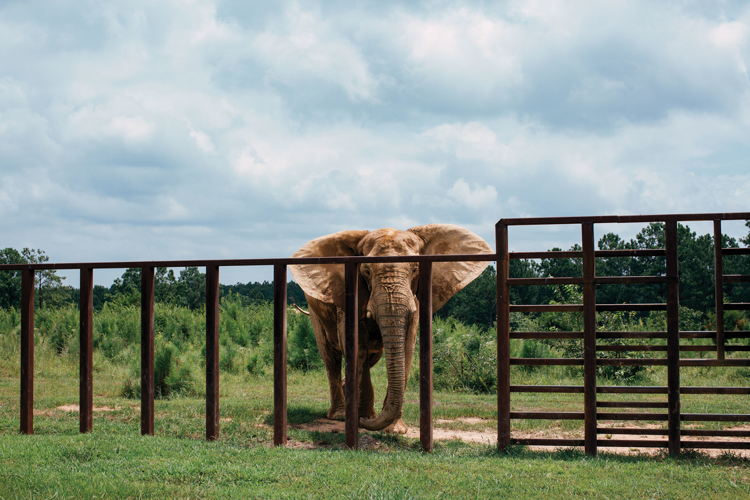
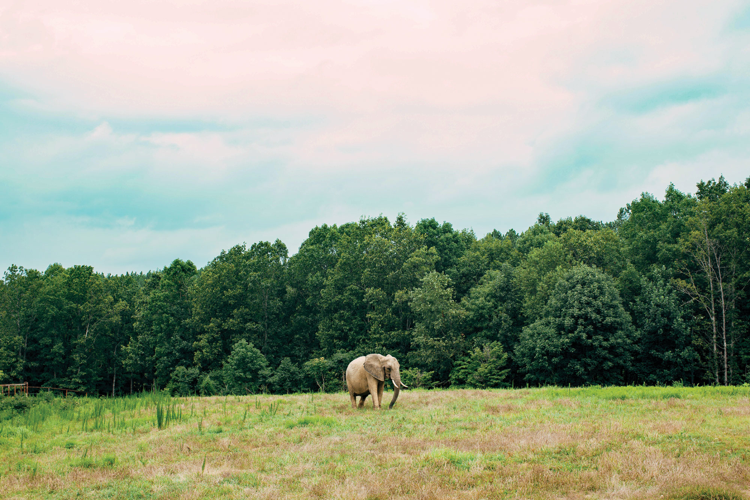


Flora at The Elephant Sanctuary in Hohenwald, Tenn.
Some call her Hurricane Flora — she leaves a path of destruction everywhere she goes. At 8 feet, 6 inches tall, the 38-year-old African savanna elephant mows down trees at The Elephant Sanctuary in Hohenwald, Tenn.
But for 18 years of her life, Flora wasn’t felling any trees. After being captured in Zimbabwe when she was 2 years old, she became the star of a traveling circus and performed in 1988’s Big Top Pee-Wee. As Flora got older, the man who owned her decided to let her retire, and The Elephant Sanctuary added Flora to their small African herd in 2004.

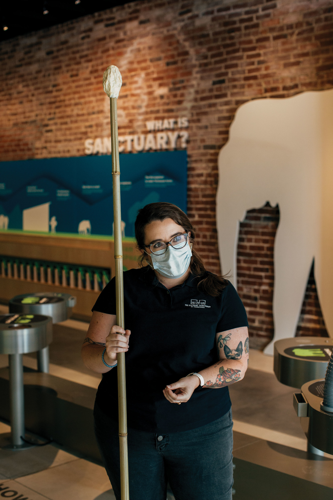
Education specialist Joy Owens holds a bamboo training pole in the Elephant Discovery Center
Joy Owens, an education specialist at the sanctuary, says Flora’s tree-felling habit is the kind of behavior that is common among her species in the wild. “It’s actually part of their ecological role in the wild to keep those savannas open and clear and grassy,” says Owens. “To see her doing this at the sanctuary is pretty incredible. Flora is a captive elephant. … She would not have seen her herd mates doing this. … That’s something we really like to see in all of our elephants — to see them kind of regain some of that wild elephant spirit and engage in those natural behaviors.”
The sanctuary sprawls across 2,600 acres in Lewis County. For the past 25 years, it has provided a safe, peaceful place for a total of 28 elephants who have lived for decades in captivity to finally rest and roam. It’s one of only two such places in the U.S.
The mission of The Elephant Sanctuary is twofold: to provide a safe, supportive environment for captive elephants to get the medical and social care they need, and to educate the public about the crisis facing elephants in the wild and the challenges they face in captivity. It’s a true sanctuary — it’s never open to the public, and the waitlist for volunteering is years long. The Elephant Discovery Center in downtown Hohenwald provides a place for supporters and students to connect, attracting visitors from around the world and hosting school groups from all over Tennessee. There you can watch three “EleCams” to see the sanctuary herds munching on grass or lounging in a mud bath, listen to the various sounds elephants make to communicate, come to understand the crisis facing elephants in the wild, and more.
While much of the world had to pivot to online activities when the pandemic started, the sanctuary’s education team members were already experts in distance learning. They host virtual classrooms with schools, libraries and civic organizations around the world, and they’ve seen an uptick in requests because of COVID-19. On Wednesday, Aug. 12, The Elephant Sanctuary will take part in World Elephant Day, an annual international event that raises awareness about the plight of the majestic mammals. To highlight the work contributing to conservation, the sanctuary will host Facebook Live sessions with five of its partnering organizations. At 10 a.m., you can hear from folks at Elephants Without Borders, the Botswana-based conservation agency on the front lines of managing the country’s elephant population. At noon, meet the sanctuary’s education team. At 2 p.m., learn about the Montana-based nonprofit Working Dogs for Conservation, which trains shelter dogs to sniff out ivory and weapons to combat poachers in Zambia. See the full schedule of virtual events at elephants.com/worldelephantday.

Nosey
The sanctuary is currently home to 11 pachyderms, who arrived there under varying circumstances. Some, like Flora, were voluntarily retired by their owners or by zoos. Others have sadder stories, marked by instances of abuse and neglect. Nosey, another of the sanctuary’s four African elephants, was seized by authorities in Lawrence County, Ala., after public outcry drew attention to her case. Nosey was the only elephant in the Liebel Family Circus for 29 years — her owner received multiple animal cruelty citations dating back to 1993. When Nosey arrived at the sanctuary, she was suffering from a painful skin condition that had gone untreated for years. It has now cleared up, but her custody battle continues in court.
The sanctuary practices protected contact — meaning that caregivers and elephants are always separated by fencing to keep everyone safe. Caregivers exclusively use positive reinforcement — never punishment — to train elephants to participate in medical care. Many elephants used in performances are trained with something called a bullhook — a medieval-looking cane with a sharp hook at the end. But at the sanctuary, keepers use a simple bamboo pole that’s topped with a wad of masking tape.
All 11 elephants roam freely in their habitats with optional use of one of four barns that is heated in the winter. Some, like Flora, love human attention — “she’s a little bit of a diva,” according to caregiver Jessica Burchard. But others, like Asian elephant Billie, took a long time to warm up to training. It was five years before Billie allowed caregivers to remove the last chain from around her ankle. “We do everything on elephant time,” says CEO Janice Zeitlin, referencing one of the staff’s favorite sayings.
“My background is as a social worker, and I specialized in attachment and separation issues, foster care and adoption,” says Zeitlin, who became involved with the sanctuary as a volunteer in 1997. “And that’s what we’re doing. We’re bringing unrelated animals together and trying to build a family, and the parallels are there. Building trust is important, having routines to build their trust is important. One of the biggest surprises is how much we can learn.”
Zeitlin says it costs around $50 per day to feed an elephant, and the 30 miles of secure fencing on the property cost $100 per foot to build. With a staff of 45 and an operating budget of $5 million per year, the sanctuary is funded by public support and grants.
Operations and outreach manager Todd Montgomery says he hopes connecting people with the sanctuary’s education programming will inspire them to take up the cause.
“If someone is thinking about going to a place to see a performing elephant,” says Montgomery, “we want them to say: ‘Now wait a minute. I know what an elephant needs. Is this elephant getting what she needs?’ And if the answer is no, then [we want them to think]: ‘Maybe there’s something I can do about that. Maybe I can contact my local representative, maybe I can write letters, maybe I can learn more.’ That’s the chain of events that we like to see happen. And it does work, because places have passed laws to protect elephants based on a better-educated populace asking those questions and having their voices heard.”



