
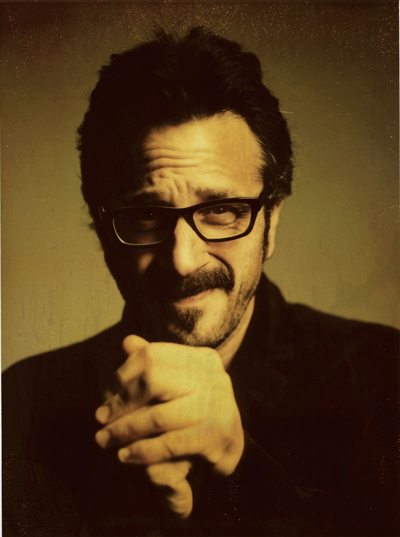

For most of us, WTF? is just another Internet acronym or lolcat caption, but for Marc Maron, it's a rallying cry, a call to arms, even a raison d'être. For two years now, on his twice-weekly podcast WTF With Marc Maron, he's been addressing that question (in one form or another) to the comedians and celebrities he interviews, society at large, and most frequently, himself. (In one memorable monologue, Maron admits to becoming enraged at a couple of pedestrians he almost ran over — for having the nerve to be in the path of his vehicle while he was texting and driving. WTF?!)
Maron describes himself as "first and foremost a stand-up comic" — he's performed on Comedy Central and HBO specials and Letterman, not to mention 46 appearances on Conan O'Brien's shows, more than any other guest — but it's his podcast that has earned him the most acclaim. After listening to an episode or two, it's easy to see why. Unrestricted by a five-minute late-night-TV time slot, he's free to let loose his unique brand of stream-of-consciousness rant, not to mention interview some of the greatest names in comedy — from current stars like Patton Oswalt, Todd Barry, Zach Galifianakis and Sarah Silverman to legends like Robin Williams and Jonathan Winters. He even interviewed watermelon-smasher nonpareil Gallagher, until Maron's blunt questions about Gallagher's racist and homophobic jokes had Mr. Sledge-O-Matic beating a hasty retreat out the door.
But for his loyal fans — whom he refers to as what-the-fuckers, what-the-fuck-buddies, what-the-fuckaneers, what-the-fuckericans and what-the-fuckonauts — Maron's appeal is much more than comedy. On WTF, getting laughs takes a backseat to having an honest, open dialogue with his guests, his audience and himself — about love, sex, comedy, neuroses, his pet cats, or whatever the fuck else is on his mind.
In fact, he's such an engaging interviewer that many listeners are surprised when they learn that at his core, he's still a stand-up comic — which is what brings him to Zanies this week. Prior to his engagement here, the Scene had an opportunity to speak with Maron about the success of his podcast, the notorious Gallagher episode, and the South's unique brand of integrity:
Have you played Nashville before?
Not in my recollection. I know I've been to Nashville once but I can't really remember what I was doing there. I think I was there for a Comedy Central event, but I've never played there before.
There's a quote on your website, "In the American South there is an ignorance that runs so deep it actually has integrity." What do you mean by that?
I think you know what I mean by that. Without deconstructing that quote too much, it is what it is. The South is known for what it's known for, for as long as it's been known for it, probably for a reason. There are plenty of people who say, "Well, but there's a lot of this, and a lot of that." But the heart and soul of what we've grown to know as the South, is sort of slow-changing. I'm not saying it isn't changing.
I grew up in a fairly integrated neighborhood in Cleveland, Ohio, but you go outside of Cleveland into some of the rural areas, and it can be almost as racist as the South.
But in the South, it's not just a surface thing. There's something ingrained in the culture that goes unspoken. The people that still speak of it, they shouldn't be, and it's very hard to justify that. But I think that the cultural and class dynamics of the South, whether or not there's a politeness on top masking it, it's still very much there.
I'm just trying to get people to come to the show. (laughs)
Has the podcast been the most successful facet of your career?
Absolutely. For whatever reason, having been a comic for 20-some odd years, and having done more television than most, it just never congealed in a large way for people who were taking in comedy. I was always a fairly respected comedian, and was always a little headier and darker than the rest of them — with or without politics, it's just the way I think — but I never really got a lot of traction with just my stand-up, despite the fact I appeared on Conan 40-some odd times, and Letterman, and HBO specials and Comedy Central specials.
The podcast is definitely the most important and best thing I've done, because if you listen to it, whether you like me or not, or whether you fast-forward through my monologue or not, it definitely is all of who I am creatively and intellectually. So if people are into that, they're genuinely into what I do. And given the format, I have a little more time to explore and talk.
I find that a lot of my new fans have never been to a comedy show. It's interesting that they never registered me as a comic, and some of them don't even really watch comedy. Because of the podcast, a lot of them have gotten into comedy, because they're being introduced to all these great comics.
Was there some pivotal point where your podcast really took off?
A few pivotal episodes brought in a lot of different crowds. The Robin Williams episode brought in a lot of people who had no idea what a podcast was, the Mencia episode brought in a lot of comedians. There are very few comics who don't listen to my show, specifically to hear their heroes.
In my mind, it evolved really as a community undertaking.
There were a few guys who were doing it long before anyone else jumped on board. Jimmy Pardo, Jimmy Dore, Kevin Smith, were doing it even before Adam Carolla moved into it. Once Carolla started, and moved from radio to podcast, he brought a lot of attention to the medium, and then a lot of people started jumping in.
The medium is very exciting. Who thought that there would be an Internet-based explosion?
There's a serious side to your podcast. You seem interested in digging deep. Is that unique among comedy podcasts?
Something's unique about it. I'm not hung up on getting laughs. I'm not hung up on doing something that sounds like a morning or afternoon radio show. I'm hung up on expressing my own particular inner dialogue that I think a lot of people share. It's my belief that everybody, with the pace and type of culture we live in, is just trying to get by. And that means there are a lot of things that remain unsaid. I'm just trying to say some of those things and share my own experience.
In terms of the interviews, I'm not hung up on what people are working on or plugging. I'm hung up on engaging in some sort of authentic conversation.
You analyze yourself a lot on the show. Do you find that cathartic?
I don't know if I focus on progress, but I think over the arc of the show, things have gotten much better.
It's cheaper than therapy.
Yeah, definitely. I get a lot of email about that. There are certain episodes that have helped a lot of people. I'll get emails, "Thank you, you really helped me, I was going through a hard time."
Do you feel like you can talk about comedians you don't like?
I try reframe it around the fact that I understand comedians, because I'm one of them. We're a catty bunch. There's no doubt about it. Obviously some comedy doesn't resonate with me, but if they're a successful comic, I have to remove myself from judging them. I can say, "It's not for me," or "I don't know your work," or whatever, but I'm not going to say, "That's wrong." I've been hard on prop acts, and on comics who I don't think take any risks.
Who are some of your favorite comics?
If I need a laugh, I'll listen to Brian Regan, Bob Schimmel. I get a big kick out of Todd Barry. Maria Bamford I enjoy watching. Certain people can take me a place where I laugh or get out of myself. I love watching Al Madrigal.
When you were growing up, who were some of your influences?
When I was very young I watched comics that my grandma liked. I liked Buddy Hackett, Don Rickles. I saw Jackie Vernon on TV, and I saw him live when I was like 12 or 13 years old. When I got older I had a lot of the George Carlin records, Cheech & Chong records. I had Woody Allen's stand-up record. I was very influenced by Woody Allen. The first season of SNL influenced me a lot. When I saw Richard Pryor's first movie it changed my fucking life. I spent some time with Sam Kinison when I was a doorman at the Store. He kind of fucked my head up for a year. I watched him a lot because I was hanging out with him.
Do you think being so open about your skepticism about relationships hurts your romantic prospects? Do you even give a shit if it does?
I'm in something now that's scary to me. It's a dangerous relationship, but I love her. She's much younger than me, and that makes me nervous, because I've been through that before. I'm trying, dude. I don't think it hurts anything. I can only do what I do.
Have women ever expressed being afraid they'll become fodder for your act?
Yeah, they all do. They all eventually become afraid. Everyone I've ever been with. I understand that. It's delicate. You have to figure out what you can and can't do. And when it comes right down to it, are you willing to risk the pussy?
I listened to the Gallagher episode. What surprised me is that I actually thought he said a few funny things. But he had no sense of humor about himself.
Yeah, it was difficult, and that thing got away from me. I never had much respect for the guy, but I tried to afford him the respect I'd give anybody. And then he started talking down to me.
And I came loaded. I wanted to confront him on this material that he was doing. I don't care what anyone says, I just wanted him to own it. The idea that he can go from being a clown to shitting on gay people seemed like an awkward jump to me.
I thought you were overly generous to him, and were actually too hard on yourself when you discussed that segment. I think he was just a prick.
I think that's right. And once I started taking it personally, it became a disaster. I still don't think he really needed to walk out.
Do you ever fear becoming a cranky old comedian, like Gallagher?
I have a lot of insecurity, and I'm pretty fucking hypersensitive. It's all about keeping your heart open a bit, and being as honest as possible. I hope I don't get my wheels stuck in the mud. That's usually what happens. You make some growth, and you start spinning your wheels again. I'd like to have some peace of mind eventually.
Email arts@nashvillescene.com.



Post a comment as anonymous
Report
Watch this discussion.
(0) comments
Welcome to the discussion.
Log In
Welcome to the discussion.
Keep it clean. Please avoid obscene, vulgar, lewd, racist or otherwise abusive language. Comments featuring hate speech or threatening or violent content will not be tolerated.
PLEASE TURN OFF YOUR CAPS LOCK.
Be truthful. Don't knowingly lie or mislead.
Be proactive. Use the “report” link on any comment that violates our comment policy.
Share with us. We'd love to hear your feedback.