

Walking into Sherrick and Paul Gallery to see Katy Grannan's photographs isn't unlike watching a film in an IMAX theater for the first time — except that the subjects of Grannan's photos, larger-than-life and crackling with supernatural detail, aren't action-packed summer blockbuster fare, unless your idea of action is big personalities posed against white-washed stucco building facades. But the 14 photographs in The Ninety Nine and the Nine are the best examples of portrait photography I've ever seen in Nashville. Bold statement? Perhaps. But Grannan, showing for the first time in the South, is a bold photographer.
The exhibit is culled from two different series of Grannan's work, both of which take their titles from the locations where they were shot. The Ninety Nine captures subjects along California's Highway 99, and The Nine is named after Modesto's South Ninth Street, along the banks of the Tuolumne River. Grannan shoots in midday, and the direct sunlight and heat — visible on her subjects' faces — function as the portraits' secondary characters. But the locations are not accidental — this is the territory of Dorothea Lange's famous Dust Bowl portraits, and Grannan, in re-examining that terrain more than 50 years later, makes herself the heir of Lange's examination of the vulnerable and the strong.
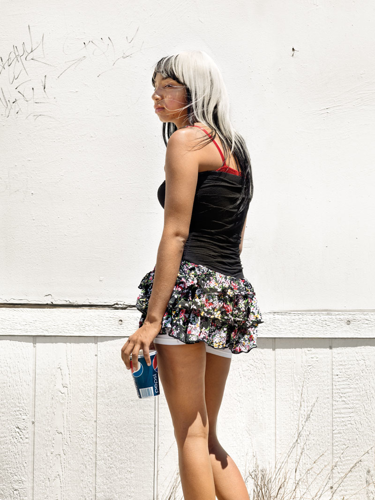
Most of the photographs don't name their subjects — titles simply feature the word "Anonymous" and the location where the photographs were shot. Several prints in the exhibit are titled "Anonymous, Modesto, CA," for example. In one, a youngish woman with caramel-colored hair beehived into an Amy Winehouse-like chignon is shot from the side, almost in profile, her layered neon tank tops in stark contrast with the matte foundation makeup, expertly groomed eyebrows and cat-eye eyeliner she wears like armor. Another shot shows an older man with slicked-back hair and the kind of cheekbones you don't often see outside of classic Hollywood cinema, a timeworn face and heavily tattooed body, with "Only the Strong Survive" in rocky cursive across his clavicle. With Grannan's sharp camera lens, these two work like contemporary cameo portraits, their subjects presented like modern-day royalty. The presentation isn't only in the subjects' pose and confident gaze, but in the precision of the shots. Grannan uses a Hasselblad model camera with a digital back, one of the most precise cameras available, to pick up details like the texture of the young woman's skin, every flaw magnified in the 55-by-41-inch print as if it were under a microscope.
The technical precision such a camera affords would make almost anything look seductive and intense, but Grannan chooses her subjects carefully. "Gale and Dale, Pacifica," a shot taken in 2007, simply features two androgynous women with their heads cocked together, one with an arm around the other. But the women are so filled with character that it's difficult not to weave a narrative around them. Dale's white-blond hair makes her look like an older version of Babes in Toyland's Kat Bjelland, and the yellowing bruises on her forearm and her hunched posture bring elements of melancholy to the photo, as does the single fly on Gale's wrinkled shirtsleeve. But the photo, even with its almost invasive clarity, never feels mean-spirited. Instead, the voyeurism involved in seeing people from such close angles seems more like intimacy than exploitation.
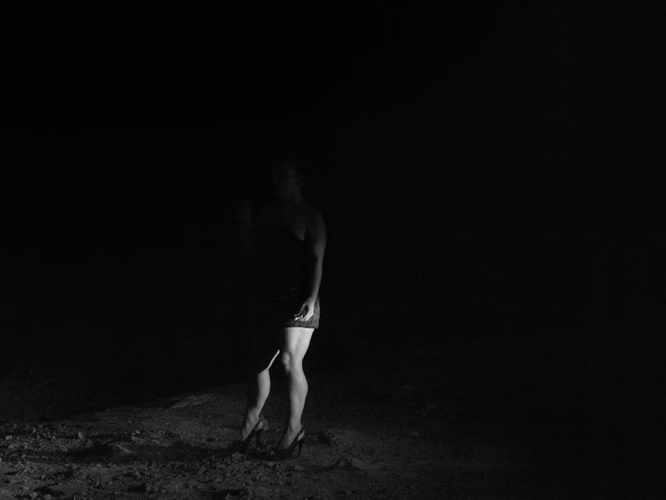
The first shot in the gallery was printed especially for the Sherrick and Paul exhibition — "Wanda Stands Alone Under the 9th Street Bridge, Modesto, CA," is an unusually atmospheric shot for Grannan that is more unlit black space than anything else. That is absolutely not a complaint — the small amount of subject matter is heightened by that absence, like a sexy woman who knows the value in leaving something to the imagination. The subject, Wanda, is a recurring figure in Grannan's work, and is a main character in her upcoming feature-length documentary, also called The Nine. Here, Wanda stands in slingback high heels on rocky terrain, her legs and little else illuminated from above. Perhaps because of the cinematic quality of black-and-white photography, this shot more than any other seems like a film still, a mysterious scene that would fit perfectly in a David Lynch film, if it were shot by Nan Goldin.
But the exhibit isn't only portraits, at least not in the traditional meaning. An enormous shot called "Man Walks Alone Through Empty Lot, Intersection of South 9th Street and River Road, Modesto, CA," is a strikingly detailed black-and-white urban landscape, and "Christ's Hands, True Love Family Church, Modesto, CA," is a close-cropped outdoor mural of outreaching hands. Both these shots ground the entire exhibit in a place and a state of mind — the empty lot working like a movie set for Grannan's cast of characters, and the hands bestowing them with divinity.
Email arts@nashvillescene.com



