
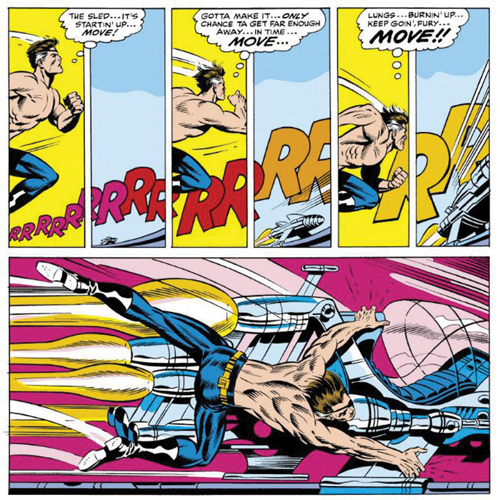
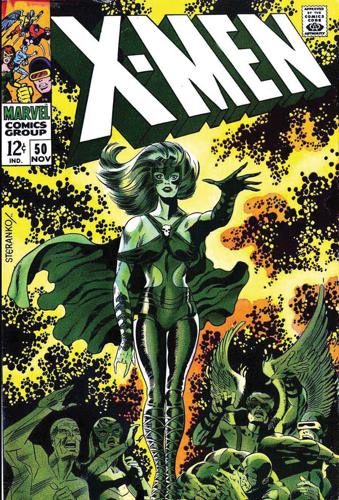
Bursting into the comics field in 1966 with his work on Marvel Comics' superspy, "Nick Fury, Agent of S.H.I.E.L.D.," Jim Steranko revolutionized comics with bold graphic design, elements of surrealism, op art techniques and mature storytelling. After just three years in mainstream comics, he moved on to book-cover illustration and conceptualist design for films (including Raiders of the Lost Ark and Francis Ford Coppola's Dracula). He also became a pioneer in independent comics publishing with his classic two-part Steranko History of Comics; one of the first graphic novels, Chandler: Red Tide; and his comics news magazine Comixscene, which expanded into covering general pop culture under the titles Mediascene and Prevue.
At 74, Steranko is still one of the most colorful, charismatic and multi-faceted figures in comics, with a life story that rivals his four-color creations. He continues tackling new projects and will be appearing at the Nashville Comic Expo this Saturday and Sunday at the Gaylord Opryland Resort. (Ticket info, schedules, and a full lineup of guests, including The Walking Dead's Steven Yeun and Lauren Cohan, Game of Thrones' Rory McCann and horror icon Robert Englund, can be found at nashvillecomicexpo.com.) In a recent email interview, he discussed his work.
In the past you've said that you wanted to make a statement when you entered the comics field in 1966. Did you have specific goals?
I had no thought of influencing comics. I was only interested in the challenge of a medium that intrigued me since I was a kid. According to my mother's baby book, I learned to read at a year-and-a-half by pointing to the word balloons in panels, which my mother would say aloud. That soon led to her pointing and me reading. So comics are in my blood.
You worked with several Marvel characters, but you're best known for your run on Nick Fury, Agent of S.H.I.E.L.D. How did you choose to work on that feature?
I walked into the Marvel offices cold at five minutes to 5 one afternoon with some story pages. [Chief editor] Stan [Lee] and I had an immediate rapport. He shuffled through my work and said it was "crude, but that it had something" he liked.
I asked what that was. "Raw energy!" he answered, and pointed to a rack on the wall that held all the month's comics. "What would you like to do for us?" he said. "Pick one!"
That's all there was to it. I could have nailed Spider-Man or Thor or the Fantastic Four, but that meant following Kirby. I might be crazy, but I wasn't stupid. I pointed to Strange Tales and said I'd tackle the S.H.I.E.L.D. series, which was a Marvel embarrassment — the word "wretched" comes to mind. I didn't mention it to Stan, but I figured that on this strip, there was nowhere to go but up! I was right. The rest is comics history.
You spent just three years working for Marvel full time and then moved on to other fields. Did you plan from the beginning to only work in mainstream comics a limited amount of time?
I had numerous careers before Marvel — rock 'n' rolled at location gigs five days a week; [Jack Kirby's] Mister Miracle was inspired by my daredevil escape stunts; advertising designer and copywriter; photographer; stand-up comic; carnival fire-eater — and knew comics were a stepping stone, but one in which I wanted to make a personal statement.
I pursued that vision with bloodthirsty passion — and undoubtedly sheer excess, too. Marvel was the maverick publisher of the period, but Stan and his editors had no interest in my experimental work, and the result was that I fought for every new narrative concept I introduced in my books, from lengthy silent sequences to four-page spreads. I generated 29 stories at Marvel, which experts claim showcased more than 150 innovations that had never appeared in comic books previously. Ironically, most artists only produce one or two in a lifetime of work, if that. Go figure!
I infiltrated the comic-book ranks and systematically violated their sterile and narcoleptic rules. Sure, it was deliberate, coiled defiance, but I was waging a cultural one-man war against the system. Did I win? No, but it's not about winning. In retrospect, I believe I may have administered an aesthetic transfusion that established an axis of modern narrative strategies and opened the door to the contemporary movement. Ultimately, the comics' booklet form smothered me creatively, so I moved on to work in other mediums.
What did you bring to comics from a personal standpoint?
I confess that I utilized and imbedded all my experiences — from switchblade fights in gang wars, to harnessing the raw energy of rock 'n' roll, to employing the secrets of magic (such as misdirection, visual puzzles, and disguise) — in my comics work. It's all implicitly autobiographical, one way or another.
What was the greatest difference between you and other artists working in the field at that time?
Before my Marvel tour, I was an art director at an advertising agency. As a kid, I learned to draw from comics, but that was ultimately morphed through my experiences as a photographer, typographer and designer. Conversely, my narrative techniques were entirely learned from film, especially during a period of my life in which I'd view three movies a day in theaters — and figured out how and why they worked. That resulted in my cinematic narrative technique, an approach that separated me from most others, whose direction was primarily influenced by newspaper strips.
The cinematic style I see most in your work is film noir. What are some of your favorite or most influential noir films, and how were you able to apply that style to comics?
Films that educated me the most would include The Best Years of our Lives, Treasure of the Sierra Madre, Champion, I Was a Fugitive from a Chain Gang, On the Waterfront, The Killers, Sorry Wrong Number, Crossfire, A Double Life, Laura, Body and Soul, Kings Row, Out of the Past, Journey Into Fear and Citizen Kane.
Storytelling is the most important aspect to me, specifically what's in a shot and how those shots are assembled. Mildred Pierce is probably the film that most informed my narrative sensibilities. From a tightly crafted script to unified cinematography, set design and editing, that picture probably encompasses 70 percent of everything I've learned about dramatic staging, lighting and character and camera movement. I lay this on director Michael Curtiz, whom historians have essentially forgotten, but who was easily the equal of Ford, Wellman and Hawks, and much better than Hitchcock, DeMille, and Lubitsch. Check out his pictures — The Adventures of Robin Hood, Angels with Dirty Faces, Yankee Doodle Dandy, Casablanca, The Unsuspected, Young Man With a Horn — and you'll see not only the basis of my storytelling style, but half of Hollywood's as well.
One of the best examples of your use of noir style is your graphic novel Chandler: Red Tide. Will it be coming back into print anytime soon, and do you have any new projects in the works?
Red Tide was the first modern graphic novel — in 1975 — which paved the way for today's material. I'm currently recoloring it with an advanced technique based on cinematic lighting, and Dark Horse will eventually publish it. And I recently signed a five-book deal with a major publisher, who'll be announcing the details soon.
Other than the satisfaction in your work, what did the comics field give to you?
Perhaps the biggest perk was being one of the architects of the Marvel Universe and becoming part of the brotherhood of comic-book creators, being tight with Jack Kirby, Bill Everett, Johnny Romita, Wally Wood, Al Williamson, Frank Frazetta, C.C.Beck, Jerry Siegel and Joe Shuster, Johnny Severin, Carmine Infantino, Alex Toth, and of course, my mentor Stan Lee — plus I've exhibited my work at more than 300 shows around the world, including in the Louvre in Paris. It's been a hell of an adventure.
Email arts@nashvillescene.com.



