
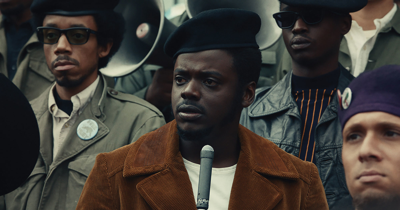


Here we go again with another fact-based movie about the Black Panthers that thinks people won’t be that interested unless it’s told in a pulpy, melodramatic manner.
Some of you may remember that Mario Van Peebles brought the story of Huey Newton, Bobby Seale and the Oakland-based Panthers to the big screen with 1995’s Panther, scripted by Mario’s legendary old man, Melvin. But that movie was told from the perspective of Judge (played by Dwayne Wayne himself, Kadeem Hardison), a Vietnam vet who joined the Panthers and was pressured by the authorities to become an informant. By the way, that character wasn’t really based on anyone.
Judas and the Black Messiah (which will simultaneously show in select theaters and stream on HBO Max beginning Friday) goes practically the same way, with an outsider infiltrating the Panthers and giving intel to people who want to take these righteous brothas and sistas down. This time around, the rat is someone who actually existed: Bill O’Neal (LaKeith Stanfield), a car thief who is approached by an FBI agent (Jesse Plemons, because of course) with an offer — he can either go to jail or infiltrate the Black Panther Party’s Chicago chapter, which is led by Fred Hampton (Daniel Kaluuya).
As someone who has followed Hampton’s life closely (check out Howard Alk’s outstanding 1971 documentary The Murder of Fred Hampton if you can), I would’ve just preferred a nice little biopic on the man. Kaluuya definitely comes to this thing with the sort of charismatic rock-star swagger Hampton had in his glory days. (Why the hell he got nominated for a Golden Globe for Best Supporting Actor and not as a lead is beyond me.) Rocking a beefy figure and an approachable cadence, Kaluuya is out to show how Hampton had the magnetism to get gangbangers, Puerto Ricans and even rednecks involved in his cause. But the movie also gives him a chance to present Hampton’s softer side, mostly through the scenes between him and his girlfriend (the terrific Dominique Fishback), also on the side of the Panthers.
The stuff with Hampton is so engrossing that it’s kinda unfortunate the movie also has to devote time to Stanfield’s two-bit, two-faced turncoat. Director Shaka King has no qualms showing how O’Neal (who provided the info that led to Chicago police killing Hampton in 1969) was a hustler — getting money from the feds for information and endangering his fellow Panthers — who realized too late that a Black man shouldn’t do that to his people. Until that happens, the usually mesmerizing Stanfield is forced to act weaselly and bad-tempered, doing everything short of letting his eyes dart around the room when people start talking about a rat being in their midst.
Judas often feels like two movies going on at the same time: an amazing one starring Kaluuya, and a bad one starring Stanfield. It probably won’t come as a surprise that this movie is actually a mash-up of two scripts: one written by brothers/stand-up comics Keith and Kenny Lucas and the other written by Will Berson. (They all share credit, along with King.) So it’s understandable why this movie is packed with so many ideas, including Martin Sheen popping up every now and then as a Negro-eradicating J. Edgar Hoover and comedian Lil Rel Howery coming out of nowhere as a shadowy pimp. (Kaluuya, Stanfield, Howery — man, Judas is a mini-Get Out reunion.)
At least this movie gives us a lot of powerful moments provided by Kaluuya. One scene has him walking up the steps to a cathedral’s stage, ready to spit Hampton’s own brand of gospel, like a veteran boxer preparing for a title bout. As much as Judas and the Black Messiah wants to present itself as a biopic dressed up in crime-thriller clothes, moments like this prove that this is still Kaluuya’s — and Hampton’s — show.



Post a comment as anonymous
Report
Watch this discussion.
(0) comments
Welcome to the discussion.
Log In
Welcome to the discussion.
Keep it clean. Please avoid obscene, vulgar, lewd, racist or otherwise abusive language. Comments featuring hate speech or threatening or violent content will not be tolerated.
PLEASE TURN OFF YOUR CAPS LOCK.
Be truthful. Don't knowingly lie or mislead.
Be proactive. Use the “report” link on any comment that violates our comment policy.
Share with us. We'd love to hear your feedback.