
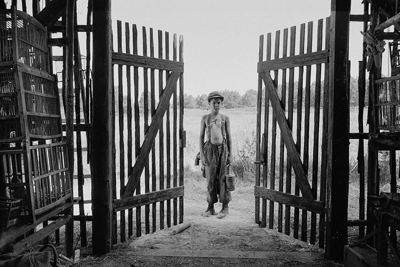


This film is too much. That’s certainly the point it’s making, and it does so with skill, style and an absence of pity or humanity. Very likely in the opening scene, you — the hypothetical viewer — will start asking yourself if this film is right for you. Call it a small act of mercy that right at the beginning, The Painted Bird offers you an exit. Its act of violence against a ferret is not actual, but it sets the tone for the next three hours, and you already know if that’s right for you; the arthouse equivalent of a frat dare.
There is no person or animal exempt from the tour of alienation and cruelty that follows. As humanity has demonstrated for millennia, from Neanderthal cave dwellings to the present day, human power structures are grotesque and numbing, and consciousness (in both senses of the word) is a battle against our tendencies toward entropy and routine.
The child Joska (Petr Kotlár) is buffeted through a cavalcade of atrocity that no one person could bear. This is a secular passion play, unfolding against Nazi occupation as a parade of every horror the 20th century perfected, and it unmakes a human being before our eyes. Maybe to undertake this journey will help someone face the horrors of right now; hopefully it will do that for whoever needs to travel this particular path. Adapter/director Václav Marhoul, working from an acclaimed novel of disputed provenance and authorship, has crafted a monochrome nightmare executed expertly — possibly, ideally, an exorcism of the worst of humanity. Is there some amount of naivete in thinking a black-and-white subtitled film (the first film shot in the Medžuslovjanski constructed language, among others) is going to break through when we’ve grown accustomed to seeing footage of police killing and brutalizing people on a regular basis?
The enduring, truly scandalous narrative films (documentary and snuff intertwine as a matter of course) always seem to be trying to address and exorcise some aspect of history or society that we do not speak of. Fascist excess recurs in the pantheon of the cinema of the truly disturbing, often represented as genocide, ritualized degradation, slavery — the callous exploitation and elimination of life. Salò, Emanuelle in America, Goodbye Uncle Tom, A Serbian Film — each of these works is fueled by deep philosophical horror, though each expresses that differently. Regardless of ideological aim or whether it’s meant for the arthouse or the grindhouse, each is remembered for its incursion into our collective cinematic awareness. They left their mark. And The Painted Bird does that too.
When this film premiered at the Venice Film Festival in September, audience members fled the screening. Artfully structured, elegantly shot and punishing to the extreme, it rewards endurance; to experience it and find your humanity intact is an achievement. The film is very much like society, and it teaches us how to watch it and how to respond to it. We expect violence, and torture, and cruelty, and the id externalized against whatever can’t get out of the way — and we are given that in abundance. There are moments of ravishing beauty and grace that we simply cannot appreciate. This film reduces experience to instinct — all is propelled by the expected knife, the imminent bullet, the clenched fist. It is a remarkable work that I never want to experience again.


Post a comment as anonymous
Report
Watch this discussion.
(0) comments
Welcome to the discussion.
Log In
Welcome to the discussion.
Keep it clean. Please avoid obscene, vulgar, lewd, racist or otherwise abusive language. Comments featuring hate speech or threatening or violent content will not be tolerated.
PLEASE TURN OFF YOUR CAPS LOCK.
Be truthful. Don't knowingly lie or mislead.
Be proactive. Use the “report” link on any comment that violates our comment policy.
Share with us. We'd love to hear your feedback.