


Warning: This post contains elliptical spoilers for Fantasy Island.
If you’re unfamiliar with Fantasy Island — the primetime anthology that ran on ABC for seven years in the long, long ago — here's the short version: People go to a remote island to experience a fantasy, but it’s almost always a "Monkey’s Paw"-type scenario where what you want and what you get do not necessarily align. Mr. Roarke, the island’s host, was a vaguely supernatural figure of indeterminate power, and some of your '70s and '80s favorites did all sorts of craziness therein.
So this new version, from Blumhouse Productions, brings a bunch of 20- and 30-somethings to a lovely Fiji location to take a journey into the absolute moral truth of themselves — and there’s lots and lots of hot people along for the ride. Some folks want revenge. Some want a chance to fix some mistakes they made. Some just want some glam in their life. And then there’s the audience, who just wants some thrills and chills. Well, it’s a tradition in all iterations of Fantasy Island that you don’t get what you hope for. For instance, Bear McCrary’s main theme has this lovely little synth glissando that never fails to make me think that the John Luongo remix of “Lose Your Love” by Blancmange is about to kick in, but it never does.
Blumhouse’s Fantasy Island is an incoherent text, and it’s impossible to tell if it was like that from the beginning or if that is the result of being bounced back and forth between too many cooks. Around about 75 or 80 minutes in, things start getting very weird, with the script piling on twists and reversals and shocks that cumulatively turn the story into a sloppy mess as well as unraveling every momentarily diverting thing that came before.
It’s like going through the season-opening course-corrections of five or six years' worth of a genre-based TV show, but it’s all happening in the space of a reel. Macho bullshit proliferates, with sub-’80s militarism (that really, really does not fit in any iteration of this film’s myriad narratives) and cocaine-ballin’ serving as a scaffolding on which some adjectives get hammered into vaguely human shapes.
If there is a truly noble pursuit in Blumhouse’s Fantasy Island, it would be in trying to diagram what all actually happens in this film. For a midbudget take on a somewhat beloved late-'70s/early-'80s weirdo property, this movie is so relentlessly complicated that it murders whatever charm it might muster before such a thing could even flower. This film is such a haphazard stack of nested fantasies it could be a Cinemax After Dark film if it took any joy in anything.
Is the narrative pileup of this film meant to represent the Pirandellian ménàge à gang that’s happening to the characters?
Director Jeff Wadlow has made several films in the past, none of them exceptional, but none of them egregiously offensive either (barring 2005's relentlessly terrible Cry Wolf). His enduring achievement is the climax of 2018’s Truth or Dare, which has one of the gutsiest and most interesting horror endings since Halloween III. The ultimate message of this film changes periodically — depending on whether Michael Rooker is around to underline some subtext — but what it ultimately settles on is twofold: that the responsibility of all bullies is to forgive themselves, and that victims need to grow up and move past their trauma. Which is deeply irresponsible, especially coming from a movie about a magic island that promises to learn you good about your own shortcomings as a human being.
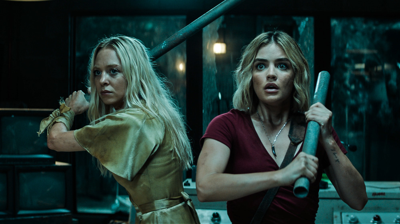
Ryan Hansen from Party Down has absolutely nothing to do, which is just saddening. Jimmy O. Yang gets a couple of good lines and has a palpable decency that makes what happens to his character not seem quite so horribly offensive. Maggie Q suffers, nobly, in a part that seems spliced in from a different, more somber movie. Lucy McHale does the best she can with a role inconsistently written to the point of exasperation. There are moments, though, when she has a Jennifer Jason Leigh-as-Allegra Gellar-in-eXistenZ thing going on, and you can feel the organizing spine of a strong will taking the muddled chaos of the part of Melanie and extracting something meaningful. But then the script shifts again, and it evaporates into Rise of Skywalker-level stupidity.
Blumhouse has done right by me in the past. The Happy Death Day diptych and 2019’s Black Christmas both did great jobs of incorporating diverse perspectives into traditional horror narratives. For all the internet-based hemming and hawing about Black Christmas '19, its problems had nothing to do with authentic voices — when you watch that film, you feel the genuine horror of women at the state of the world. The genuine and focused rage of BC19 is the most enduring (and endearing) thing about it. And that's why Fantasy Island seems so perfunctory. Every time it attempts to say something relevant about being alive, something unmakes it within the next 10 minutes, or there’s a double- or triple-reveal of a different dominant fantasy driving the narrative.
It’s weird how gayness is now allowed to be generic. It’s a perfectly reasonable choice for the most mainstream of genres, and it neither signifies nor represents anything. A character can be gay without having to do any emotional heavy lifting — it’s the Mrs. Dash of contemporary screenwriting. All it takes is abs and speedos, and there you have it, equivalent to tanned women with silicone breasts and feathered hair as representative of the finer things, as marketed to you, the viewer. There's a big kick in the soul at the very end of the film, wherein the aforementioned gay character gets talked into giving up his own life so his well-meaning but terribly defined stepbrother can be resurrected and returned to the outside world so he can get back the love of his life who couldn’t handle him opening up his home to his disowned gay brother. So the message of this film to gay people is Wouldn’t it be better for you to give up on the real world and remain in this liminal state of magic and mayhem so that the parents who disowned you don’t have to mourn your brother? Which is horrifying bullshit, especially when one gets the vibe that the whole reason this character was made gay in the first place was to motivate this choice and make things tidy.
The biggest problem with Blumhouse’s Fantasy Island — and this goes beyond representational endeavors and exploiting gay people — is that it ultimately reserves its sympathies for shortsighted idiots. It’s perhaps giving too much credit to the film to call these concepts "characters," and perhaps that’s meant as a criticism of the parades of guest stars who funnelled into the show back in the day. But there is such profound narrative incoherence around this film that you can’t ever really tell what the endgame is supposed to be.
Is this a twisty morality tale in which the selfish get punished? Is this a series of exaggerated tableaux meant to put flawed people through it and have them emerge on the other side as better human beings? Is this a tropical cash-grab? Is this a series of portraits of the flawed nature of the human animal, and how we’re irredeemable primates incapable of seeing how we fit into the lives of those around us because the world we live in has killed empathy dead?
Blumhouse’s Fantasy Island is all of those things at the same time. It is an incoherent mess, and it is fucking exhausting.



