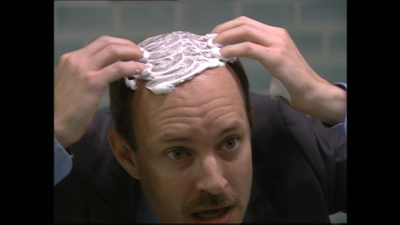


Director Jack Henry Robbins’ VHYes is like Amazon Women on the Moon or The Kentucky Fried Movie or UHF in the way it uses every form of discourse it can to address the joy of cultural detritus. It draws from everything that society currently enjoys, turning it all into a pointillist collage that aims to entertain in every imaginable way all at once. It’s a noble, giant-sized goal, and this brisk little film achieves it in a way that leaves you, as a viewer, refreshed, energized and ready to do some creating of your own. Whether it’s the emotional freedom of hosting a live music show with your parents, the horror of awful people in all sorts of positions of power, the liberating strangeness of the human body, or the physical limit of corporeal control, there’s something in this film that’s going to stay with you.
What makes this lo-fi, heartfelt whatsit of a movie so endearing is its willingness to embrace the schizophrenic, protean polyculture of modern pleasure and serve things up in a way that everyone — regardless of personal aesthetics, ideology or attention span — can identify with. VHYes is viral cinema both in its structure (countless differentiated shorts and segments that could be sliced out, decontextualized and offered for the delectation of the outside world) and in the way it sets up shop in the viewer’s subconscious and reproduces itself.
It’s Christmas 1987, and 12-year-old Ralph has just been given a VHS camcorder. (Reasonably) portable and not at that time linked to neck-and-shoulder strain and drama, this camera isn’t just a means to capture the minutiae of day-to-day suburban life. It can record directly from the TV, so the mysterious netherworld of late-night programming, forbidden to kids with bedtimes, is now only the press of a button away. All that is required is a tape — and Ralph has found one, unlabeled, with its safety tab still in place. And though we discover that Ralph is recording over the video of his parents’ wedding, unmaking the record of this cosmic event heralding the beginning of his own existence, there are many other mysterious forces afoot.
Robbins — who with his brother Miles (star of the sorely underseen Daniel Isn’t Real) is having a remarkably creative year — has a gift for texture and go-for-broke energy. Some of the segments of this film spring from shorts disseminated throughout the internet. The majority of them were developed and filmed as part of this project, but all of them seem genuine. These fragments work as delightful little snatches of thought and humor, but when taken as a whole, they feel like disparate elements that have actually begun to react to one another. It’s a strange mix of tones, and the fact that it works is a wonder — emotionally effective like some kind of miracle. Part of that is the remarkable array of a cast that the filmmakers have assembled (personal faves include John Gemberling, Kerri Kenney and Mark Proksch), but there’s a pervasive “let’s put on a show” energy in everything present.
For anyone who grew up with these kinds of camcorders as the height of personal technology, this is going to get automatic nostalgia points. But this isn’t an empty gesture — it specifically pinpoints the place in time when awareness, capability and monoculture intersected to make innovative minds take their own leap forward, and all before the democratizing expanse of the internet. And VHYes, in its 72 minutes, is a complex and delightful experience that simultaneously serves as a comfortable glance in the rearview mirror and a look forward into an utterly terrifying future.