
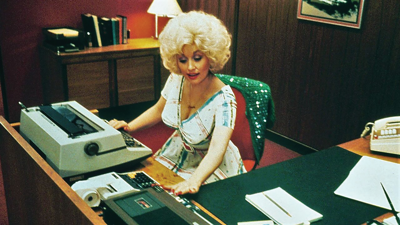


Few films are willing to delve deeply into the truth of the American workplace. Domestic cinema likes to treat work as an abstraction — a place for people to be when they aren’t at home, where something can happen to them. But occasionally a film gets real about what it means to be a worker in America, and Harold and Maude writer Colin Higgins’ 9 to 5 (co-written by Patricia Resnick) is one of them. (You could add Blue Collar and Alien to that short list as well, but for the purposes of this piece, let’s stick to 9 to 5.)
Even if it hadn’t been the motion picture debut of beloved icon and Consistently Best Tennessean Dolly Parton, 9 to 5 would have been an important moment in 20th-century cinema — as an exposé of the institutionalized sexism and corruption that still plague us as a society, as an insightful dissection of how marginalized people can be turned against one another by circumstance, and as a no-big-deal depiction of recreational pot-smoking by responsible adults with jobs. But would it have been as enduring (and endearing) without her? Dolly’s Doralee Rhodes is a kind woman, tolerant and always willing to give others the benefit of the doubt — even as she is mocked and exploited for her burlesque of femininity. But when pushed too far, she becomes a crusader for justice in the American workplace.
Along for the ride and turning in exemplary comedic performances are Lily Tomlin, Jane Fonda and Dabney Coleman. Each of the leads shines via a fully realized character, always funny even as they grapple with some unpleasant truths. Tomlin’s widowed single mother feels the grind of corporate America the hardest, keeping countless plates spinning but always willing to answer yet another phone call with the Zen mantra “Violet Newstead, please hold.” Fonda’s recently divorced Judy Bernly battles for her own independence on countless levels, exploring consciousness-raising solidarity with other exploited workers (not for nothing is her rage triggered by the firing of an associate for union organizing), and maybe even dabbling in “M&Ms.” And Coleman’s lying, hypocritical, sexist, egotistical bigot Franklin Hart Jr. is a cartoon who nonetheless incarnates the patriarchy’s bullshit on countless levels.
You know the song, immortal and constant. But if you haven’t seen 9 to 5 in awhile, do yourself a favor and catch up with one of the funniest, most enduring and radically political works of the ’80s. It shows Monday night as part of the Belcourt’s ongoing Music City Mondays series.



Post a comment as anonymous
Report
Watch this discussion.
(0) comments
Welcome to the discussion.
Log In
Welcome to the discussion.
Keep it clean. Please avoid obscene, vulgar, lewd, racist or otherwise abusive language. Comments featuring hate speech or threatening or violent content will not be tolerated.
PLEASE TURN OFF YOUR CAPS LOCK.
Be truthful. Don't knowingly lie or mislead.
Be proactive. Use the “report” link on any comment that violates our comment policy.
Share with us. We'd love to hear your feedback.