
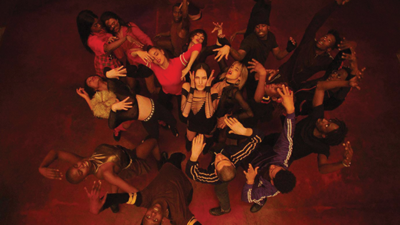


“It’s not a party until everyone gets broken.”
The troupe, nameless, is an astonishing gathering of dancers. Krumpers, voguers, p-poppers, ballerini — even what looks like some lambada and contra dancing surfaces among this dynamic, diverse group of young folks. Their production numbers are remarkable, an auspicious omen for their upcoming international tour, and the three days they’ve already spent working on this new piece in what looks like an abandoned French provincial school are yielding remarkable dividends.
And then, while having a little party to decompress, someone has put something in the sangria. Though we’re told it’s LSD, it doesn’t seem to work quite like that. No two people seem to have the same reaction, except that inhibitions and courtesy are severely diminished, and the basic instincts are emerging. Even the troupe’s DJ and moral center Daddy (house diva Kiddy Smile), who is simply everything (as well as style goals for every plus-sized individual who wants to make a tartan kilt, fake fur coat, and long, curly blond wig all work together), can’t keep the vibe from spilling over into something primal.
Politically, this film is a visceral indictment of tribalism and leaving emotions suppressed. Mythically — and possibly literally — it’s your classic Dionysian sparagmos carried out by the overly enthusiastic. It is most definitely a horror film about what happens when the brain is unlocked and the id is free to rampage. Writer-director Gaspar Noé (Irréversible, Enter the Void) specializes in emotional responses to difficult situations, and he’s in his element here as conductor and architect of the saddest kind of madness. (See our interview with Noé here.) Climax is no less extreme than any of his previous films, but it’s focused on the universal.
If as a viewer you don’t feel like digging any deeper than the surface, that’s OK. As with any of Noé’s films, the surface yields heaps of pleasures and perils. Some of the more negative reviews decry the film’s lack of subtlety, using phrases like “afterschool special” to try to encompass the journey into the hell of other people on display here, but subtlety in a film about artists and drug drama would be disingenuous. These are dancers, and it isn’t a stereotype to say dancers know their bodies. One can watch this film and think it’s reactionary and puritanical in its attitude toward drugs, but the key point is that these people were all dosed without their consent or knowledge. Again and again, the film comes back to issues of consent.
This is a situation in which (almost) everyone is all fucked-up and doing fucked-up shit, and amid the Sadean/Pasolinian array of cruelties and horrors, we see that possessory attitude toward another’s body and soul surface in nearly infinite variations. It starts with trash-talking sexual braggadocio and the laments of exes. But it expands, via the confidence of the entitled, or those who perceive themselves as irresistible. And then things get really bad.
No one in this film is really evil, but damn, if it isn’t easy for anybody to do evil things.
There’s a pairing of scenes that, if they aren’t already infamous, they soon will be. One is a shocking act of violence born out of the most petulant kind of ignorance, but what follows is a real-time demonstration of the death of empathy, as a group of friends and colleagues become a living comments section. It’s something everyone can relate to, which is staggering and deeply sad.
The music — exquisitely cultivated and spanning Giorgio Moroder, Soft Cell, Cerrone, Chris Carter, M/A/R/R/S, Aphex Twin and so many more — pounds relentlessly. The screams we hear in the background are diegetic, though they may also be those of rockists who find themselves in a film that eschews guitars. The visions we see delve into the unspeakable, those recovered Event Horizon transmissions at 130 bpm, and no one escapes unscathed. The approach masks itself as edgelord playful, but there’s a sadness for humanity that suffuses every frame; every hope undercut by the exterior world and the interior mind. Climax is alive and grotesque and deeply concerned with who and where we are.



