


“Darkwater Record,” Terry Adkins
Terry Adkins: Our Sons and Daughters Ever on the Altar is a big deal. And rightly so — the outsized talent, who died at age 60 in 2014, was a Fisk University alum, and yet this exhibit is his first in Middle Tennessee.="drop-caps">
It makes sense, then, that the exhibition should cross the city like a ceremonial torch. Starting on Feb. 20, you’ll be able to see Adkins’ work in Fisk’s historic North Nashville gallery as well as at the Frist Art Museum on Broadway. Joining Fisk and the Frist is the soon-to-open National Museum of African American Music, which is producing a multidisciplinary performance inspired by Adkins’ performance collective, the Lone Wolf Recital Corps.
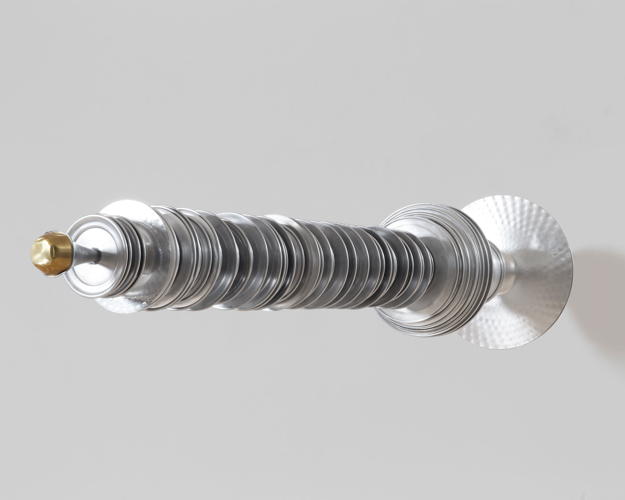
Adkins was a singular talent whose influence is evident in all that institutional support — everyone wants to be part of this show. A Washington, D.C., native, Adkins came to art-making naturally, and credited Fisk’s legendary Aaron Douglas — one of the forefathers of the Harlem Renaissance who taught art at the historically black college from 1944 to 1966 — with igniting his interest in visual art. Adkins’ work transcends disciplines, often incorporating the legacies of underappreciated figures in black history, especially when it comes to music. He even referred to his artworks as “recitals.”
“One of [Adkins’] primary aims was to forge a link between music and art, reversing each discipline in order to make sculpture more ethereal and music more concrete,” says Frist Art Museum curator Katie Delmez in the exhibition statement.
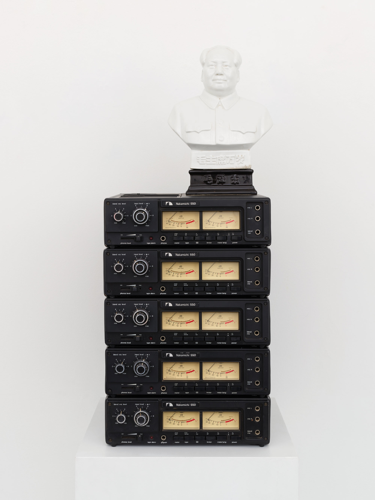
The works in the concurrent exhibits of Our Sons and Daughters Ever on the Altar pay tribute to the legacies of several influential black figures, among them Jimi Hendrix, Bessie Smith and W.E.B. Du Bois. Among the show’s 40-something sculptures, works on paper and videos, several are influenced by the artist’s experience in Nashville, specifically his time at Fisk. One of the highlights in the Fisk installment is “Darkwater Record,” which features a porcelain bust of Mao Zedong sitting on five recorders as they play excerpts of the Du Bois speech “Socialism and the American Negro.” An 1888 graduate of Fisk, Du Bois is perhaps the university’s most notable figure, and he met Chairman Mao in China in 1959.
Adkins was prolific, and the wide-ranging exhibits — particularly the Fisk installment, which stays up through September — will likely get the national attention the influential artist deserves.



Post a comment as anonymous
Report
Watch this discussion.
(0) comments
Welcome to the discussion.
Log In
Welcome to the discussion.
Keep it clean. Please avoid obscene, vulgar, lewd, racist or otherwise abusive language. Comments featuring hate speech or threatening or violent content will not be tolerated.
PLEASE TURN OFF YOUR CAPS LOCK.
Be truthful. Don't knowingly lie or mislead.
Be proactive. Use the “report” link on any comment that violates our comment policy.
Share with us. We'd love to hear your feedback.