
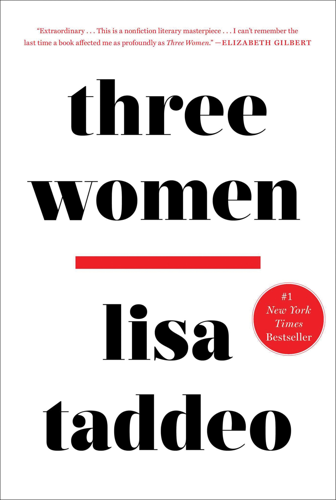
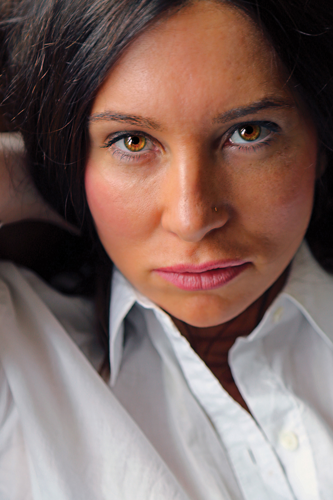

Lisa Taddeo set out to write a book about human desire. After spending nearly a decade driving across the country and conducting a broad spectrum of personal interviews, she found herself compelled to share what she found. Most propulsive were the stories of three particular women. The nonfiction book that emerged, Three Women, takes us deep into the worlds of Lina, Maggie and Sloane.
Lina is an Indiana homemaker, stuck in a sexless marriage. She wants out, so she initiates an affair with an old high school flame. When her passion is met with casual indifference, she is left in agony.
At 17, Maggie and her high school English teacher form a close relationship that becomes physical. After the teacher’s wife finds out, the relationship is abruptly terminated. Several painful years later, Maggie learns he has been named North Dakota’s Teacher of the Year, and she decides to come forward.
Sloane is a savvy restaurant owner living in an exclusive Rhode Island community. She’s considered very attractive, and her husband has no trouble recruiting other people to participate in consensual three-ways.

Taddeo meticulously reports on the desires of all three women in a way that feels revelatory — it’s so absorbing that it reads like a novel. Three Women is a journalistic feat, and easily one of the most important books of the year — it debuted at No. 1 on The New York Times Combined Print and E-Book Nonfiction bestsellers list, where it spent 11 weeks.
On Oct. 28 in Nashville, Taddeo will be in conversation with bestselling author Stephanie Danler (Sweetbitter). Danler’s reaction to the book was published in this summer’s issue of The Sewanee Review, where Taddeo is also a contributor (her forthcoming story “The Huntsman” will be published in this fall’s issue). In a first-time partnership, the evening will be co-presented by The Porch and The Sewanee Review and hosted at Bastion — a Wedgewood-Houston staple and purveyor of fine food and craft cocktails. Tickets are available at porchtn.org/events and include the fall 2019 issue of The Sewanee Review.
The Scene spoke to Taddeo by phone ahead of the event.
Three Women has been out for a few months, and you’ve done a lot of publicity for it. Now that some time has passed, are you in a different place emotionally than you were on publication date?
Honestly, it’s been go-go-go. I haven’t even really taken anything in, like, at all. Did I register that I was on the bestseller list? Yeah, but it’s just been insane. I’ve been working on planes, working on trains, working in the middle of the night, so I literally have had zero time to process. I haven’t had a chance to sleep, really.
My understanding is that your goal was initially really broad in scope — you had more than 30 subjects who spoke with you in depth, including men, people of color, and people in the LGBT community. Is it fair to say that Three Women was not the story you set out to write, but was the story that unfolded most organically for you?
Oh yeah, absolutely. I set out to write something that was wide-ranging. My proposal was like: “It’s going to be about 500 people from all walks of life.” Anyone who I spoke to for longer than three weeks to a month was someone who I considered might be in there. And certainly anybody whose city I moved into I considered as someone who might be included. It’s not even close to the book I set out to write. That said, I think it’s better than the book I set out to write.
I feel like we can’t ignore the privilege that comes with straight white women getting to tell their stories, though. What would you say to that?
I was looking for the whole income spectrum, the whole sexual-orientation spectrum, race, geography. At one point I was worried about not representing certain people because I felt by worrying about it so much, I would be trying to create this book that would check all these boxes. I didn’t know who was going to be in it, but I did know whoever was had to be emotionally raw. At the end of the day, these were the people who were the most blisteringly raw. They’re also the people who consented.
I’d like to talk about #MeToo, which, believe it or not, began as a viral hashtag exactly two years ago in October 2017.
It does feel like yesterday.
I was wondering if you remember where you were when it first happened.
I don’t remember where I was. I remember being confused because it started on Twitter.
I felt the same way. I remember scrolling through Facebook and seeing post after post and thinking, “No shit, duh. Me too.”
Totally, same.
I wasn’t thinking that it would become a movement because it just seemed so —
Obvious!
Exactly. You had done most of your reporting for this book before that happened. Can you tell me what that was like?
I had already submitted the book to the publisher when #MeToo came out, but I was still writing the prologue and epilogue. So I started writing [the #MeToo movement] into the prologue because I thought, I can’t ignore that this is happening. And my editor was like, “You know what? You wrote this before [the #MeToo movement], and I don’t think jumping on it now is right for the book.” And the second he said that, I thought, You know what, it’s so true. The media was talking about what women don’t want, and my book is about what women do want.
Can you talk about your relationship to The Sewanee Review? There are a lot of literary magazines out there, so what particularly drew you there?
They’re one of the oldest magazines. They’ve published great writers who have been around forever, as well as new voices who have never been published. And not only is it this legendary magazine, but it’s also now helmed by a modern, amazing writer, Adam Ross. I read Mr. Peanut when it came out several years ago, and I thought it was absolutely fantastic.
Speaking of Ross, he told me that the magazine’s subscriptions are up nearly 400 percent.
I think it’s because of him and what he’s willing to do. I feel like nobody, especially in literary magazines, takes chances anymore. For Sewanee to be fearless in publishing stuff that people haven’t seen yet, that’s huge.
I also wanted to talk about Stephanie Danler — have the two of you met in person?
No, we have not.
I feel it’s like a conversational match made in heaven. Her review of Three Women in The Sewanee Review was incredible.
Yeah, 100 percent. I talk a lot about how people who’ve read Three Women felt seen — I felt seen by Stephanie’s review. It felt great to have someone get the nuance of it, rather than talk about it in extremes, which a lot of people have done. It was just really refreshing and it made me feel really good, so I’m excited to meet her in person.


Post a comment as anonymous
Report
Watch this discussion.
(0) comments
Welcome to the discussion.
Log In
Welcome to the discussion.
Keep it clean. Please avoid obscene, vulgar, lewd, racist or otherwise abusive language. Comments featuring hate speech or threatening or violent content will not be tolerated.
PLEASE TURN OFF YOUR CAPS LOCK.
Be truthful. Don't knowingly lie or mislead.
Be proactive. Use the “report” link on any comment that violates our comment policy.
Share with us. We'd love to hear your feedback.