

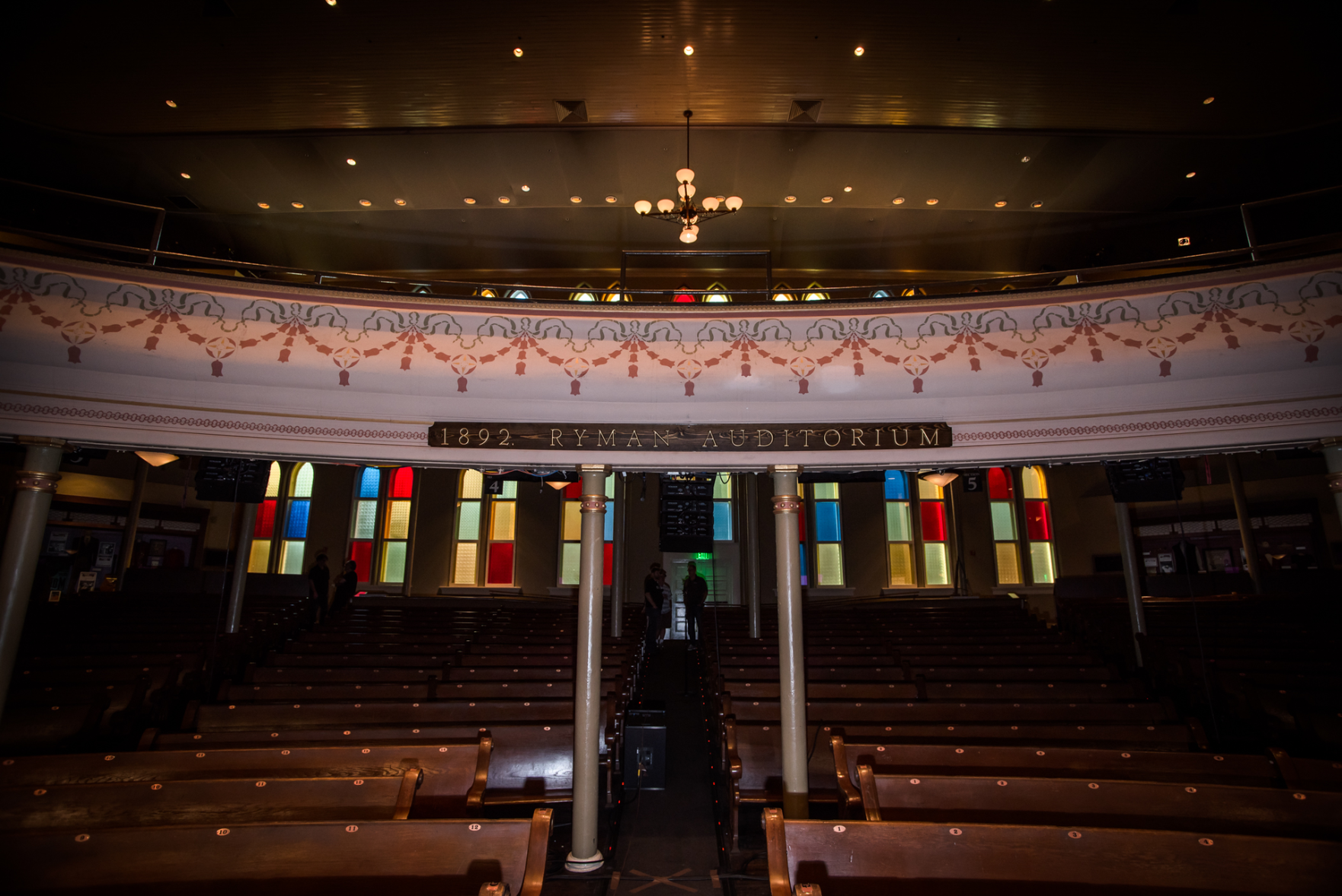
The current signage in Ryman Auditorium
For the past several years, there was no obvious rhyme or reason to the signage hanging from the upper level of the Ryman Auditorium, facing any performer onstage almost directly in the face.
One night it would read “1897 Confederate Gallery” and the next night it was “1892 Ryman Auditorium.” During higher-profile events — a 2008 John McCain campaign visit and the filming of a Netflix comedy special last year — the Confederate signage was typically covered.
But the selective concealment is no more. The prominent sign honoring an 1897 reunion of Confederate veterans at the Ryman has been permanently removed from the main auditorium and added to a museum exhibit that explains the history of the 125-year-old downtown music hall.
“If you come to the Ryman [as] a big name performer and you’re looking right out at the center of the balcony and you see that sign, you don’t know what it means,” says historian and Ryman consultant David Ewing, standing in the upper level hallway home to a large timeline of the auditorium and, now, the Confederate sign, accompanied by an explanation of its own history. “Or if you’re a fan that comes at night, not during the tour, you don’t know what it means either. This is the appropriate place to have the sign and tell the story of 125 years of the Ryman and particularly how the gallery got built.”
According to Ewing, the sign was added a few months after thousands of former Confederate soldiers gathered at the Ryman for their annual reunion. The Confederate soldiers wanted to hold their reunion in Nashville, which was that summer in the midst of the Tennessee Centennial Exposition, but the Ryman was not large enough to hold them.
To help attract the group, Belle Meade Plantation owner and Confederate Brigadier General William Giles Harding spearheaded a community fundraising campaign to build the upper gallery at the Ryman. The upper level had been part of Tom Ryman’s original vision for the theater, then called the Union Gospel Tabernacle, and the gallery’s addition would provide enough space for the Confederate veterans.
“If they didn’t come [to the Ryman], their Plan B — or maybe their Plan A — was they were going to go to the Centennial Exposition … and build a temporary building for them to have their three-day convention in,” Ewing says. “The temporary building would’ve cost a little over $2,000 in 1897 money, and they had budgeted that, and since they came [to the Ryman] they didn’t have to build a temporary building. After their convention was over, they were doing their accounting and they had $2,300 left in their budget, so they donated it to the Tabernacle because the Tabernacle built this balcony that cost $12,000. They kind of felt a moral obligation to give their remaining convention money to this.”
The sign now on display in the Ryman’s museum gallery is not the original one put up shortly after the Confederate veterans’ visit to Nashville, though.
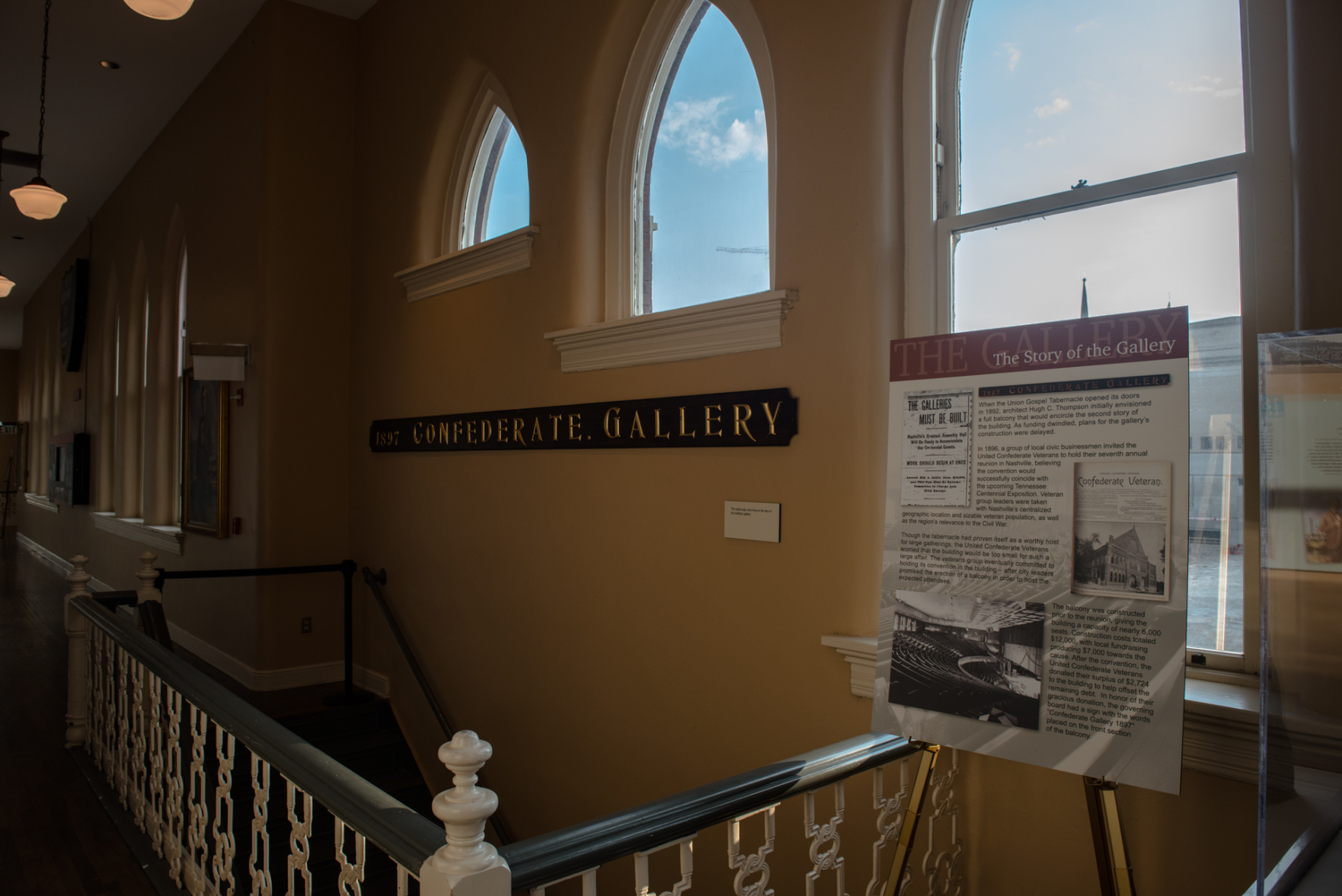
The new display for the Confederate Gallery sign
“We don’t know what happened to the original sign,” Ewing says, though he has a guess.
He says that the Ryman’s mostly dark period — between the Grand Ole Opry’s departure in 1974 and the 1994 renovation — was something of a free-for-all for treasure hunters.
“As a collector of Nashville memorabilia, I have seen curtain pulleys from the Ryman for sale, old radiators for sale, windows for sale, and it wouldn’t surprise me if during that time when there were scavenger hunters here, the original sign was taken by somebody, and it’s in somebody’s home right now on the wall.”
In 1994, when the Ryman reopened after major renovations, a reader wrote a letter to The Tennessean praising the work but asking where the Confederate Gallery sign was.
“I’m sure after seeing that, and maybe having some other calls or old-fashioned written letters, Gaylord probably decided to reproduce the sign and put it back up where it was,” Ewing says.
Part of the allure of the Ryman stems from its remaining historic features. The steel beams that support the upper gallery are the same ones installed by the Louisville Bridge Company in the 1890s. The pews installed by the Indiana Church Furnishing Company remain the same — they’ve been cleaned of chewing gum stuck underneath them over the years, but not of the nicks and scratches left by decades of music fans.
“This is how it looked, this is how it sounded, and this is why people want to come to perform and hear concerts here,” Ewing says.
But one thing has changed: A group of Confederate veterans who spent three days at the auditorium more than a century ago are no longer honored with a prominent marker staring the musicians who take the Ryman stage in the face.



