
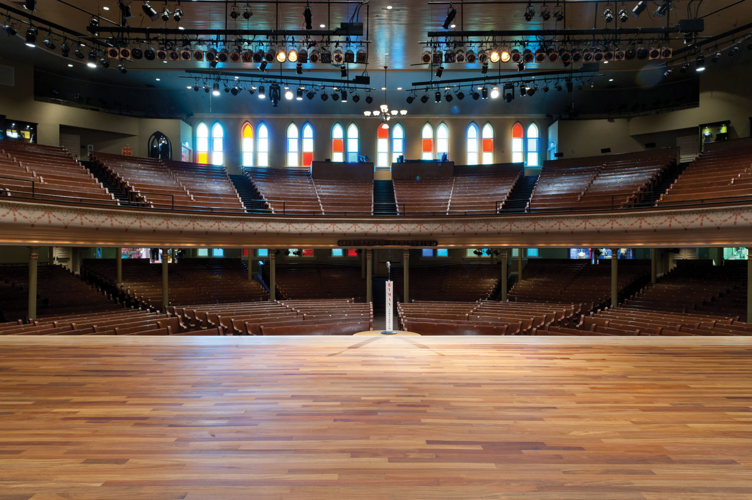


The upper gallery at the Ryman Auditorium is a place with two names — or two signs, at least.
Sometimes the long wooden marker that hangs from the balcony and stares down at any performer who takes the stage reads “Confederate Gallery,” accompanied by the year 1897. That’s the year the United Confederate Veterans held their annual reunion in Nashville.
According to Ryman lore, the group helped fund the construction of the upper gallery, thus the placard in their honor that hangs to this day.
At a recent Drew Holcomb and the Neighbors concert, the sign read “Confederate Gallery,” as it did during the Stanley Cup’s recent trip to the famed concert hall. But at other times, the long wooden sign reads “Ryman Auditorium,” accompanied by the year 1892 — the year the building opened to the public as the Union Gospel Tabernacle.
Mayor Megan Barry spoke on the stage just a couple of days before the Holcomb show, proclaiming May 10 as Ryman Auditorium Day. As she spoke from a podium on the stage, the sign hanging prominently at the front of the balcony read “Ryman Auditorium.”
A spokesperson for the mayor says her office did not request the change.
The puzzlement lies in the Ryman’s evolving policy on when it displays a particular sign. Even on a recent tour of the auditorium, two guides gave contradictory explanations. One, who said he’s been a guide at the Ryman for several years, had no idea the “Confederate Gallery” signage was ever covered up, even after it was pointed out that the sign read “Ryman Auditorium” at that moment. Another guide said each artist is given the option of having the Confederate signage covered with the newer “Ryman Auditorium” sign.
But the theater is working on a policy. David Ewing, Nashville’s unofficial city historian and a historical consultant for the Ryman, says he’s working with the auditorium to find a better way to contextualize the Confederate Gallery sign within the larger history of the 125-year-old theater.
For example, Ewing says, the Confederate veterans donated just $2,700 of the total $12,000 cost to build the upper gallery. And the gallery was built ahead of time explicitly to attract the Confederate veterans to Nashville, rather than as a result of their donation. The Confederate gathering lasted three days. The Grand Ole Opry lasted more than three decades in the building (and the Ryman still hosts Opry performances each winter), yet the Opry name doesn’t grace a prominent part of the structure, Ewing points out.
It’s unclear how long the Ryman has had the new cover-up sign. In 2008, John McCain made a campaign stop at the Ryman. A makeshift banner emblazoned “Ryman Auditorium” was draped over the “Confederate Gallery” sign, perhaps a precursor to the more official and uniform “Ryman Auditorium” signage now often displayed.
Though the Ryman covers the “Confederate” signage during many of its most public-facing events — including the filming of comedian Bill Burr’s recent Netflix special — it continues to prominently display historical information about the name and the meeting of Confederate veterans that precipitated it. A glass display case in the building includes a program and other memorabilia from the Confederate reunion, and the gathering receives prominent billing on the large timeline of the theater’s history. The Confederate reunion shares its 1897 slot on the wall-length timeline with graduation ceremonies for Meharry Medical College, the first Southern medical school to admit African-American students.
A Ryman spokesperson tells the Scene that the Ryman’s policy on displaying the sign is evolving as it treats the historic site as a museum during the day, and as a performance venue at other times. The auditorium plans to relocate the sign to a viewing case where it can be displayed alongside the appropriate historical context.

“I’m working with the Ryman to enhance the visitor experience to tell the complete 125-year history of the building,” says Ewing, who is African-American, “and when someone sees that sign up there, either during a show or on a tour, they may not know why it’s there and what it means. Moving the sign to a different location where it could be properly interpreted probably serves the purpose of being able to document and explain the convention and yet brand the Ryman Auditorium for other purposes.”
The prominent recognition of the three-day veterans reunion is “disproportionate” to the event’s significance in the Ryman’s 125-year history, Ewing adds.
As part of a growing trend, the city of New Orleans last month famously took down statues of Confederate figures Robert E. Lee, Jefferson Davis and others. Last year, Vanderbilt University returned a donation from the Tennessee Division of the United Daughters of the Confederacy so the school could remove the word Confederate from the university’s Confederate Memorial Hall.
“We have asked time and again, how can we have this symbol in the sky — a pediment is intended to draw a gaze upward — as part of our aspirational goals?” Vanderbilt Chancellor Nicholas Zeppos said at the time. The dorm’s name, he continued, “spoke to a past of racial segregation, slavery and the terrible conflict over the unrealized high ideals of our nation and our university, and looms over a present that continues to struggle to end the tragic effects of racial segregation and strife.”
The Ryman is working on a plan for its own “symbol in the sky,” which Ewing wants to be displayed alongside a complete historical explanation — and perhaps away from its current perch in the main auditorium.
William Alexander Percy, a Southern author whose own views on race relations would not be considered enlightened by today’s standards, called the preponderance of statues and historical markers celebrating the Confederacy around the South “sentiment driveling into sentimentality.”
“Perhaps a thousand years from now the spade of some archaeologist will find only these as relics of and clues to the vanished civilization we call ours,” he wrote in 1941. “How tragically and comically erroneous his deductions will be!”



