
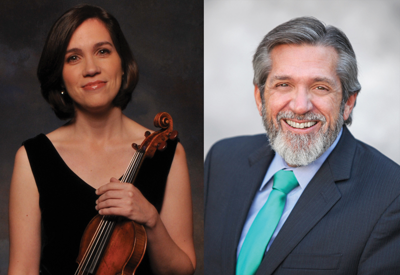

In concert, the violinist Carolyn Huebl and pianist Mark Wait perform with such beauty and precision that one imagines they communicate through telepathy. The duo has performed together for years — hence the polished perfection of their ensemble playing — and has released two critically acclaimed recordings. But they have never played a work written specifically for them.
That changes at Turner Recital Hall on Thursday evening, when the duo presents the world premiere of Michael Hersch's Zwischen Leben und Tod ("Between Life and Death"): Twenty-two Pieces After Images by Peter Weiss. The impetus for this ambitious, evening-length piece — which was commissioned by Vanderbilt University's Blair School of Music and dedicated to Huebl and Wait — was a chance encounter a few years ago with a student in Erie, Pa.
"We had just played a recital, and after the concert a student came up and asked whether anything had been written for us," says Wait. "We said no, but that got us thinking that after so many years of playing together, maybe we should have our own piece. The first composer we thought of was Michael Hersch."
The music of the 43-year-old Hersch was fresh on the minds of Huebl, Wait and other faculty at Blair. In 2012, the Blair String Quartet presented the world premiere of Hersch's Images From a Closed Ward, a sprawling string quartet that found inspiration in artist Michael Mazur's etchings and lithographs of inmates from a Rhode Island psychiatric hospital. Wait considered that work, a sonic expression of almost unreachable isolation, to be a true masterpiece. So he didn't hesitate to ask Hersch for a new piece.
"I was flattered by the offer, but I was also intimated by it," says Hersch, speaking to the Scene by phone from his home near Philadelphia. "It's difficult to write for the combination of violin and piano — everything is so exposed — so I took some time to come up with a conception. I was thrilled that they liked my idea for a big piece."
Big, of course, is a relative concept, even for this composer, who's no miniaturist. Hersch, who now heads the composition department at Johns Hopkins University's Peabody Institute, has a penchant for writing works on a monumental scale. His solo piano piece The Vanishing Pavilions, for instance, consists of 50 movements and takes more than two-and-a-half hours to perform. By comparison, Zwischen Leben und Tod, which clocks in at around 80 minutes, seems like a mere bagatelle.
"Michael is very philosophical, very psychological in his approach to music," says Wait. "So his music needs length and scale to express his ideas."
The inspiration for Hersch's ideas often come from literature and the visual arts. He composed The Vanishing Pavilions, for example, after reading the poetry of British writer Christopher Middleton. Images From a Closed Ward and Zwischen Leben und Tod reflect the composer's reactions to emotionally wrenching visual art.
Weiss' surreal paintings, which often depict anguished figures in devastated landscapes, suggested very specific sounds to Hersch. Throughout the score for Zwischen Leben und Tod, Hersch instructs the violinist to perform with as little vibrato as possible while drawing the bow close to the fingerboard. The overall effect is to create a sound that is pure, luminous and cold, a sound that's as stark and translucent as Gregorian chant.
"This is music that takes you to a lot of intense psychological places," says Huebl.
The audience will be able to accompany Huebl and Wait on this psychological journey, since Weiss' artwork will be projected above the stage during the performance. "These paintings and drawings have certainly informed our interpretations," says Huebl. "So they provide the perfect backdrop to the concert."
A German-born Swiss artist, Weiss was something of a Renaissance man. He was best known for his play Marat/Sade, which won a Tony Award, and for his novel The Investigation. Few people, however, realize that Weiss was also an experimental filmmaker and prolific creator of surrealist artwork. Hersch first learned of Weiss' visual art while reading W.G. Sebald's now classic essay On the Natural History of Destruction. He found Weiss' art to be immensely appealing.
"Weiss' spectrum of color and motion, of proportion and spacing, struck me as particularly musical, and I found this both provocative and inspiring," Hersch writes in his program note for Zwischen Leben und Tod. "Weiss' environments included both familiar and alien worlds that I wanted to capture directly in sound."
To suggest this sound world, Hersch has created music of extraordinary precision and daunting technical difficulty. In fact, the complexity of some of the work's notation — all those 64th notes that flow into 16th notes, triplet 32nd notes and eighth notes — boggles the mind.
In his performance notes to the score, Hersch concedes the difficulty of his fast notes and suggests that gesture and emotion should sometimes take precedence over mathematical precision. Huebl takes some comfort in that advice.
"You can bet I'll be shooting for the big gesture," she says.
Email arts@nashvillescene.com



