
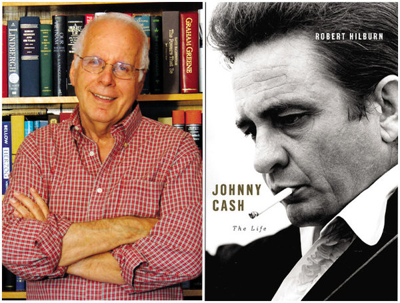


John R. Cash was one of the most inspiring singers and songwriters of the 20th century, in rock, country, or gospel — whether all the things that aspiring musicians have done with his influence are worthy of praise or not. Cash struggled to find hope and redemption in his own well-publicized character flaws, that he might lift himself up with them rather than be dragged down by them. Over a 50-year career that yielded stunning work in rock 'n' roll, country, and even gospel, The Man In Black rode the highs and lows of commercial success, always striving for artistic integrity with his soul-piercing songwriting and complemented by his soulful baritone voice.
It was during one of the low points, in January of 1968, that Robert Hilburn was cutting his teeth as a freelance writer for The L.A. Times, and found himself the only journalist interested enough in Cash to report on his performance at Folsom Prison. The performance electrified the young writer, who interviewed Cash at length many times over the rest of his life, as well as Cash's family and friends. Those decades of investigation, plus three more years of interviews and writing, became the in-depth new biography Johnny Cash: The Life.
Hilburn will be at The Johnny Cash Museum for a Q&A session and book signing at 6 p.m. on Friday, Nov. 1; that one is free and open to the public. He will also be at The Country Music Hall of Fame and Museum's Taylor Swift Education Center at 11 a.m. on Saturday, Nov. 2, which is free with museum admission or membership. For both events, the only books signed will be copies bought on site.
Before he boarded his plane for Nashville, I had an opportunity to chat with Mr. Hilburn. Check out our conversation after the jump.
You began your career with The L.A. Times in the mid-1960s, a time when pop music was a huge industry there. What drew you to covering country music?
Country music was very big in Los Angeles. I think there’s a misconception that it was only popular in the South and Southeast. They had country music radio stations here, they had several clubs, [country performers] were always coming through Los Angeles. It was different in terms of the media. The Los Angeles Times, for instance, wasn’t covering music much at all in terms of rock ‘n’ roll, country or blues. It was more old-time [pop singers like] Frank Sinatra. So country music didn’t get a lot of attention in the media at all, but in terms of the population, there was a program called Town Hall Party, equivalent to the Louisiana Hayride or Grand Ole Opry, that was televised every week. There were two or three TV shows — there was a lot of interest in country music. …
I grew up in Louisiana, and my uncle just loved country music. I’d go to his room and just sit and listen to records; I remember hearing people like Hank Williams and Hank Snow. That’s what started my interest … and then I moved to California and kept listening to it, because there were so many country stations, and you saw it on television — it was very easy to find. Even before Elvis, I started getting into rock 'n’ roll in the '50s, like every other teenager. But I always kept my love of country music. … Because I was from the South, I was listening to country and blues, and rock ‘n’ roll was the natural blend of the two.
You were the only journalist to cover Johnny Cash’s concert at Folsom Prison. What compelled you to keep following his story?
I was just beginning to try and become a writer at The Los Angeles Times on a freelance basis, and that was the first big story I did for them, convincing them to let me cover the guy who wrote “Folsom Prison Blues” [singing it to the inmates of] Folsom Prison. It was an amazing show, just fantastic! I was just getting into this world, and this was my first big deal. Cash was great when I talked to him — he was warm, and he had a lot to say. He was a smart guy, that was one thing that really impressed me. In writing the book, I learned he had an IQ of 150 or 160. You could tell, even at that point, that he had ambition about making quality music — not just a hit on the jukebox, which was all that most people in country music were doing.
That’s fine, but I was much more excited that this guy had ambition like Dylan and John Lennon and people like that, and so I kept up with him the whole time that I was at The L.A. Times, which was 30 years or so. Every few years, I would do a story on John. The most important was when I went down to see him and June at the Carter family cabin in Virginia just a few months before June died. [After her death] we sat a lot and talked his life, about his regrets and his joys . It was just a conversation — I never planned to write a book about that, but it came back and was helpful. …
[It was] the week before he made the “Hurt” video, and he was in such bad shape, but he was trying so hard to talk about his life in an honest way about what he would’ve done over again. But he was basically a contented, happy man. He had gone through all the hells of Earth, but he came out feeling OK, and he was happy. …
I still wasn’t thinking about doing a book on Johnny Cash until after his death, when I saw the movie [Walk The Line], and I read some books that came out about him, and his autobiographies. I felt that though they had some good points in them, none of them captured Johnny Cash. None of them captured the artistry, or the total portrait of his personal life, and that’s what I wanted to do. Mainly, I wanted to talk about his artistry, and when I started doing the book, I could see how his personal life impacted his artistry, for good and for bad.
From the very first page of your book, you point out that Cash wasn’t afraid to embellish a story to make it tell better. When did you first become aware of that part of his personality?
I find that to be true of a lot of artists, because they’re used to being onstage. They’re used to being dramatic and charismatic, and people start asking them about their lives, and it’s not as exciting. So they tend to take things that happen in their lives and make them a little more dramatic so it’s more interesting for people to hear. John would do that a lot; he had this saying, “Never let the facts interfere with a good story.” In writing the book, I was constantly checking things that he had said, to make sure that it was possible that it had happened, or if it were true.
Usually, there was a germ of truth in what he said, but he would often change it. For instance, he said he wrote “Folsom Prison Blues” after seeing a movie called Inside The Walls of Folsom Prison in Germany. He did, but it was three years later — he didn’t write it right after. [In the meantime,] he heard another song called “Crescent City Blues” that gave him the blueprint. He left out the three years and the blueprint, and just said he wrote it.
Eventually, John got sued for copyright infringement because he took so much from “Crescent City Blues.” … He got sued for $75,000 because he took too much — he literally stole some of that song. That was common in folk music, and he had heard that over the years [auth. note: see some extensive notes on the Carter Family and the origins of their songs for an example]. “Crescent City Blues” was not an old folk song, though, it was a new song, written by Gordon Jenkins. Sure, he took lots of songs over the years, just like Bob Dylan and lots of other people take songs and re-cast ‘em. “Delia’s Gone” is a classic example. …
But “Crescent City Blues” was copyrighted. [Cash] changed it significantly; the original is about a woman in New Orleans who’s lost her boyfriend, and he changed it to be about a guy in prison shot a man to watch him die — that’s a big difference. But they start [with the same lyrics], and the format was the same.
I was always a fan of Cash, and thought he was a great artist, but I didn’t understand until I started researching it and listening to all the records again how great an artist he was, and how he struggled to maintain that artistry. Lots of people start off as a good artist and give up because they have success, and start taking it easy. Cash always wanted to make music that was meaningful, and that distinguished him from everyone else in country music in the ‘50s. Webb Pierce, Porter Wagoner, Ray Price — they all wanted hits for the jukebox. Johnny Cash wanted more. He wanted to lift people up. He got that from singing gospel music in the cotton fields. He would go to church and see how it lifted the destitute farmers and made them feel better, comfort them, and give them hope.
That’s what he tried to do all his life in his music, and I never understood that until I started really digging into him and his life. I think he’s going to be one of the 10 or 12 people from the last century that will still be remembered 50 years from now. I think Hank Williams will, Bob Dylan, John Lennon, and Johnny Cash.
Every artist starts losing their fans and losing their sales. That happened to him in the ‘80s, and he was dropped by Columbia Records. Nashville turned their back on him, and they didn’t play him on the radio anymore. Country music fans found new favorites, so this rock ‘n’ roll producer, Rick Rubin, comes to Johnny Cash and gives him a second chance. John is physically ill, very frail, and makes some of the best music in his life in the ‘90s, ending up with “Hurt” and the “Hurt” video. That’s one of the most dramatic chapters in any musician’s life.
There aren’t a lot of country musicians that are as universally revered outside of country music as Johnny Cash. I grew up with the group of Cash fans who know the records he did with Rubin, but what most of what my peers talk about is his earlier work. Is that just an anomaly among people I happen to know?
No, I think he’s got all different audiences, because his music had character and meaning. He was an adult, and made music as an adult, even in the ‘50s, when rock ‘n’ roll started. He wasn’t like Elvis and Jerry Lee — he was an adult singing to adults, not “Sweet Little Sixteen” or “I Want to Be Your Teddy Bear,” even though he was only two or three years older than those guys. He captured both the rock and country audiences in the ‘50s. Then, he fades away from the rock audience because of The Beatles and Dylan and all these people. Then, with Folsom Prison, he reunites with the rock audience, because that’s a very dramatic thing.
So, at various times, when he would do his best work, he would reconnect with the rock audience as well as the country audience. In the ‘90s, he reconnected with a young rock audience who knew his work from earlier years — they had heard “I Walk the Line” and “Ring of Fire” and “Folsom Prison Blues,” but they weren’t following Johnny Cash. When Rick Rubin made those records, that’s who bought them. It wasn’t Nashville that came back and re-embraced Johnny Cash, it was this rock audience. Finally, Nashville caught up with that. But first, Rick Rubin took out an ad in Billboard giving the finger to the Nashville establishment for dropping and getting rid of Johnny Cash in the first place, and not coming back even when he made these great records in the ‘90s. Now, I think Nashville probably loves Johnny Cash again. It took the rest of America for Nashville to love Johnny Cash again, that’s kind of a funny thing. …
I think Jack White and Johnny Cash would have been great friends. A lot of country artists wouldn’t appeal to a rock audience because they’re really not saying anything except entertaining — there’s not a depth and meaning to what they’re doing. Merle Haggard is certainly a great artist the way Johnny Cash was, but most of them are entertainers. They’re not communicators or really trying to spread ideas.
You interviewed Cash many times, as well as his friends and family. Something that comes out in the book is that he had a way of closing off when you broached a subject that he didn’t want to discuss. How did you get him to open back up?
Everybody does that, you know? One thing I learned doing the book was how little we really know about celebrities. Even though we may do all these interviews, it’s what they choose to tell us. There’s all this stuff going on in my life that I wouldn’t want people to know. Cash was not alone in terms of hiding things from people. But the thing he said over and over and over again was “I want people to know about the problems in my life, the times I’ve stumbled and fallen and lost my way, because I want them to see, if they have those problems in their own lives, they can eventually be redeemed.” That was his great message, that you always have hope — no matter how much you’re suffering, you’re out of a job, you’re in jail, whatever it is, there’s always hope.
That was the overarching message of Johnny Cash’s music and his life, because for all the problems he went through, ultimately he was redeemed. During the whole Rick Rubin period, he had his family back together, and his music, his respect, his legacy — he was redeemed. Johnny Cash was a living example of what he preached. It’s hard to believe when you’re having hard times, but when he plays at Folsom Prison, you can hear he’s trying to give those people hope, trying to touch them and entertain them and make them laugh. Here’s a great example: when Cash played San Quentin in 1958, Merle Haggard was in the audience … and it inspired him to turn his life around and become a country singer. Cash was always trying to give people hope.



