
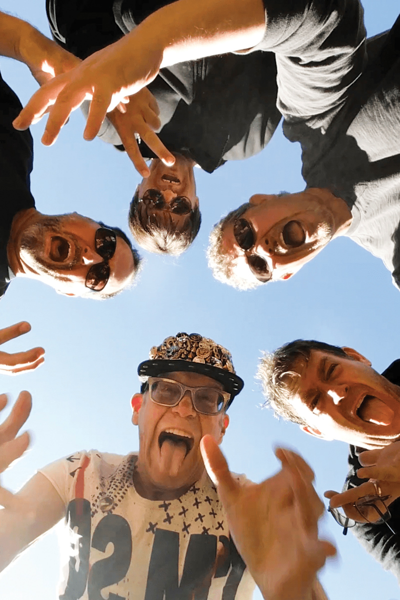

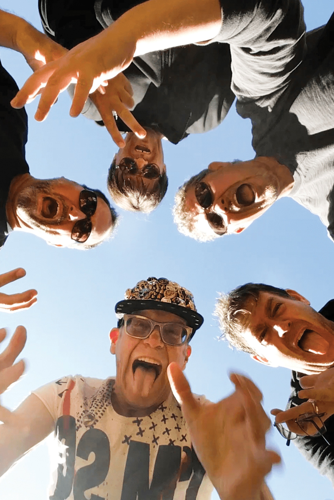
If he hadn't gotten bored at his day gig as a stockbroker and taken voice lessons — and if his voice teacher hadn't insisted he put what he'd learned into practice — an adventuresome character named Hunter Armistead from an upstanding Nashville family might not have taken the stage one night at 12th & Porter playing tennis-racket guitar in December 1984. And if his limited repertoire of cover tunes hadn't drawn a big, boisterous (and thirsty) crowd, he might not have ended up providing the soundtrack to a lot of Southern kids' college years.
But it did, and for many years his band Mel and the Party Hats ruled on the Mid-South club and frathouse circuit, with Armistead belting covers of everything from "Come On Eileen" to Nine Inch Nails clad in his trademark skirts made of neckties (a nod to the brokerage fate he'd escaped). They've weathered losses, family obligations and at least one break-up, but Friday night at Marathon Music Works Armistead and Party Hats Larry Little, Mark Seymour, Tony Crow and Christian Witt will celebrate the band's 30-year anniversary. A lot has changed since Mel worked the Rock Block, and we asked Armistead about those days and the band lore that followed.
In the '80s, different bands seemed to be associated with different clubs — the Scorchers with Cantrell's, White Animals and Webb Wilder at Exit/In. What was home base for you all? In the beginning, we played in smaller clubs like Bogey's and 12th & Porter. But once we got to the Exit/In with its "big" stage, I did all I could to become a fixture there, as that stage was finally big enough to move. I'm a mover. In the '80s we had one weekend a month there and routinely sold out both performances.
How were you all accepted by the other bands, and did you get caught up in that mid-'80s wave of optimism about where the scene was headed? We were a cover band from the get-go, and I was very self-conscious around the original bands at first. I felt like they were the true artists. But to my surprise a lot of friends from the big bands used to come see us and sit in. We enjoyed friends from several local bands, especially Walk the West. I think it's because we were an original band in terms of our presentation, and we were all over the place with our song list. I also worked with R.S. Field, Gerd Muller and Jim Zumwalt, all heavy hitters, on my original stuff.
I didn't develop any optimism about the scene per se because I wasn't wired into that scene, nor had I been seeing enough acts before my time to know any comparisons. In retrospect, there was clearly some great thing happening — though at the time I think there was a bit of a stigma by record labels against acts from here. Timing is everything.
You had the rep as one of the biggest party bands on the frat circuit. Were those audiences as wild as legend has it? Once you get popular, it's so fucking crowded at most of the places we played that things happened by sheer crowd dynamics. We saw fights, people pissing on each other, lots of lovers ...
OK, so what's the story about the hospital bed? After being diagnosed with pneumonia and being very directly told by the ER doctor that playing that night could kill me, my drummer at the time, Jeff Stallworth, a Culver Military grad who was set on schedules, essentially refused to let me cancel. So I sang the whole show from a hospital bed on the stage. I never moved my head except to sing. After the gig, I listened to the board tape — I sounded like a toad when he had pneumonia. We have never gone over better. Lesson learned.
There's a famous show in Murfreesboro club lore where you all got fed up with how dead the crowd was and decided to take revenge. What happened that night? I feel you're at your best when you are authentic and also a bit of an alchemist. Now, we were playing this particular show, and nobody was paying any attention. The idea, then, was to amuse ourselves. So we all laid down on our backs and did our songs mixed with random observations about the lighting, the room, people's clothes, my deodorant — anything but stage patter. Well, it worked.
On the opposite end, does any show in particular stand out as the best? And is there any record of it? We played so many special gigs. Once we opened for the Beach Boys at Starwood, then flew down to Birmingham to play Louie Louie, a club there. I was told we were high as kites (more or less naturally) and that we absolutely killed it. Best to me always has to do with the performance — what we brought — not as much about the size of the crowds. Like the hospital gig, we made lemonade out of lemons several times. Another example of playing in different rooms was at a frathouse when the stage was too small for the band. The unusual gigs are the greatest memories. They feel like ... victory.
Is there anybody you look at today on the local rock scene and think, "Yeah, that was us 30 years ago?" You know, sadly I don't really run into many people who were on the warpath, although Dave Olney and people from the Nerve, the best band I have seen here, are friends of mine. They could have killed but nobody would go on the road.
Have fans stayed in touch with you over the years, and what is it like to keep running into people who've aged along with the band? Are their children Melheads? I do run into old fans all the time. That's really fun, and always a bit of a surprise. We have not obtained Jimmy Buffett status in terms of second-generation fans fed on the Milk of Mel. Maybe I just don't see them, but it's easier to wear a parrot on your head than a tie skirt on your waist!
Do you miss anything about the old club scene? I miss the people, especially Mike Tidwell and Janet from the Exit/In. And the centricity of things.
How do you view the band's 30-year history as a whole? The whole thing has been a miracle, starting with a stockbroker who couldn't sing to being a top draw in my hometown a couple years later. Then 15 years of heavy touring, getting better and better along the way. Deciding to take a long break at the height of our fame, random gigs in that 15 years but never as a full-time touring band — two members got very good day jobs — and now coming full circle to a great show and occasion to celebrate everyone who has helped us and supported us. I count myself extremely lucky to have played with the people I have and to have had our most special fans.
Email music@nashvillescene.com



