I love borscht—or borsch, depending on who's doing the spelling—but my past borscht encounters have generally been the kind with beets and other stuff, like the purplish-brown soup bobbing with cabbage at Elena's Cafe in Brentwood, or the beety broth brimming with beef, potatoes, onions and carrots at Taste of Russia in Cool Springs.
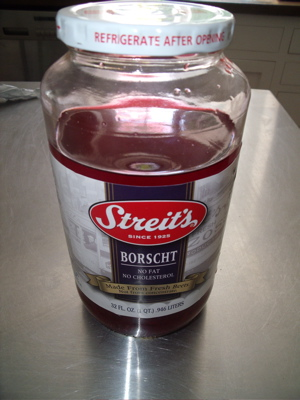
The jar I recently picked up on After Passover endcap was the fuschia borscht nightmare of my childhood—a straightforward brew of beets—and more beets. When my father would take me to the supermarket, he would make a point of stopping in the kosher aisle to show me the jar, which looked like a 32-ounce extremely decisive litmus test, and tell me how good it was served cold. But I was pretty sure the vibrant pink juice was too cheerful to come from a vegetable—or anything in nature, for that matter—and that colorful disconnect made me live in fear that Dad would one day pluck a jar from the shelf and make me try it.
He never did make me eat jarred borscht. Still, I never see a jar of Manischewitz that doesn't make me think of him and his beloved cold pink soup.
Maybe I was just missing my dad the other day, but when I saw that borscht stacked next to the aging matzoh and past-their-prime macaroons, I bought a jar. Against Dad's prescription, I heated mine and breathed in the steam as I held the piping-hot bowl to my lips. With such potential to stain everything, it seemed best to cut out that perilous spoon-trip from bowl to mouth, so I drank the fuschia broth straight from the bowl, fully expecting it to stain my teeth a telltale pink.
For a simple recipe of beets, water, sugar, salt and citric acid, that borscht sure had a lot of complexity and contradiction. In each hot slurp, an inviting sweetness mingled with a slightly forbidden flavor—like the pucker of an apple core. It was brightly colored but earthy in its finish. It was satisfying, but not filling. It was new, but extremely familiar. I could see why my dad liked this borscht so much. It made me happy, but a little sad.