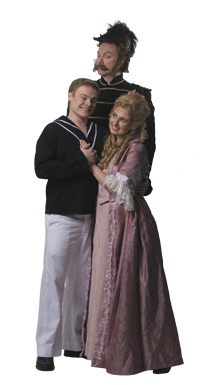
Despite some rough seas at the outset, Nashville Opera’s opening performance of HMS Pinafore had much to recommend it. Gilbert & Sullivan’s fourth collaboration is a wryly wrought, if silly, confection about love and social status, and for the most part, this production hit all the right notes.
One exception was the clunker of a brass tone honked out at the conclusion of the overture, something seldom heard from the Nashville Symphony, which provides the musical accompaniment. The opening number, “We Sail the Ocean Blue,” also had its problems, which had nothing to do with music but with the somewhat disheveled staging of the men’s chorus of sailors. Even a comical motley crew with a few potbellies needs to perform with more precision.
Fortunately, the voyage thereafter is pretty crisp, due to some first-rate principals who bring strong voices to Sullivan’s varied melodies—in solos, duets, trios, octets, arias, madrigals, ballads and recitative passages—while maintaining a clear sense of the unbridled whimsy of Gilbert’s brilliantly rhymed lyrics. Even the less noticeable numbers are written with canny wit, and his story’s satirical dissection of British classism and governmental bureaucracy is spot-on, yet characterized by an exuberance that transcends the sly critique.
There are many notable performances, first and foremost bass-baritone Paul Houghtaling as Sir Joseph Porter, First Lord of the Admiralty, who makes a hilarious entrance, twirling his umbrella like a drum major. He later launches into “When I Was a Lad,” which recounts how his attention to mundane landlubber office duties eventually earned him his lofty title without ever having set foot on a ship in his life. Houghtaling is a short, wiry stage presence—he moves like a cat, and he’s a consummate showman. He’s also a standout in the marvelously incessant trio, “Never Mind the Why and Wherefore.”
Chad A. Johnson is the young hero, seaman Ralph Rackstraw, and he brings an earnest enthusiasm and a sturdy yet impassioned tenor to the role. He’s paired up romantically with captain’s daughter Josephine, played by soprano Kate Oberjat, who, along with Houghtaling and Johnson, is making her Nashville Opera debut. Though pitchy for a moment, Oberjat is a fetching ingenue, and her acting is superb. She executes a winning duet with Johnson (“Refrain, Audacious Tar”), then movingly hits the high B-flat on her solo ballad, “Sorry Her Lot.”
Mark Walters brings a splendid baritone to the role of Capt. Corcoran, commander of the Pinafore. After the lengthy and deliciously rousing Act 1 finale (“Can I Survive This Overbearing?”), Walters opens Act 2 with the plaintive, mood-changing solo “Fair Moon, to Thee I Sing.” This is followed by the eminently literate duet “Things Are Seldom What They Seem,” featuring Walters with mezzo-soprano Melissa Parks as the “plump and pleasing” Little Buttercup. (Parks enters the show early on with one of the most memorable tunes in musical theater history, “I’m Called Little Buttercup,” which she renders with the appropriate bittersweet humor.)
Terry Hodges plays Deadeye Dick, the play’s Cassandra figure, predicting no good end for the young lovers. Even though he’s just a mongrelly sailor, he’s got the swagger of a crusty pirate. (It’s very funny when he plucks at his ukulele with a hooked hand.) Baritone Jonathan R. Green makes a good impression in the supporting role of Bill Bobstay, and he waves the Union Jack from the Pinafore’s deck with patriotic pride. The 24-strong Nashville Opera Ensemble carries the choral load with strength throughout.
With minor exceptions, William Florescu’s direction maintains Pinafore’s requisite brisk maritime energy, all the way to Gilbert’s contrived, neat-as-a-pin ending.