
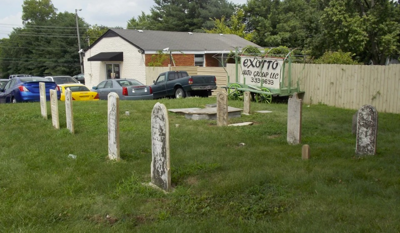

The legal proceedings surrounding the Rains family cemetery have reached a dramatic climax. As you may recall, in April I wrote about the destruction of the Rains family cemetery on Nolensville Road. It seemed like a tragedy, but a legal tragedy that could be guarded against in the future by mandating that people check in with the Metro Historical Commission and get help finding descendants of people buried in the cemetery before taking any action on said cemetery.
But no! It turns out that things were much, much juicier. In May, the Rains family argued in court that David Ashkarari and Akbari Fariborz (who own the used-car lot next to the cemetery) and their lawyer, Jason Holleman, aided by Metro Councilwoman Davette Blalock, were not honest with the court about many facts about the cemetery.
The petition states that Ashkarari, Fariborz and Holleman gave the wrong address to the cemetery in legal documents, which means, if you were a Rains family member and you heard about some issue with a cemetery on Ash Grove Drive, you wouldn’t realize it was your family cemetery, because that’s on Nolensville Road.
The petition recounted many occasions when Fariborz and Ashkarari spoke with people who were at the cemetery taking care of it, even though they told the court they had never seen anyone doing so.
Also in this petition filed in May 2017 is an affidavit from archaeologist Dan S. Allen, who did a massive restoration of the cemetery in May 2016 at the behest of the Rains family and the Davidson County Historical Commission.
The descendants had an affidavit from Eric Barnes, CEO and publisher of the Nashville Ledger, stating that though Holleman said that he had run notice in the paper for all of August 2016 about the removal of the cemetery, no such notice ever ran in the Ledger — not those weeks, not any other weeks.
The descendants also alleged in May that Ashkarari and Fariborz misrepresented to the court how long they had “adversely possessed” the cemetery, telling the court they’d had it for the legally mandated 20 years when they had not.
In the only part of the May document to make me snicker, we also found out that Holleman never asked Fletch Coke if she knew of any Rains descendants. Holleman served as president of the Nashville City Cemetery Association while Coke was on the board. If you’re not a Nashville history buff, you may not know who Coke is, but believe me, she is the Wonder Woman of Nashville history. If there is history being preserved, you can bet that Coke is somehow involved. Not asking her is akin to admitting that you don’t want to know.
But that brings us to the most disturbing allegation in these documents: You remember I thought that the Rains family member they’d found might have been dead? Well, it turns out that one should never underestimate the ability of these old Nashville families to use and reuse names. But them using a dead man as their one Rains would be less disturbing than what James Rains alleges was done to him.
He alleged that Councilwoman Blalock showed up at his house and promised him that if he refrained from opposing the moving of the family cemetery, she would make sure his ancestors’ graves would be moved to a special spot at the fairgrounds — fitting, since the Rains family gave the city that land. She allegedly promised Rains media coverage of the move and a nice monument explaining who the family was. He then allegedly spoke to Holleman on the phone and got assurances from Holleman that this would all happen.
Rains even sent a letter to Holleman on March 16, 2016, stating that, after talking to his immediate family — which is important, because this is Rains telling Holleman that there are other family members that Holleman then knew needed to be contacted — he didn’t object to the relocation if the remains would be moved to the fairgrounds, a monument erected, a ceremony performed and the media present to cover the event. He also insisted that the remains be relocated according to state law and that the people who wanted them moved pay for everything. He also stated clearly that he didn’t own the cemetery land and doesn’t know who does.
The remains, of course, didn’t end up at the fairgrounds.
If the lawsuit is correct, these people tracked this guy down, pressured him to speak for the whole family and promised him a glorious new spot at the fairgrounds — so they could use him for cover in order to avoid contacting the rest of the family. And then, after making him the sole decider for the whole family, they allegedly didn’t even honor the promises that they made him!
So fast-forward to last week. In a court order filed July 11, we learn what the court made of all this, and it’s a doozy of a batch of findings. First, the court decided that the default judgment granted in January must be set aside because, “Petitioners freely and candidly admit, in paragraphs 33, 34, 35, 43, and 47 of their response to the Respondents’ Motion for Relief, that notice was never published as required.” In other words, though the folks who moved the Rains’ family’s bodies told the court they had published a notice of what they were up to, they hadn’t, which they then admitted to in other court documents.
Also, the court found that the petitioner’s lawyer, Jason Holleman, was aware of Rains family members aside from the one he talked to, but he didn’t seem to have tried to contact them. Holleman contacted Pith and said:
“I first began by asking the client if they knew of any family/interested parties that came to the cemetery, and they did not. In fact, they told me that in the almost 20 years that they had run the business on the adjacent lot, they had not seen any family members on the property, only homeless people that they shooed away to prevent damage to the markers.
“After that conversation, I determined that we knew that it was the ‘Rains’ family cemetery from the hand-written deed that we had for the property, and I sent a letter to all persons owning property in Davidson County with the last name of ‘Rains’ informing them of the intent to relocate the graves and asking them to contact me with any objections or questions. From those letters, I heard from one family member: Mr. Larry Rains. [Larry and the aforementioned James Rains are the same person.] Though we had actually made contact with the Rains family and, therefore, had a representative contact for service of process, we determined that it was still appropriate to move forward with further service of process through publication in a newspaper of general circulation.”
A number of Rains family members who remember meeting and talking to David Ashkarari and Akbari Fariborz over the years attested to it in affidavits in May. Dan Allen spent weeks working in the cemetery in 2016, and he also attested to the court in May that he spoke to Ashkarari and Fariborz about his restoration work during this time. Plus, the Metro Historical Commission was actively involved in the preservation of the cemetery.
The court in July agreed that it was obvious that someone other than the men who moved the Rains family had been taking care of the cemetery. In response to the Rains’ family’s claims, “This Court is deeply troubled by the allegations in the Respondents’ motion” (the one they filed in May).
But those claims are moot, because the court set aside the Order of Default Judgment. Chancellor Bill Young was not happy with the events of the case, one he inherited from Chancellor Ellen Hobbs Lyle when he came on the bench last year. A judge doesn’t write “misrepresents,” “misrepresented” or “misrepresentation” in a court order without someone being in trouble. In this case, that someone is Jason Holleman. The judge wrote, “Finally, in light of the aforementioned record, the Court has no option but to refer this matter for review by the Board of Professional Responsibility.”
Holleman’s explanation for how this happened is this: “I shared a copy of proposed notice language with Councillady Blalock, who indicated to me that she had arranged to have the notice published in the Nashville Ledger. She later confirmed to me in writing that the notice had been published. I learned after the order became final and the grave relocations had occurred that the notice had not, in fact, been published in a newspaper of general circulation.”
Holleman says Blalock even brought to his office copies of the papers where notice was supposed to run. Did Blalock deceive Holleman? It looks that way, but, in the end, he represented to the Court that notification had happened. If he didn’t know with certainty that it had happened, he shouldn’t have said it did.
The former councilman was adamant to Pith that he hadn’t acted unethically.
“I’ve never had a complaint in 20 years of practice, much less a sanction,” Holleman says, “and when I found out about the notice not getting filed, the first phone call I made was to the Board of Professional Responsibility to pre-emptively say: ‘What should I do ethically?’ I now know that I’ve represented to the court, based on Davette’s representation and her bringing the newspapers, that this notice got filed. It turns out it didn’t get filed, and they asked me ‘Is the matter still pending?’ And I said ‘no,’ and they said ‘have the appeal rights run?’ and I said ‘yes,’ and they said: ‘Your ethical obligation on behalf of the client is not to basically readdress it to the court.’ Now if it comes up in later proceedings, you obviously have to tell the truth to the court, but your ethical obligation to represent your client is essentially not to be the catalyst to bring it back up. It would be different if it were a pending matter, but essentially I think the paraphrase is ‘what’s done is done.’ ”
Holleman says he helped his clients find other counsel when it looked like this was going sideways.
Ashkarari and Fariborz are going to need lawyers, because the process is about to start over for them. The guys who moved the graves and paved over the cemetery have to take all their property off the cemetery. And then we wait to see what happens in the next round of legal proceedings.
But this is an important victory for Nashville history.
I can’t help but think of the vital role that John Rains — the father of the folks in this cemetery — played in our early courts, both as a trusted fair juror and as a defendant on charges of cussing. I imagine, if he’s somewhere to hear about how the courts have ruled in favor of his family, he probably did let out an enthusiastic ,“Hell yes!”



Post a comment as anonymous
Report
Watch this discussion.
(0) comments
Welcome to the discussion.
Log In
Welcome to the discussion.
Keep it clean. Please avoid obscene, vulgar, lewd, racist or otherwise abusive language. Comments featuring hate speech or threatening or violent content will not be tolerated.
PLEASE TURN OFF YOUR CAPS LOCK.
Be truthful. Don't knowingly lie or mislead.
Be proactive. Use the “report” link on any comment that violates our comment policy.
Share with us. We'd love to hear your feedback.