
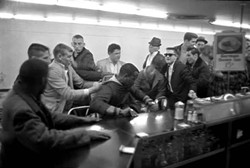
Whites attacking civil rights activists on February 27, 1960
Since Tuesday morning, the online version of David Plazas' Tennessean editorial about the library turning away Black Lives Matter has been substantially toned down. Gone is the headline, "Nashville Library Right to Stop Anti-White Meetings," but it lives on in their Twitter feed and in the url for the current editorial, "Nashville Library Right to Stop Black Lives Matter Meetings."
Let me be clear before I go on that I think the Nashville Public Library did the right thing. Events at the library should be open to everyone and, if you need to hold an event that can't be open to everyone, you shouldn't have it at the library. I also think that Black Lives Matter has the right to exclude white people from its meetings. The same way that I wouldn't expect a group of women who'd been raped who are organizing to try to figure out how to end sexual violence against women while sharing their own experiences of sexual violence to be open to men, I don't think that a group that bears the brunt of white supremacy and who's trying to organize to figure out how to end it owes it to white people to perform their grief and pain in front of us. It's not the Library vs. Black Lives Matter. It's not Black Lives Matter being evil and "anti-white." It's about two groups with incompatible agendas and it's a shame and it sucks. But it is what it is.
I won't further address the embarrassing clusterfuck that was the original version of the article. I'll simply stick with the version we have now and the troubling misunderstandings it shows about Nashville's history.
Yet this particular group’s people-of-color-only policy runs counter to the values of the civil rights movement, which sought inclusion and equality — not further segregation.That legacy is enshrined in the main branch of the public library.
In the second-floor Civil Rights Room stands a replica of a 1960s-era lunch counter, honoring the valiant efforts of black and white civil rights protesters to integrate restaurants during the Jim Crow era.
A quote by Dr. Martin Luther King Jr. appears on the wall behind the counter. It reads:
“I came to Nashville not to bring inspiration, but to gain inspiration from the great movement that has taken place in this community.”
The first paragraph of this quote is not true. It was an ongoing, complicated, painful discussion throughout the civil rights era if inclusion and equality were the way to go or if a kind of separate but truly equal society might be for the best. (It was not a new discussion in the 1960s, either. It's a question black people in the United States have been wrestling with since our founding.) Even King, who was committed to integration, wrestled with whether whites would ever treat black children fairly in integrated schools. The Student Non-Violent Coordinating Committee (SNCC) started out as an integrated group, but over the course of the 60s, due in part to the behavior of whites in the group and a growing disillusionment with what being nice to whites was getting them, black members moved to push whites out of the group, especially out of leadership positions.
Stokley Carmichael came to Nashville, remember. He found an audience here willing to entertain his ideas.
The point being that BLM's position now doesn't run counter to the values of the civil rights movement. They're participating in, like I said, a two-century-long conversation about what the civil rights movement's ultimate goals and the strategies for getting there should be. And it's not David Plazas' place to tell black people they're doing civil rights wrong.
Then there's this "black and white civil rights protesters" nonsense. I mean, yes, there were a few white people who came to Nashville to support black civil rights activities. There were an even smaller group of white people form Nashville who did, also.
The overwhelming majority of white Nashvillians who "participated" in the civil rights movement did so as the folks trying to stop it. The people beating on, poisoning, spitting on, arresting, bombing, kicking, shooting at, mocking, cursing, blocking, pulling, twisting, pinching, punching the black protesters were white people "participating" in this pivotal moment in our city's history.

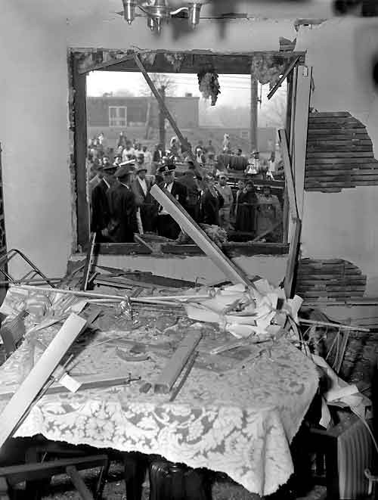
Civil rights lawyer Alexander Looby's house after it was bombed on April 19, 1960
Have white people ever really addressed that legacy? I say, no, not really. After all, someone knows who those people in that top picture are. Someone knows who bombed Alexander Looby's house. And protecting white Nashville is still more important to those people than the truth. As long as we choose protecting the feelings of white people over the truth, we can't reckon with our legacy as a city.
You can even see this in the library's use of King's quote (and in Plazas'). That quote is put up there without context like some compliment to the city. Like we all behaved so well and did the right thing. Like we'd accidentally segregated in the first place and it just took Diane Nash going out for a Sunday stroll and then sweetly asking the mayor if he wouldn't mind, pretty please, desegregating the city to get us justice.
King was complimenting the black students, the young people, who looked at Nashville, looked hard at themselves, and then figured out what they could do to change the city. His words were intended to buoy up civil rights activists, not pat the city on the back.
Taking the words King intended to be a comfort to young black activists and using them against young black activists is evil. There's no other word for it.
Nashville papers complaining about young black activists is nothing new. Considering how history regards the editorial stances of the papers that have taken that position previously, you'd think The Tennessean would be more considerate about whether that was a tradition it wanted to participate in.



Post a comment as anonymous
Report
Watch this discussion.
(0) comments
Welcome to the discussion.
Log In
Welcome to the discussion.
Keep it clean. Please avoid obscene, vulgar, lewd, racist or otherwise abusive language. Comments featuring hate speech or threatening or violent content will not be tolerated.
PLEASE TURN OFF YOUR CAPS LOCK.
Be truthful. Don't knowingly lie or mislead.
Be proactive. Use the “report” link on any comment that violates our comment policy.
Share with us. We'd love to hear your feedback.