




Stephanie Silverman
On the November night that ended with the stunning and, in many quarters, unsettling election of Donald Trump to be the next president of the United States, these are among the movies playing at the Belcourt Theatre in Hillsboro Village: Moonlight, the story of a young black man coming of age — and coming to terms with his sexuality — in an area of Miami ravaged by crack cocaine and the War on Drugs; and Certain Women, a portrait of three white women living distinct but intersecting lives in the American Northwest.
This is the theater that also ran a series of black-and-white political-themed movies through August and September, regularly hosts the best foreign-language offerings from around the world and screens It’s a Wonderful Life every holiday season. It’s the place that hosts a documentary series covering a wide range of subject matter every October, and whose upcoming Midnight Movies lineup includes Good Burger and The Big Lebowski.
There are as many versions of the American Experience as there are people in America, but a great many of them have been projected onto the Belcourt’s screens and discussed in its lobby. In New Nashville, a place that has recently been thrust into the national spotlight as a cultural destination but also seems constantly at risk of losing beloved cultural landmarks — see the legendary Station Inn ominously surrounded by towering condominiums in the Gulch, or another Hillsboro Village gem, BookManBookWoman, closing at the end of this year — the Belcourt is a place where that increasingly rare thing, the shared experience, is preserved. Go there and you can sit next to someone whose life is nothing like yours, and together you can encounter a story that is foreign to you both. It’s the only theater left in town where you can see those stories either via digital projection or by way of light projected through film onto a screen.
Those screens, and the aforementioned lobby — named after the Scene’s late editor, Jim Ridley, who loved few places more — are now housed in a Belcourt that’s been made new again. After a massive renovation that stabilized the beloved institution, both figuratively and quite literally, it stands as a cultural beacon, shining a light into the future while maintaining a view of history.
For the past decade, this wonderful place — and its community-minded mission — has been overseen by executive director Stephanie Silverman, who by all accounts has brought a vision and an energy to the Belcourt that is inseparable from its success. For that reason, she is the Scene’s 2016 Nashvillian of the Year.
During a recent interview in the Belcourt’s Jackson Education and Engagement Space, a classroom on the second floor of the theater in an area that didn’t exist six months ago, Silverman — unaware of the Scene’s plan to honor her — was nevertheless deflecting credit for the Belcourt’s success.
“The journey that this theater has made in the 10 years I’ve been with it, in the seven or eight years prior to that, has been pretty heroic, frankly,” she says. “And heroism by a ton of different people, because there were lots of points along the way where we could’ve turned the corner the other way. So to be here now in a building that’s stabilized, with a program that’s thriving, being able to imagine how to use film in different ways — which is what this classroom is all about — is pretty great. And the credit goes to this community and to the staff of people and to the board of supporters.”
The people involved with the theater, Silverman says, “have always been willing to imagine what’s next,” avoiding the survival anxiety that can so easily plague a nonprofit organization. That’s the spirit, she says, that has allowed the Belcourt not just to survive but to thrive.
Silverman grew up in Omaha, Neb. Her mother was a viola player in the Omaha Symphony and went on to become an attorney, although she continued to play in the symphony — viola players are few and far between. Her father was a family therapist. After pursuing a theater degree at the North Carolina School for the Arts, she returned to Omaha when her mother was diagnosed with breast cancer. There she began working with a woman who ran a dance project in New York City. They set up a dance residency in Omaha, bringing top-notch contemporary dancers to the Midwest for weeks at a time.
“What I learned there was how you talk to audiences about work that may be challenging,” Silverman says.
“When I moved here and this job opened up, that was the thing that I felt I could bring to the table, how to sort of frame up work that might be challenging, frame up an institution that may have some perceived aloofness or inaccessibility on some level, and how we begin to feel more like a place with open doors and open arms.”
Silverman recalls interviewing for the job in 2007, nine months’ pregnant, and appreciating the supportive accommodation she received from the Belcourt’s board of directors after her child was born.

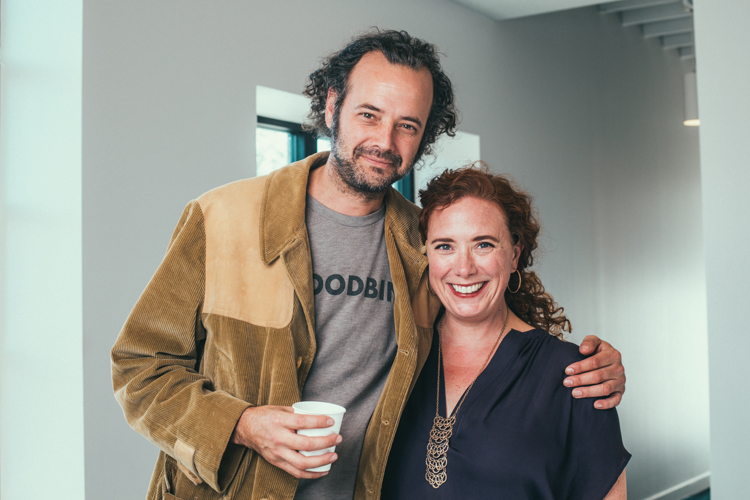
Toby Leonard and Stephanie Silverman
Belcourt programming director Toby Leonard is one of the few people on staff who have been at the theater longer than Silverman.
“I can’t help thinking of the first time I met her,” Leonard tells the Scene. “It was probably the final in a series of job interviews, and one that included senior staff at the time. Stephanie rolled in — about nine months’ pregnant, I should note — and knocked it out of the park. She started working pretty soon thereafter, and she’s exuded the same confidence and resolve ever since.
“It takes a lot of intuition and foresight to steer this ship, and I’m fortunate to work as closely with Stephanie as I do.”
Megan Barry, now Nashville’s mayor, was on the board when Silverman was hired.
“Stephanie was somebody that everybody got excited about because she just had this vision and this passion and this energy for local film houses, and she brought that with her,” Barry says. “And one of the things I think we’ve seen is she’s been able to capitalize on that and build on that, and now we have this beautiful new Belcourt that absolutely wouldn’t exist without her and her leadership.”
Years earlier, the theater had been on the brink of shutting down, saved by the generosity of deep-pocketed Nashvillians who believed in what it could be.
“At that point we’d just saved a building and an idea,” Barry says. “What Stephanie was able to do was come in and take that idea and create an incredible asset for our community.”
The fact that the Belcourt has become such an asset to the community around it is the entire point, baked right into its mission as an institution.
“The point of showing these movies is not just to cycle people through the building,” Silverman says. “The point of showing these films that we love so much — a film like Moonlight is the perfect example — is to pull people into an experience, a narrative, a storyline that they may have experienced themselves, that they may have never been able to get their head around before, that everyone’s coming at from a different angle. But then the next extension of it is having a conversation around it as a community.”
The renovated Belcourt is finally in a position to see that mission fully realized. Although the old theater was beloved by its patrons, in part, because of its hole-in-the-wall charm, Silverman acknowledges that it “felt very imposing, it didn’t feel very friendly — hard to see in and figure out what’s going on.” The new building is able to truly be a gathering place for community film lovers.
The new classroom space has allowed the Belcourt’s Allison Inman to expand her on-site education and engagement programming. Take a stroll by the theater any given evening and you might see the lights on in the corner room, with a group of students, or adults, discussing one film or another. A third screening room — the smaller and more intimate Manzler/Webb room — contributes to the same, but also allows Leonard to fit more films into the theater’s packed schedule.
But a high priority for Silverman was making sure the theater would finally be able to accommodate all of its patrons. If the theater’s age brought with it some upsides in the way of charm, the claustrophobic bathrooms and general lack of handicap accessibility was a downside.
In the middle of our interview, John Greenwood, who led the renovation project for R.C. Mathews Contractor, interrupts to ask Silverman to come downstairs and make an executive decision. A handicap button needs to be placed on the wall somewhere in front of a new set of sliding doors where the old theater entrance used to be. After examining two different buttons and two different placements, Silverman makes the call.
“We were not a friendly place to people who have any kind of mobility challenge,” she says once we’re back upstairs. “We didn’t even have bathrooms wide enough to put rails in, just for people who need a little more support. And we have a lot of people who come to the theater, who have come to the theater since they were children. But they’re not young people anymore, and they could use just a little bit of help. To not even have the ability to do that humanely was really kind of unforgivable. And again, people were patient with us beyond the point that they probably should have been.”
That patience is proof of the goodwill the Belcourt has earned in the community, and in the new theater, the Belcourt has made good on that trust. When the theater reopened in July, Silverman stood outside and invited the crowd to check out the spacious new bathrooms. In this way, the Belcourt is the perfect example of how a local institution can move into the future, and be part of New Nashville, without leaving its history behind. It’s there where you can see a classic movie from the 1950s or a new indie release. It’s there where you can sit and rest on a wooden bench in the lobby, made from wood taken from the old theater’s rafters. And in a growing city where many residents feel the New Nashville is one where they are left behind, the Belcourt is the place where anyone can go, feel comfortable, and see multitudes.
“I think the Belcourt is actually a great example of what we need to be doing, which is recognizing our history but also making room for the new,” Barry says. “With the reimagination and the reconstruction of how the Belcourt looks, I think that’s a great example. We are going to change, we’re going to have change. So how do we make sure we capture the good things in Nashville, like the Belcourt and its history, but then build on it.”
As has long been the case, the community has bought into that idea.
Since the reopening, The Belcourt has ranked among the top-performing theaters in the country, prompting a shout-out at this year’s Toronto Film Festival to “the mighty Belcourt.” On the weekend it began screening Captain Fantastic, the film’s fourth week in release, the Belcourt had the second-highest gross sales out of all 550 theaters playing the film in the country. When Ron Howard’s documentary The Beatles: Eight Days a Week opened in 85 theaters in September, the Belcourt had the fourth-highest gross. One of the theaters that beat it had director Howard in attendance.
But that’s nothing new for the Belcourt. Films like Moonrise Kingdom, Boyhood and Tree of Life have also earned some of their best sales there in the past. And in a cultural moment when we are increasingly able to access any entertainment we want, and watch it alone, the fact that crowds keep coming to the Belcourt is a sure sign that it’s contributing to the health of the city.
Silverman uses a metaphor: “We’ve all had kitchens for a long time, and that doesn’t mean we don’t want to go out for dinner.” She adds, “It’s just having someone choose something for you, prepare it for you, deliver it to you and sort of coddle you in that experience.”
With Silverman leading its team, the Belcourt is no doubt in good hands. And as long as it’s around, both Nashvilles — new and old — are too.




